

Key Takeaways
- Coastal Portugal offers polished infrastructure, beaches, and seafood culture, but draws significantly larger tourist crowds.
- Inland Portugal — including the Alentejo, Douro Valley, and Beira Alta — moves at a slower pace with fewer foreign visitors.
- Costs are generally lower inland, particularly for accommodation and dining outside of Porto and Lisbon.
- Summer heat inland can be intense; coastal breezes make the shore more forgiving in July and August.
- The two regions complement each other well — many travelers combine both in a single itinerary.
Option A
Coastal Portugal
The sun-drenched, Atlantic-facing classic.
Best for: Travelers who want beaches, seafood, maritime culture, and easy tourist infrastructure.
Option B
Inland Portugal
The slower, deeper, wine-and-stone alternative.
Best for: Travelers seeking hilltop villages, river valleys, local festivals, and off-the-beaten-path authenticity.
If you're visiting Portugal for the first time
Coastal Portugal
Lisbon, the Algarve, and Sintra offer strong infrastructure, English is widely spoken, and the logistical learning curve is gentle.
If you want to avoid tourist crowds and discover quieter culture
Inland Portugal
Regions like the Alentejo and Douro Valley attract far fewer international visitors, offering a more grounded and local experience.
If beach time is central to your trip
Coastal Portugal
The Algarve and the Silver Coast offer some of Europe's most scenic Atlantic beaches, suited to both swimming and dramatic cliff scenery.
If food and wine are your primary motivation
Inland Portugal
The Douro Valley and Alentejo are Portugal's great wine and gastronomy heartlands, where local restaurants and quintas (estates) offer exceptional depth.
If you're combining Portugal with a broader European itinerary
Coastal Portugal
Coastal cities like Lisbon and Porto have major international airports and well-connected rail and bus links to the rest of Europe.
The Landscape Divide: Cliffs, Sand, and Stone Villages
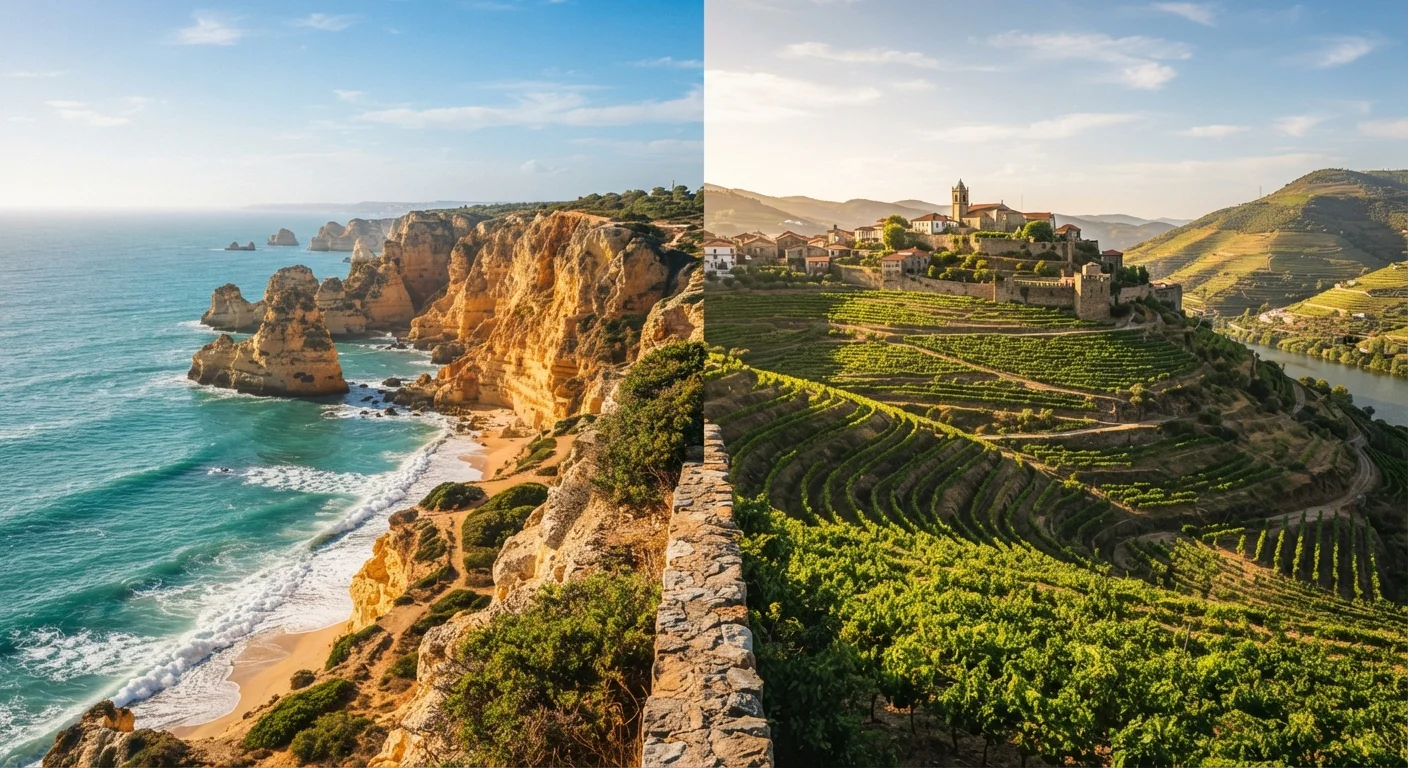
Portugal is a compact country — roughly the size of Indiana — but its geography creates two strikingly different travel worlds. The coast runs along the Atlantic for nearly 1,800 kilometers, shaped by dramatic cliffs, wide sandy beaches, and historic port towns. Inland, the terrain rises into rolling plains, river gorges, forested hills, and terraced hillsides that have grown wine for centuries.
The Algarve's sea-sculpted limestone formations in the south are Portugal's most recognizable coastal image. Moving north, the Silver Coast (Costa de Prata) and the Minho region offer wilder, less-developed shoreline. Inland, regions like the Alentejo unfold as vast golden plains dotted with cork oaks and whitewashed villages, while the Douro Valley cuts a dramatic gorge lined with vineyard terraces. The Beira Alta and Trás-os-Montes in the northeast feel almost entirely forgotten by international tourism — which, for the right traveler, is exactly the appeal. Much like choosing between island types in the Caribbean, the contrast between Portugal's coastal and interior zones is a question of infrastructure versus authenticity.
Pace, Culture, and the Visitor Experience
Coastal Portugal — particularly the Algarve and Lisbon's surroundings — has adapted significantly to international tourism. English signage is common, menus are frequently translated, and tourist offices are well-staffed. That ease of navigation is genuinely valuable for first-time visitors, but it comes with a trade-off: the most popular coastal areas can feel heavily commercialized in peak season, with crowded beaches and restaurants oriented more toward visitors than locals.
Inland Portugal operates on a different social rhythm. Lunch is still an event. Village squares fill with locals on Sunday mornings. Festivals — grape harvests, saints' days, medieval fairs — are organized for residents, not tourists. Language can be a modest barrier, as English fluency is less universal outside cities, but this also signals that you've stepped into something more genuinely Portuguese. Travelers who find deep satisfaction in that kind of immersion consistently describe inland Portugal as underrated. The dynamic mirrors what separates urban France from its quieter rural regions.
| Criterion | Coastal Portugal | Inland Portugal |
|---|---|---|
| Landscape | Atlantic cliffs, beaches, port towns | Plains, river valleys, terraced vineyards |
| Crowd levels (peak season) | High, especially Algarve and Lisbon area | Low to moderate; few international tourists |
| Accommodation cost | Moderate to high in resort areas | Generally lower; good value quintas and guesthouses |
| Summer climate | Warm with Atlantic breeze; manageable | Hot and dry; extreme in July–August |
| English fluency | Widely spoken in tourist areas | Less common outside cities |
| Getting around | Rail, bus, and flights widely available | Rental car strongly recommended |
| Food and wine scene | Excellent seafood; more tourist-oriented menus | Alentejo cuisine and Douro wines; deeply local |
| Best for | First-time visitors, beach lovers | Return visitors, culture seekers, wine enthusiasts |
Practical Considerations: Cost, Climate, and Getting Around
Portugal as a whole remains more affordable than much of Western Europe, but cost differences between coastal and inland areas are real. Resort towns in the Algarve can rival Spanish coastal prices in July and August. Inland, guesthouses (often in historic manor houses called solares or quintas) typically offer better value, and restaurant meals in towns like Évora or Lamego cost noticeably less than comparable meals in Cascais or Lagos.
Climate is a meaningful factor. The Atlantic moderates coastal temperatures — even in midsummer, sea breezes keep things manageable. Inland regions experience a more continental pattern: winters are colder and summers hotter. The Alentejo plain can reach sustained temperatures above 40°C (104°F) in July and August, which significantly shapes how and when you'd want to explore it. Spring (April–May) and early autumn (September–October) are widely considered the most comfortable periods inland.
~30M
Annual tourist arrivals in Portugal
Portugal's national tourism authority (Turismo de Portugal) has reported visitor numbers approaching or exceeding 30 million in recent years, with coastal regions absorbing the majority.
40°C+
Peak summer temperatures in the Alentejo
The Portuguese Meteorological Institute (IPMA) records regular summer highs above 40°C in the Alentejo interior, making spring and autumn the preferred travel seasons for inland Portugal.
1,794 km
Length of Portugal's Atlantic coastline
Portugal's extensive coastline — one of the longest in Western Europe — encompasses everything from sheltered estuaries to exposed Atlantic surf beaches.
Transportation access also differs substantially. Coastal Portugal — Lisbon, Porto, Faro — is well served by rail, bus, and international flights. Inland travel often requires a rental car. Public bus routes exist but can be infrequent in rural areas, and many of the most rewarding inland villages aren't easily reached without your own transport. That practical detail shapes the trip significantly.
How to Choose — or Combine Both
Most travelers visiting Portugal for a week or more don't need to choose strictly one or the other. A common and effective itinerary pairs Lisbon or Porto (coastal-adjacent cities with great access) with an inland excursion of two to four nights — into the Douro Valley from Porto, or into the Alentejo from Lisbon. This structure gives you the ease of a well-connected base alongside the depth of slower rural exploration.
If your trip is shorter — say, four to five days — committing to one region makes more sense than rushing between contrasts. Beach-focused travelers and those on their first Portugal visit should lean coastal. Those returning to Portugal, or those who've already ticked off Lisbon and Porto, often find the inland regions the most rewarding discovery remaining. Italy presents a similar internal geography challenge, and the framework for reading regional differences across Italy translates well here.
Entry Requirements and Travel Conditions Vary
Travel requirements, visa rules, and local conditions in Portugal can change. Always verify current entry requirements, road conditions, and regional travel advisories with official government sources — such as the U.S. Department of State or the Portuguese government's tourism authority — before finalizing your trip. This article provides general destination context only.
Travelers considering Portugal as part of a broader Mediterranean cruise itinerary will typically encounter only Lisbon or Porto as port calls — meaning inland Portugal requires a dedicated land trip to experience properly. See our overview of cruise itinerary planning by region for context on how to sequence both.