

Key Takeaways
- Off-the-beaten-path Caribbean islands typically offer fewer crowds but also fewer services and infrastructure.
- Flight connections to smaller islands often require layovers, adding travel time and cost.
- Dining and nightlife options are limited but tend to reflect genuine local culture more authentically.
- A flexible mindset and advance planning are essential when visiting lesser-visited islands.
- Medical facilities and emergency services on small islands may be significantly limited compared to larger destinations.
Dramatically fewer crowds on beaches and trails
Smaller islands with limited tourism infrastructure see a fraction of the visitor numbers of major Caribbean hubs, meaning genuinely uncrowded beaches are the norm rather than an exception found only at 6am.
More intact reefs and marine ecosystems
Lower visitor pressure generally means less reef degradation, fewer anchored boats, and better conditions for snorkeling and diving — a meaningful draw for underwater-focused travelers.
Authentic local food culture rather than tourist menus
Restaurants serving primarily local clientele tend to reflect genuine regional cuisine. Expect local fish preparations, Creole dishes, and rotating menus based on what's available rather than standardized tourist offerings.
More natural, less transactional social encounters
Where the tourist economy is thin, interactions with residents are less shaped by commercial hospitality scripts, which often produces more genuine and memorable human connections.
A stronger sense of place and discovery
Islands that haven't been extensively packaged for tourists retain an unedited character — not perfect, but more legible as a real place with its own rhythms and identity.
Limited and complicated flight connections
Most small Caribbean islands require at least one connecting flight via a regional hub, adding travel time, cost, and vulnerability to disruption. Missed connections can mean waiting 24 hours or more for the next available seat.
Minimal medical facilities and emergency services
Many small islands have only basic clinics. Serious medical situations typically require air or sea evacuation to a larger island, making comprehensive travel insurance with evacuation coverage an essential, not optional, purchase.
Fewer dining, shopping, and nightlife options
Travelers expecting resort-style variety — multiple restaurant types, bars, entertainment venues — will find the reality of a small island economy significantly more limited.
Unreliable transport and infrastructure
Ferries operate on weather-dependent schedules, rental car availability is thin, ATMs can be out of service, and power and internet reliability varies considerably from island to island.
Accommodation options are narrower and harder to vet
Large booking platforms often have sparse or outdated listings for very small islands, meaning guesthouses and small inns require more direct research and verification before committing.
Limited accessibility for travelers with mobility needs
Physical infrastructure on small islands — roads, docks, accommodation, beaches — is rarely designed with accessibility in mind, which can create significant barriers for travelers with mobility considerations.
Our Verdict
Choosing a smaller, lesser-visited Caribbean island is a fundamentally different kind of trip — one that rewards patience, adaptability, and curiosity. The tradeoffs are real: thinner infrastructure, longer travel logistics, and fewer amenities. But for travelers who prioritize quiet beaches, genuine local encounters, and the feeling of genuine discovery, those tradeoffs are often worthwhile.
Best suited to independent travelers with flexible itineraries, previous Caribbean experience, and a genuine appetite for slower, unscripted travel over resort-style convenience.
What 'Off the Beaten Path' Actually Means in the Caribbean
The Caribbean is not a monolith. It spans dozens of independent nations, territories, and island types — from well-developed hubs like Jamaica and Barbados to tiny, rarely visited islands such as Saba, Bequia, or Carriacou. When travelers talk about going off the beaten path, they usually mean choosing islands that see a fraction of the tourist traffic of the major destinations.
That shift carries immediate, practical consequences. Infrastructure built for mass tourism — international airports, established resort corridors, multilingual signage — exists because demand created it. On smaller islands, demand never reached that threshold. What you find instead is a place that functions primarily for its own residents, into which visitors fit rather than dominate.
Understanding this distinction before you book is crucial. It's less about romance and more about logistics. See our guide to researching a destination honestly for a practical approach to building an accurate picture of any island before arrival.
The Real Advantages of Choosing a Smaller Island
The case for a lesser-visited Caribbean island is genuine — not just marketing language for travelers who want to feel adventurous.
Dramatically fewer crowds on beaches and trails
Smaller islands with limited tourism infrastructure see a fraction of the visitor numbers of major Caribbean hubs, meaning genuinely uncrowded beaches are the norm rather than an exception found only at 6am.
More intact reefs and marine ecosystems
Lower visitor pressure generally means less reef degradation, fewer anchored boats, and better conditions for snorkeling and diving — a meaningful draw for underwater-focused travelers.
Authentic local food culture rather than tourist menus
Restaurants serving primarily local clientele tend to reflect genuine regional cuisine. Expect local fish preparations, Creole dishes, and rotating menus based on what's available rather than standardized tourist offerings.
More natural, less transactional social encounters
Where the tourist economy is thin, interactions with residents are less shaped by commercial hospitality scripts, which often produces more genuine and memorable human connections.
A stronger sense of place and discovery
Islands that haven't been extensively packaged for tourists retain an unedited character — not perfect, but more legible as a real place with its own rhythms and identity.
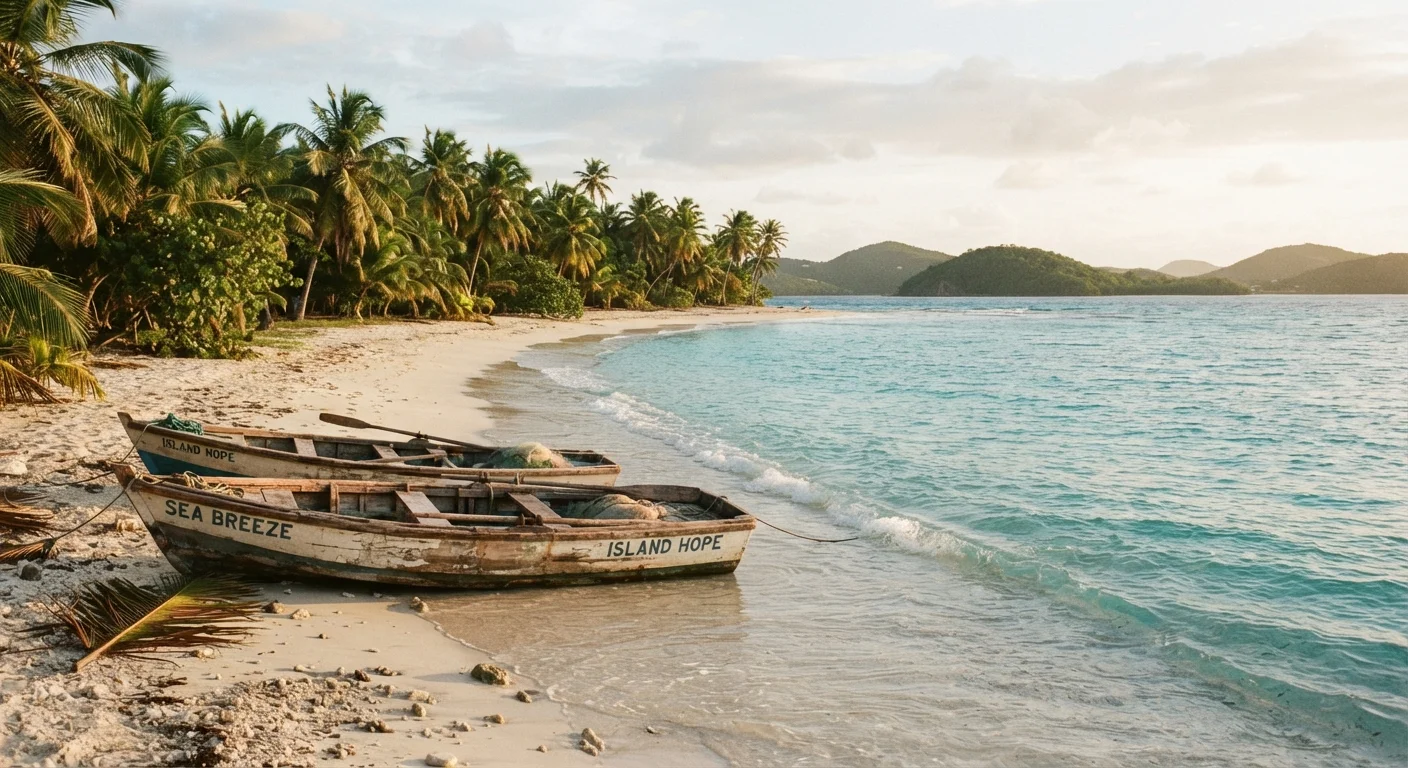
Beaches on smaller islands are often uncrowded in a way that simply isn't replicable on popular destinations, regardless of which cove you find. That quietude extends to the water: snorkeling and diving reefs see far less human pressure, which frequently means better marine life encounters. Local restaurants, when they exist, tend to cook for a local clientele rather than tourists, which often translates to more authentic, less homogenized food.
There's also a relational quality that changes. On islands where the tourist economy is thin, encounters with residents are more likely to be ordinary social interactions than transactional ones. For travelers who prioritize that texture of place, smaller islands deliver it more reliably.
The Honest Disadvantages You Need to Account For
Every advantage of a small island has a corresponding friction point that deserves equal weight before you commit.
Limited and complicated flight connections
Most small Caribbean islands require at least one connecting flight via a regional hub, adding travel time, cost, and vulnerability to disruption. Missed connections can mean waiting 24 hours or more for the next available seat.
Minimal medical facilities and emergency services
Many small islands have only basic clinics. Serious medical situations typically require air or sea evacuation to a larger island, making comprehensive travel insurance with evacuation coverage an essential, not optional, purchase.
Fewer dining, shopping, and nightlife options
Travelers expecting resort-style variety — multiple restaurant types, bars, entertainment venues — will find the reality of a small island economy significantly more limited.
Unreliable transport and infrastructure
Ferries operate on weather-dependent schedules, rental car availability is thin, ATMs can be out of service, and power and internet reliability varies considerably from island to island.
Accommodation options are narrower and harder to vet
Large booking platforms often have sparse or outdated listings for very small islands, meaning guesthouses and small inns require more direct research and verification before committing.
Limited accessibility for travelers with mobility needs
Physical infrastructure on small islands — roads, docks, accommodation, beaches — is rarely designed with accessibility in mind, which can create significant barriers for travelers with mobility considerations.
Getting there is often the first hurdle. Many smaller Caribbean islands are served only by small regional aircraft from a connecting hub, which adds a layover leg, additional baggage handling complexity, and — critically — a narrower window of flight options if something goes wrong. Travel disruptions that are inconvenient at a major hub can become multi-day problems on a small island.
Once there, the absence of a tourist economy means fewer choices at every level. Grocery options may be limited. ATMs may be scarce or unreliable. Medical facilities on many small islands are basic clinics at best; serious emergencies typically require evacuation to a larger island or the mainland. This is not a reason to avoid smaller islands, but it is a reason to carry comprehensive travel insurance, discuss any pre-existing health needs with a physician beforehand, and understand what evacuation coverage your policy actually includes.
For travelers weighing how to structure time on any island, our breakdown of fixed vs. flexible itineraries is worth reading — flexibility tends to matter more on islands where plans can change due to ferry cancellations or limited opening hours.
Planning Differently for a Small Island
Visiting a lesser-known Caribbean island rewards a different planning posture than booking a trip to an established resort destination.
Entry Requirements and Safety Advisories
Entry rules, visa requirements, and safety advisories vary by island and can change. Before booking, verify current requirements with the U.S. Department of State's travel advisories and the official government or tourism authority of whichever island you're considering. Do not rely on third-party summaries for information that affects your ability to enter or travel safely.
Accommodation ranges shift significantly. Large all-inclusive resorts rarely operate on small islands; you'll more commonly find guesthouses, small inns, or self-catering apartments. These options can offer a more immersive stay, but they also require more upfront research to verify quality, reliability, and cancellation terms.
Transportation assumptions also change. Rental cars may be limited in supply, left-hand drive may apply depending on the island, and some roads may be unpaved or steep. Inter-island ferries often operate on irregular schedules influenced by weather. Building buffer time into any itinerary isn't optional — it's part of competent planning for these destinations.
If you're approaching the Caribbean via cruise and considering stops at smaller ports, the dynamic of short port calls on low-infrastructure islands is worth thinking through carefully. Our analysis of ship tours versus independent exploration covers how to make the most of limited time ashore.
Who Thrives — and Who Struggles — on a Small Caribbean Island
Honest destination knowledge means acknowledging that some travel styles genuinely suit smaller islands more than others.
~7,000
Islands in the Caribbean
The Caribbean contains roughly 7,000 islands, islets, reefs, and cays, of which only a small fraction see significant tourist traffic — illustrating just how wide the range of 'off the beaten path' actually is.
Under 100K
Annual visitors on smallest islands
Some of the Caribbean's smaller inhabited islands receive fewer than 100,000 visitors per year, compared to millions on major destinations — a difference felt immediately in infrastructure and crowd levels.
Travelers who do well on smaller islands tend to share a few characteristics: they've already experienced the polished version of the Caribbean and are looking for something different; they're comfortable with ambiguity and last-minute adaptation; they approach service gaps with patience rather than frustration; and they're interested in the island as it actually exists, not as it might be imagined.
Travelers who tend to struggle include those with specific accessibility needs (smaller islands often have significant physical infrastructure gaps), those traveling with very young children who need reliable medical access nearby, and those whose primary priority is nightlife, fine dining, or a curated resort experience. None of those preferences are wrong — they simply point toward a different kind of Caribbean destination.
For travelers who want the best of both worlds — major Caribbean circuit alongside a smaller stop — understanding how cruise itineraries are structured can help. Our regional cruise itinerary guide explains how port selections vary by route and how to evaluate what each stop actually offers.