

Key Takeaways
- City breaks in France offer dense cultural programming, strong public transport, and reliable dining but come with higher costs and crowds.
- Countryside regions like Provence, Alsace, and the Dordogne reward slower travel with landscapes, local markets, and a different pace of French life.
- A car is essential for most rural French regions; cities are comfortably navigable without one.
- Shoulder seasons (May–June and September–October) benefit both options but are especially transformative in the countryside.
- Your trip length, travel companions, and tolerance for logistical complexity should guide the choice as much as scenery preferences.
Our Verdict
Neither urban nor rural France is objectively superior — they serve different traveler needs. Cities like Paris, Lyon, and Bordeaux deliver cultural intensity, seamless infrastructure, and spontaneity. The countryside offers authenticity, open space, and a slower immersion that cities simply cannot replicate. Many travelers find that a combination — a few days in a city bookending a rural stretch — provides the most satisfying balance.
| Best for | Recommended |
|---|---|
| First-time visitors to France with limited time | City break |
| Return visitors seeking deeper cultural immersion | Countryside escape |
| Families or groups who value flexibility and open space | Countryside escape |
| Solo travelers or couples prioritizing dining, nightlife, and museums | City break |
What Each Option Actually Delivers
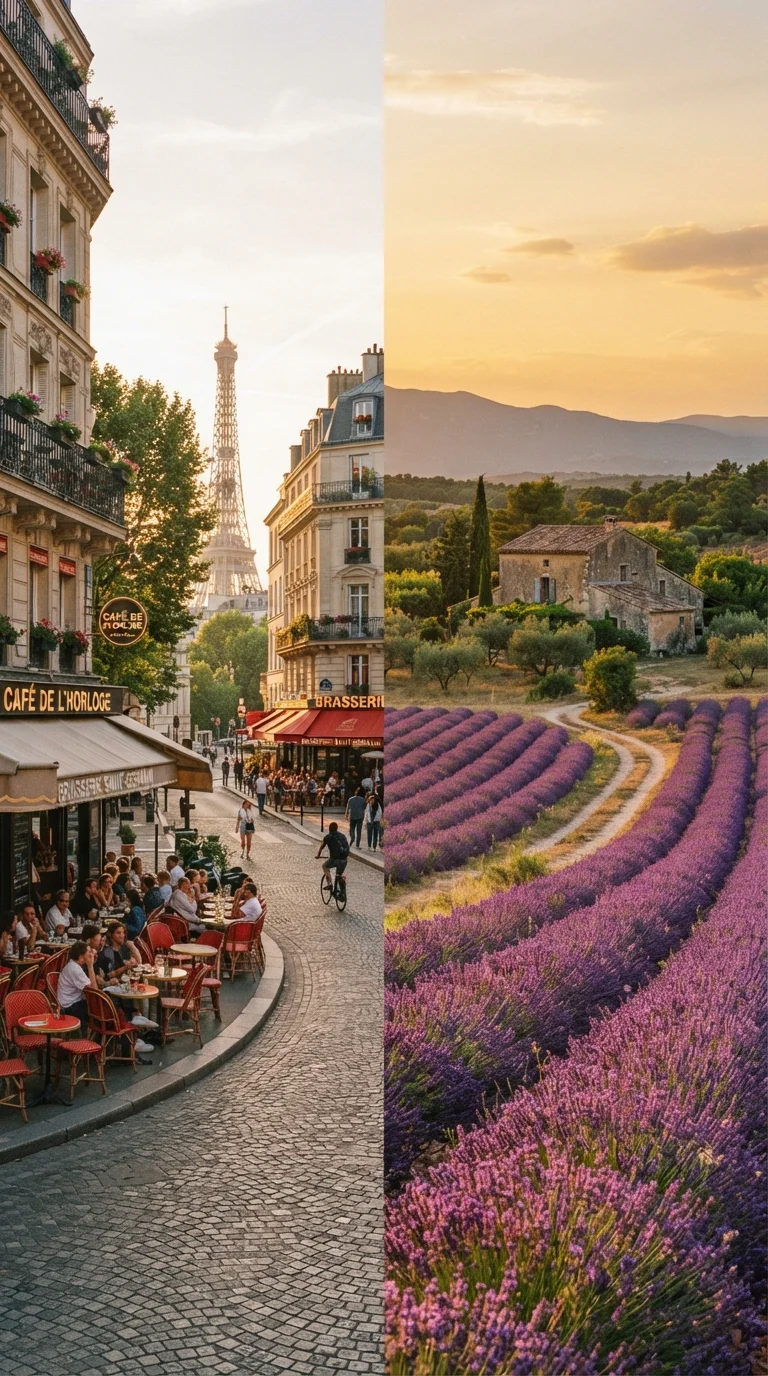
France's urban centers — Paris above all, but also Lyon, Bordeaux, and Marseille — pack extraordinary cultural density into walkable areas. World-class museums, historic architecture, neighborhood markets, and a restaurant scene that ranges from casual bistros to ambitious modern kitchens are all accessible without a car or complex logistics. The tradeoff is real: costs are higher, tourist crowds in peak season are substantial, and the experience is fundamentally urban — stimulating but rarely quiet.
The French countryside operates on an entirely different register. Provence's hilltop villages and lavender plateaus, the Alsatian wine route's half-timbered towns, and the Dordogne valley's medieval châteaux and river landscapes reward travelers who are willing to slow down. Markets run on village schedules, restaurants often close between lunch and dinner, and a missed turn on a back road can accidentally become the best part of the day. This is not a failure of planning — it is the point.
Understanding a destination's rhythms before you arrive is especially important in rural France, where schedules and local customs shape the experience more than any highlights list will tell you.
The Practical Differences That Matter Most
Transportation is the sharpest dividing line. French cities have robust metro and tram networks; the TGV high-speed rail connects major urban centers efficiently. Rural France, by contrast, is largely inaccessible without a rental car. Buses serve some villages, but infrequently and on schedules that rarely suit a traveler's day. If driving abroad feels stressful, that is a meaningful data point when choosing between a week in Lyon and a week in the Lot valley.
Cost patterns also diverge significantly. Urban accommodations, particularly in Paris, carry a premium for central locations. Rural gîtes (self-catering cottages) and chambres d'hôtes (family-run B&Bs) often provide more space and character for comparable or lower nightly rates — though food and fuel costs for driving tours add up quickly.
Weather and seasonality affect both options, but with different stakes. A rainy week in Paris still fills itself with indoor museums, covered passages, and restaurant hours. A rainy week in the Luberon, when the main draw is the landscape, is a more significant disappointment. Shoulder seasons generally favor the countryside most strongly.
| City Break (Paris / Lyon / Bordeaux) | Countryside Escape (Provence / Alsace / Dordogne) | |
|---|---|---|
| Transport needed | Metro, tram, walking | Rental car essential |
| Typical accommodation cost | Higher, especially central Paris | Often lower; more space per euro |
| Best season | Year-round viable | May–June and September best |
| Rainy-day resilience | High — museums, galleries, cafés | Lower — landscape-dependent |
| Crowd levels (July–August) | Heavy in tourist zones | Heavy in Provence; lighter elsewhere |
| Food scene | Wide range, always accessible | Excellent but limited hours and options |
| Language barrier | English widely spoken in tourist areas | Less English outside main towns |
Choosing Your Region: Beyond Paris
If a countryside escape appeals, the choice of region matters as much as urban versus rural. Provence is the most visited rural region — beautiful but busy in July and August, and genuinely magical in May or September. Alsace offers a distinct Franco-German cultural blend, excellent local wines, and extraordinary Christmas markets in late November and December. The Dordogne is less internationally crowded, historically rich, and particularly well-suited to families or travelers who enjoy prehistory (Lascaux), medieval architecture, and river landscapes at a gentle pace.
For those drawn to wine country, Burgundy and the Bordeaux hinterland both offer the appealing combination of accessible small cities with serious rural wine-touring options — a natural bridge between the two modes of travel.
Whether you plan a fixed or flexible itinerary affects countryside travel particularly sharply: rural France rewards spontaneity but punishes over-scheduling, especially around market days, winery visits, and restaurant reservations.
Time Your Countryside Visit Carefully
The Provençal lavender bloom typically peaks in late June to mid-July, but that window coincides with peak crowds and prices. Visiting Provence in May or September offers better availability, cooler temperatures, and a more authentic feel. Alsace's quieter winter charm — particularly around its Christmas markets — is an underrated counterpoint to summer visits.
Combining Both: The Hybrid Approach
Many travelers find the most satisfying France itinerary is neither purely urban nor purely rural. A common framework: arrive into Paris or Lyon for two to three days to absorb city energy, handle jet lag in a stimulating environment, and cover major cultural priorities — then transition by TGV or rental car into a rural region for the remaining portion of the trip. Returning to a city for the final night before a flight simplifies logistics and allows for any last-minute errands or dinners.
This structure also mirrors how many French people experience their own country — cities for work and culture, the countryside for vacances. It is not a compromise but a deliberately designed experience that draws on the genuine strengths of each mode.
If you enjoy the contrast of urban versus rural travel in other contexts, the framework for thinking through this decision maps well across destinations. See how similar tradeoffs play out in coastal versus inland Portugal for a comparable European case study.
~90M
Annual international visitors to France
France has consistently ranked among the world's most visited countries, with Paris accounting for a significant share of arrivals, according to Atout France tourism data.
~60%
Visitors who stay only in Paris
Industry estimates suggest the majority of international visitors to France spend their entire trip in Paris, leaving rural regions relatively underexplored by foreign travelers.