

Key Takeaways
- Miranda warnings are only required before a custodial interrogation - not every police encounter.
- Failing to Mirandize a suspect doesn't automatically dismiss charges; it affects admissibility of statements.
- You can invoke Miranda rights mid-interrogation, but must do so clearly and unambiguously.
- Volunteered statements made without questioning are generally admissible even without a Miranda warning.
- Waiving Miranda rights is legal and happens frequently - understanding the process helps you protect yourself.
What Miranda Rights Actually Are
Miranda warnings trace back to the 1966 U.S. Supreme Court decision Miranda v. Arizona, which established that people in police custody must be informed of specific constitutional rights before being questioned. Those rights stem from the Fifth Amendment's protection against self-incrimination and the Sixth Amendment's guarantee of counsel.
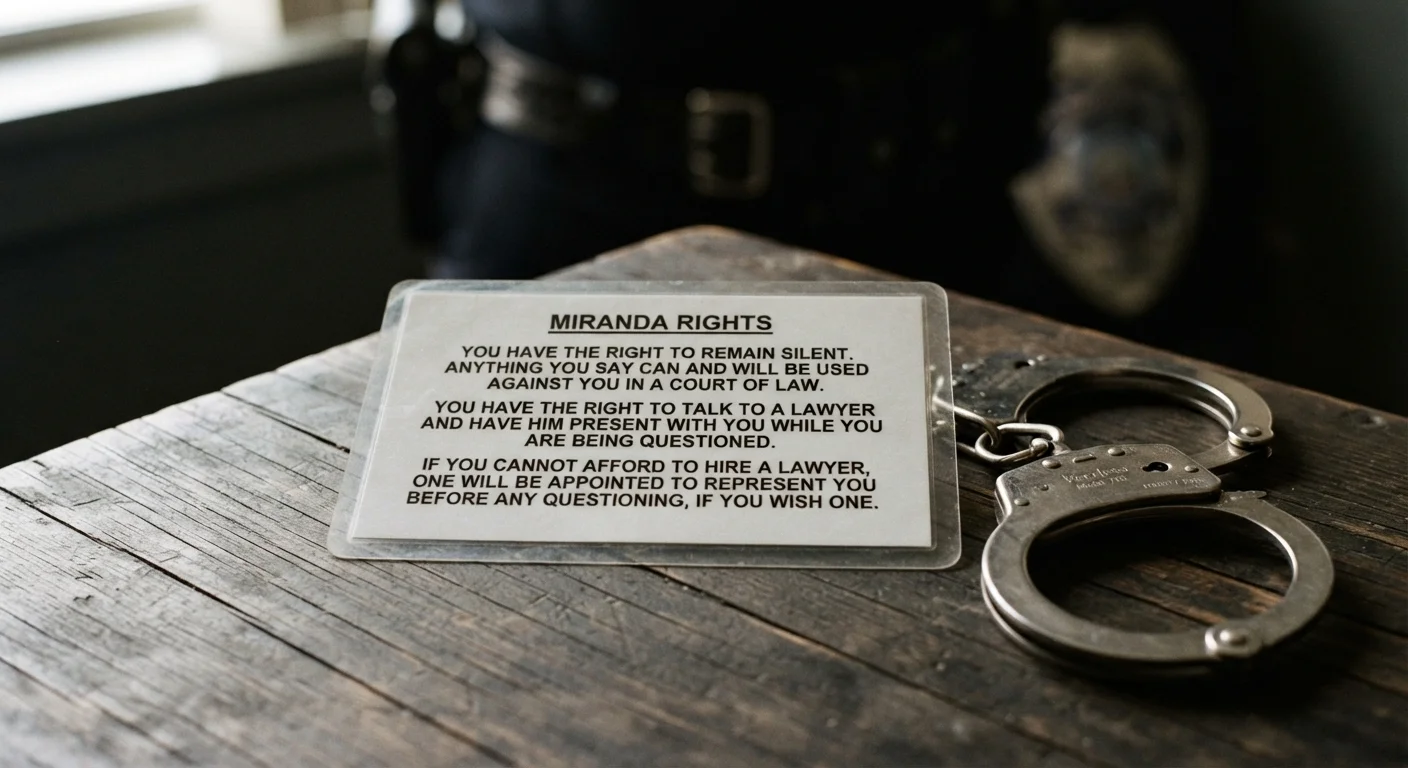
The standard warning - that you have the right to remain silent, that anything you say can be used against you, and that you have the right to an attorney - is a procedural safeguard, not a magic formula. The exact wording varies by jurisdiction, but the substance must be communicated clearly. Understanding what triggers this requirement - and what doesn't - is where most misconceptions begin. For a broader look at how constitutional protections work day-to-day, see What the Fourth Amendment Actually Protects You From.
Common Myths Debunked
Television dramas have cemented a distorted picture of Miranda rights in the public imagination. Below, we address the most persistent misconceptions with accurate legal context.
Myth
Police must read you your Miranda rights the moment they arrest you.
Fact
Miranda warnings are required only before a custodial interrogation - not at the moment of arrest itself.
An arrest and a custodial interrogation are two distinct legal events. Officers can lawfully handcuff you, transport you, and book you without ever reciting Miranda. The warning is only legally required once you are both in custody and subject to questioning. If police never ask you questions, Miranda may never formally apply - though anything you voluntarily say can still be used against you.
Myth
If police don't read Miranda rights, the entire case gets thrown out.
Fact
A Miranda violation results in suppression of the unwarned statements, not dismissal of the charges.
Suppression is a targeted remedy: it removes the improperly obtained statements from evidence. But prosecutors can still build a case from physical evidence, surveillance footage, witness accounts, or statements made at other times. A case dismissal based solely on a Miranda violation is extraordinarily rare and legally unfounded in most circumstances.
Myth
Miranda rights apply whenever police ask you a question.
Fact
Miranda only applies during custodial interrogations - not casual street encounters or voluntary conversations.
A police officer asking your name or whether you've seen anything suspicious during a sidewalk encounter does not trigger Miranda. You are not "in custody" simply because an officer is speaking to you. Custody requires that a reasonable person in your position would not feel free to leave. Roadside stops and brief investigative detentions occupy a legal gray area, but they typically fall short of full custody for Miranda purposes.
Myth
Once you waive Miranda rights and start talking, you can't change your mind.
Fact
You can invoke your Miranda rights at any point during an interrogation, even after initially waiving them.
If you begin answering questions and then decide to stop, you have the right to invoke at that moment. Clearly state that you are exercising your right to remain silent or that you want an attorney. Questioning must cease. Any statements made before a valid mid-interrogation invocation, however, may still be admissible - so invoking early is always the safer course. For more on navigating police encounters strategically, see Before You Talk to Police Without a Lawyer.
Myth
Miranda rights protect you from having to answer any question from any authority figure.
Fact
Miranda applies specifically to law enforcement custodial interrogations, not to employers, school officials, or other authorities.
Miranda is a constitutional constraint on government agents conducting custodial questioning. Your employer asking about workplace misconduct, a school principal questioning a student, or a private security guard detaining someone does not trigger Miranda protections. Other legal frameworks - employment law, school disciplinary policies, or state statutes - may apply in those contexts, but Miranda is not among them.
What Happens When Miranda Is Violated
If police conduct a custodial interrogation without giving Miranda warnings, the primary consequence is suppression - statements obtained in violation of Miranda can be excluded from evidence at trial under the exclusionary rule. However, the Supreme Court clarified in Vega v. Tekoh (2022) that a Miranda violation alone does not give rise to a standalone civil rights lawsuit against an officer.
Suppression Is Not the Same as Dismissal
Many people assume that a Miranda violation automatically ends a prosecution. It does not. Courts suppress improperly obtained statements, but the case itself continues on other evidence. Do not rely on a Miranda issue as a substitute for competent legal defense - consult a criminal defense attorney as early as possible.
Critically, suppression of a statement does not automatically mean a case is dismissed. Prosecutors may still proceed using physical evidence, witness testimony, or other lawfully obtained information. If you believe your Miranda rights were violated, the appropriate step is to raise the issue with a defense attorney immediately - not to assume the charges will disappear. See Before You Talk to Police Without a Lawyer for guidance on what to consider before any police interaction.
Invoking and Waiving Your Rights
Miranda rights are not self-executing. Once warned, a person must affirmatively invoke them to stop questioning. The Supreme Court held in Berghuis v. Thompkins (2010) that simply staying silent for hours does not constitute an invocation - you must state clearly, "I am invoking my right to remain silent" or "I want a lawyer." Ambiguous statements like "maybe I should talk to a lawyer" may not be sufficient.
80%+
Suspects who waive Miranda rights
Research published in law review literature consistently estimates that the large majority of custodial suspects waive Miranda and speak to police without an attorney present.
1966
Year Miranda protections were established
The U.S. Supreme Court's ruling in Miranda v. Arizona created the modern warning requirement, rooted in Fifth and Sixth Amendment guarantees.
Conversely, waiving Miranda rights is permissible and surprisingly common. A waiver must be voluntary, knowing, and intelligent - but it does not need to be in writing. Courts have found implied waivers when suspects continued talking after receiving warnings. This is why understanding your rights during any police stop is essential before you find yourself in a high-pressure situation. If you're uncertain about the distinction between constitutional rights and civil liberties more broadly, Civil Rights vs. Civil Liberties provides useful context.
This article is for general informational and educational purposes only and does not constitute legal advice. Laws and their application vary by jurisdiction and individual circumstance. Consult a licensed attorney for guidance specific to your situation.