

Key Takeaways
- Civil liberties protect individuals from government interference; civil rights protect individuals from discrimination by others.
- Civil liberties are largely grounded in the Bill of Rights; civil rights stem primarily from statutes like the Civil Rights Act of 1964.
- Both concepts can overlap in real-world situations, making it important to understand which legal framework applies.
- Violating civil liberties typically involves government actors; civil rights violations can involve private employers, landlords, and businesses.
- Understanding the distinction helps you identify the correct legal remedy and the right agency or court to contact.
Option A
Civil Liberties
Constitutional protections against government overreach.
Best for: Individuals seeking to understand protections like free speech, privacy, and due process that limit what the government can do to them.
Option B
Civil Rights
Legal guarantees of equal treatment and non-discrimination.
Best for: Individuals confronting unequal treatment based on characteristics like race, sex, or disability in employment, housing, or public life.
If a police officer searched your home without a warrant
Civil Liberties
This implicates your Fourth Amendment protection against unreasonable searches - a civil liberties claim involving government conduct, not private discrimination.
If an employer refused to promote you because of your race
Civil Rights
Title VII of the Civil Rights Act prohibits discriminatory employment practices by private employers, making this a civil rights matter.
If you were denied housing based on your disability
Civil Rights
The Fair Housing Act prohibits discrimination in housing on the basis of disability, among other protected characteristics.
If a government agency retaliated against you for speaking out
Civil Liberties
First Amendment protections guard against government suppression of speech - a civil liberties concern rooted in constitutional protections.
If you want to understand your rights during a police encounter
Civil Liberties
Rights during arrest, questioning, and detention - including Miranda warnings - fall under civil liberties and constitutional due process. See our guide to Miranda rights for more detail.
Two Terms, Two Distinct Legal Frameworks
Ask most people to define civil rights and civil liberties and you'll likely get a shrug - or the two used as synonyms. Legally speaking, they are not the same. Each concept has its own origin, its own set of legal protections, and its own remedies when those protections are violated.
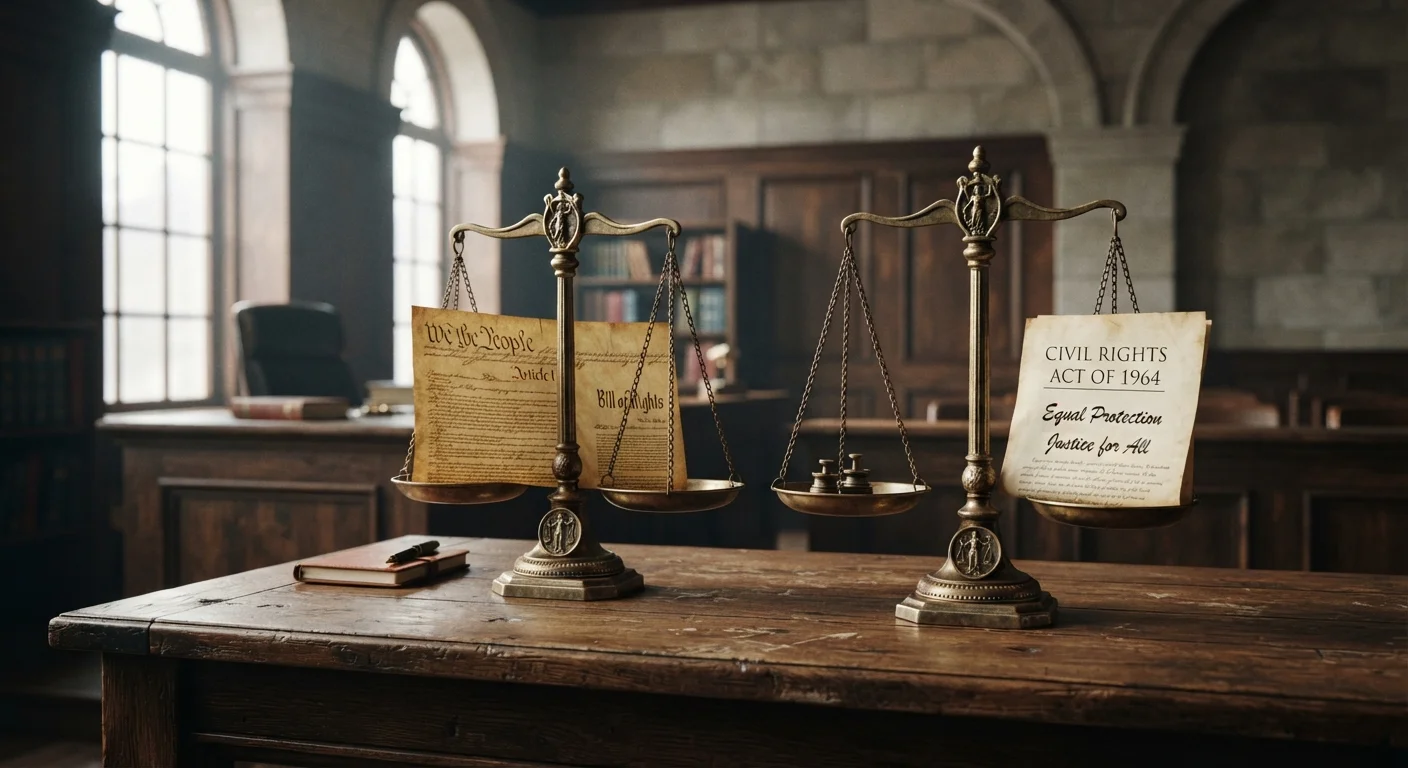
Civil liberties are freedoms that protect individuals from governmental overreach. They are grounded primarily in the U.S. Constitution and its Bill of Rights - the first ten amendments. Think of free speech, freedom of religion, the right against unreasonable searches and seizures, and the right to due process. These protections define what the government cannot do to you.
Civil rights, by contrast, are legal guarantees that individuals will be treated equally and without discrimination - particularly by other private actors, institutions, and government entities operating in their regulatory capacity. They arise primarily from legislation: the Civil Rights Act of 1964, the Fair Housing Act, the Americans with Disabilities Act, and similar statutes. These laws prohibit discriminatory treatment based on characteristics such as race, color, sex, national origin, religion, age, or disability.
In practical terms: if a government agent violates your right to free speech, that is a civil liberties issue. If a landlord refuses to rent to you because of your ethnicity, that is a civil rights issue.
| Criterion | Civil Liberties | Civil Rights |
|---|---|---|
| Primary source | U.S. Constitution / Bill of Rights | Federal and state statutes |
| Who is bound | Government actors only | Government and private actors |
| Core concern | Freedom from government interference | Equal treatment and non-discrimination |
| Example protections | Free speech, due process, privacy | Protection from race, sex, disability discrimination |
| Common legal vehicle | Section 1983 federal lawsuit | EEOC complaint, HUD complaint, or lawsuit |
| Key legislation | First, Fourth, Fifth, Fourteenth Amendments | Civil Rights Act 1964, ADA, Fair Housing Act |
Where These Rights Come From - and Who They Bind
One of the clearest ways to tell these concepts apart is to ask: who is bound by the protection?
Civil liberties bind the government - federal, state, and local. The First Amendment does not prevent your employer from firing you for your opinions; it prevents the government from punishing you for them. The Fourth Amendment's protections against unreasonable search and seizure apply to law enforcement acting with government authority, not to a neighbor searching through your belongings.
Civil rights, meanwhile, typically extend to private actors operating in regulated spheres. Title VII of the Civil Rights Act of 1964 applies to private employers with 15 or more employees. The Fair Housing Act applies to most private landlords. These statutes effectively require that private parties not discriminate on protected grounds - creating enforceable rights that the Constitution alone would not provide.
The Fourteenth Amendment: Where Both Concepts Meet
The Fourteenth Amendment is unique because it bridges both worlds. Its Equal Protection Clause - a constitutional provision - prohibits government discrimination on the basis of race and other characteristics, making it both a civil liberties protection (against government) and the constitutional foundation for civil rights legislation. Many landmark civil rights laws were enacted under Congress's authority to enforce the Fourteenth Amendment, meaning both concepts converge in this pivotal provision of the Constitution.
This distinction matters enormously when you are trying to determine where to turn. Civil liberties violations are generally challenged in federal court under constitutional claims, often through Section 1983 suits against government officials. Civil rights violations may be brought to the Equal Employment Opportunity Commission (EEOC), the Department of Housing and Urban Development (HUD), or directly through the courts depending on the statute involved. Understanding which framework applies directs you to the correct process - and the right agency. For protections that apply in the workplace, our overview of consumer and work rights provides helpful grounding.
Real-World Overlap and Why Clarity Still Matters
In practice, a single incident can raise both civil liberties and civil rights concerns simultaneously. A Black man stopped and searched by police without cause may have a Fourth Amendment civil liberties claim - and may also be able to demonstrate that the stop was racially motivated, giving rise to an equal protection civil rights claim under the Fourteenth Amendment.
Despite this overlap, the distinction drives strategy. The legal standard you must meet, the agency you file with, the statute of limitations, and the remedies available all differ depending on which framework applies. Conflating the two can lead someone to file in the wrong forum or miss a critical deadline.
Consider a workplace scenario: an employee who is fired after reporting misconduct may think their freedom of speech was violated. But unless the employer is a government entity, the First Amendment offers no direct protection here. The applicable legal framework would instead be employment law - specifically whistleblower protection statutes - rather than a civil liberties claim. Understanding this boundary helps people pursue remedies that actually exist, rather than ones that don't apply. Our article on employee vs. independent contractor classification illustrates how similar definitional clarity can determine your legal protections entirely.
For readers navigating consumer contexts, it's also worth noting that many civil rights protections extend to commercial transactions - prohibiting discrimination in lending, retail, and public accommodations. For a broader view of protections many people overlook, see our piece on consumer protections Americans overlook.
This article is for general informational and educational purposes only and does not constitute legal advice. Readers facing specific legal situations should consult a licensed attorney in their jurisdiction.