

| Legal Name | Monroney label (Automobile Information Disclosure Act, 1958) |
| Required by Law | Yes - federal law mandates display on all new passenger vehicles |
| Who Can Remove It | Only the buyer (removing it before sale is a federal violation) |
| Fuel Economy Data Source | U.S. Environmental Protection Agency (EPA) |
| Safety Rating Source | NHTSA (National Highway Traffic Safety Administration) |
| Destination Charge | Non-negotiable; uniform across all dealers for the same model |
What Is the Monroney Label?
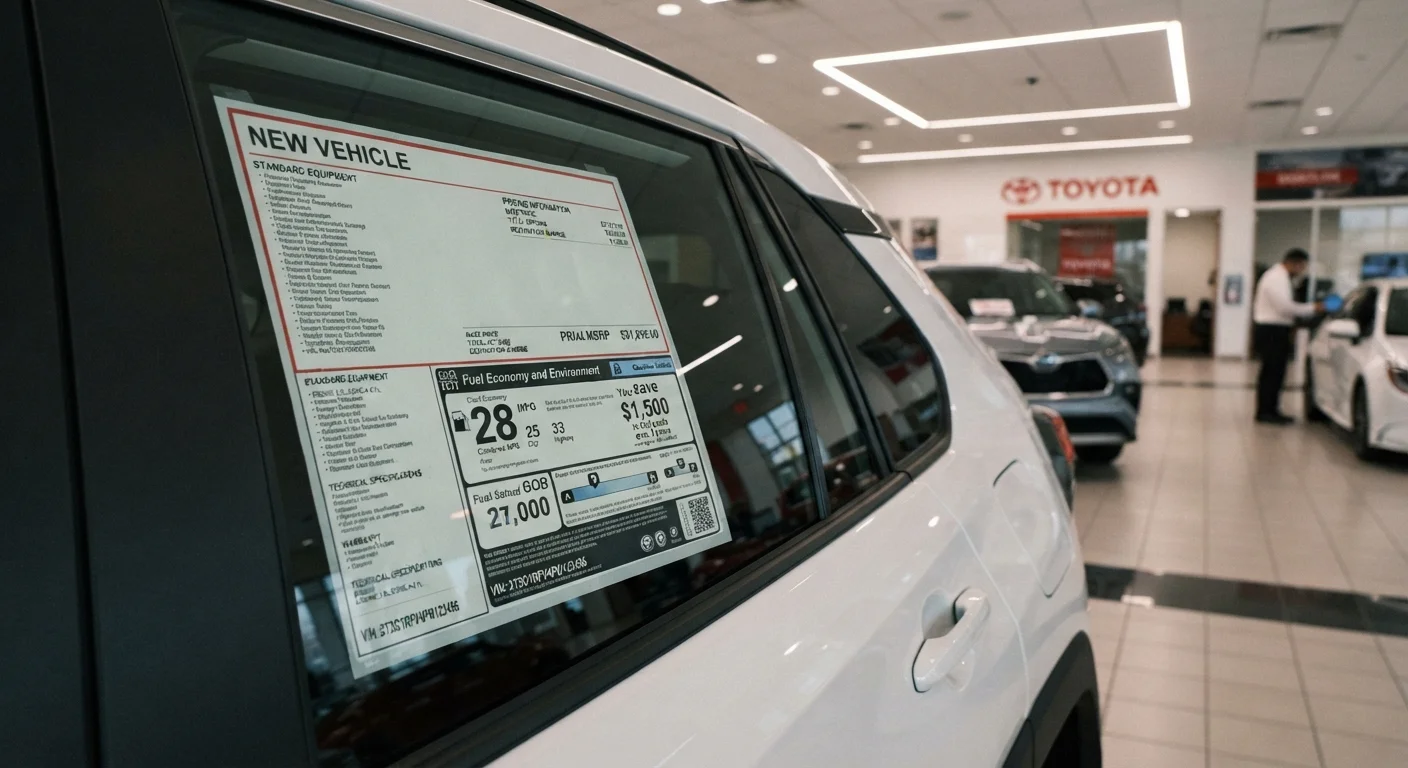
The sticker plastered to a new car's window isn't just a price tag - it's a federally mandated disclosure document. Formally called the Monroney label (named for the Oklahoma senator who championed the 1958 Automobile Information Disclosure Act), it must appear on every new passenger vehicle sold in the United States. Removing it before purchase is illegal - only the buyer can take it off.
The label is standardized, which means once you know how to read one, you can decode any new car's sticker at any dealership. Think of it as a nutritional facts panel for your vehicle purchase - just as you'd examine a nutrition label before buying food, a Monroney label rewards a careful read before you sign anything.
| Legal Name | Monroney label (Automobile Information Disclosure Act, 1958) |
| Required by Law | Yes - federal law mandates display on all new passenger vehicles |
| Who Can Remove It | Only the buyer (removing it before sale is a federal violation) |
| Fuel Economy Data Source | U.S. Environmental Protection Agency (EPA) |
| Safety Rating Source | NHTSA (National Highway Traffic Safety Administration) |
| Destination Charge | Non-negotiable; uniform across all dealers for the same model |
Breaking Down Every Section of the Sticker
Modern Monroney labels are divided into several distinct regions. Here's what each one contains:
Vehicle Identification
At the top you'll find the make, model, trim level, and model year. This section also lists the Vehicle Identification Number (VIN), which you can use for independent history checks and insurance quoting. Understanding trim designations matters: a single model name can cover very different feature sets. Our guide on trim levels and packages explains what those suffixes actually add.
Standard Equipment
This block lists features included in the base price of that specific trim. Read it carefully - items here are already paid for and shouldn't be upsold as add-ons.
Optional Equipment & Packages
Any factory-installed options or bundled packages appear here with individual prices. Each line represents money above the base price. Dealers cannot charge you for factory options not listed on this sticker.
Manufacturer's Suggested Retail Price (MSRP)
The MSRP is the automaker's recommended selling price, broken into: base price + options + destination & delivery charge. It is a starting point for negotiation, not a fixed transaction price. The destination charge - what it costs to ship the car from the factory to the dealer - is non-negotiable and the same at every dealership nationwide for a given model.
Monroney Label
The federally required window sticker on every new car, disclosing price, equipment, fuel economy, and safety ratings. Named after U.S. Senator Mike Monroney.
MSRP
Manufacturer's Suggested Retail Price - the automaker's recommended sale price, including base price, options, and destination charge. It is a starting point, not a fixed price.
Destination Charge
The fixed fee for transporting the vehicle from the factory to the dealership. It is set by the manufacturer and identical at every dealer nationwide for a given model.
MPGe
Miles Per Gallon equivalent - a metric used for electric and plug-in hybrid vehicles to compare energy efficiency against gasoline-powered cars on a common scale.
Addendum Sticker
A secondary sticker added by the dealer - not the manufacturer - listing additional markups, accessories, or protection packages. These charges are typically negotiable.
VIN
Vehicle Identification Number - a unique 17-character code that identifies a specific vehicle and can be used to look up its build specifications, history, and recall status.
Fuel Economy
The EPA fuel economy section shows city, highway, and combined MPG (or MPGe for electric/plug-in vehicles). A cost-to-drive estimate compares the vehicle against the average new car. These figures come from standardized EPA tests; real-world results vary based on driving habits, climate, and load.
Safety Ratings
If the vehicle has been tested, government safety ratings from the National Highway Traffic Safety Administration (NHTSA) appear here as star ratings (1-5) across frontal, side, and rollover categories. Some stickers also reference IIHS ratings. A vehicle without ratings listed simply hasn't been tested yet - absence isn't a red flag on its own.
Dealer Add-Ons: The Second Sticker Problem
Many shoppers are surprised to find a second sticker - sometimes called an addendum sticker - alongside the Monroney. This one is placed by the dealer, not the manufacturer, and lists additional markups such as market adjustments, dealer-installed accessories, or protection packages. Unlike the Monroney, these items are frequently negotiable or removable.
Key principle: the Monroney label represents the manufacturer's terms. Anything on a dealer-added sticker is subject to discussion. Review both documents side by side before any negotiation begins.
Addendum Items Are Not Manufacturer Prices
Dealer-installed accessories, paint sealants, and 'market adjustment' fees listed on addendum stickers are not part of the federally standardized Monroney label. These costs vary by dealership and are often negotiable. Always confirm which sticker each line item appears on before agreeing to a price.
Once you understand the sticker, your next reference point is the car's long-term cost of ownership - including the service intervals that will apply after you drive off the lot. Our plain-language breakdown of service schedules is a natural follow-up read. For broader market context, a first-timer's market roadmap covers segments, pricing norms, and the vocabulary you'll need throughout the buying process.