

Key Takeaways
- Your owner's manual is the only authoritative source for your car's specific service schedule.
- Service intervals are triggered by mileage or time - whichever comes first.
- "Severe" driving conditions apply to more drivers than most people expect.
- Letter codes in service schedules map to specific inspection or replacement tasks.
- A simple log or app is all you need to stay on top of upcoming services.
Start here
Where to Find Your Service Schedule
Next
Decoding Intervals: Miles, Months, and Conditions
Then
Common Service Codes and What They Mean
Apply it
Normal vs. Severe Driving: Which Schedule Applies to You?
Finally
Keeping Track Without Losing Your Mind
Where to Find Your Service Schedule
Every car comes with an owner's manual - a document that most drivers glance at once and never open again. That's a missed opportunity. Your owner's manual contains the manufacturer's official service schedule, which is the only authoritative guide to what your specific vehicle needs and when.
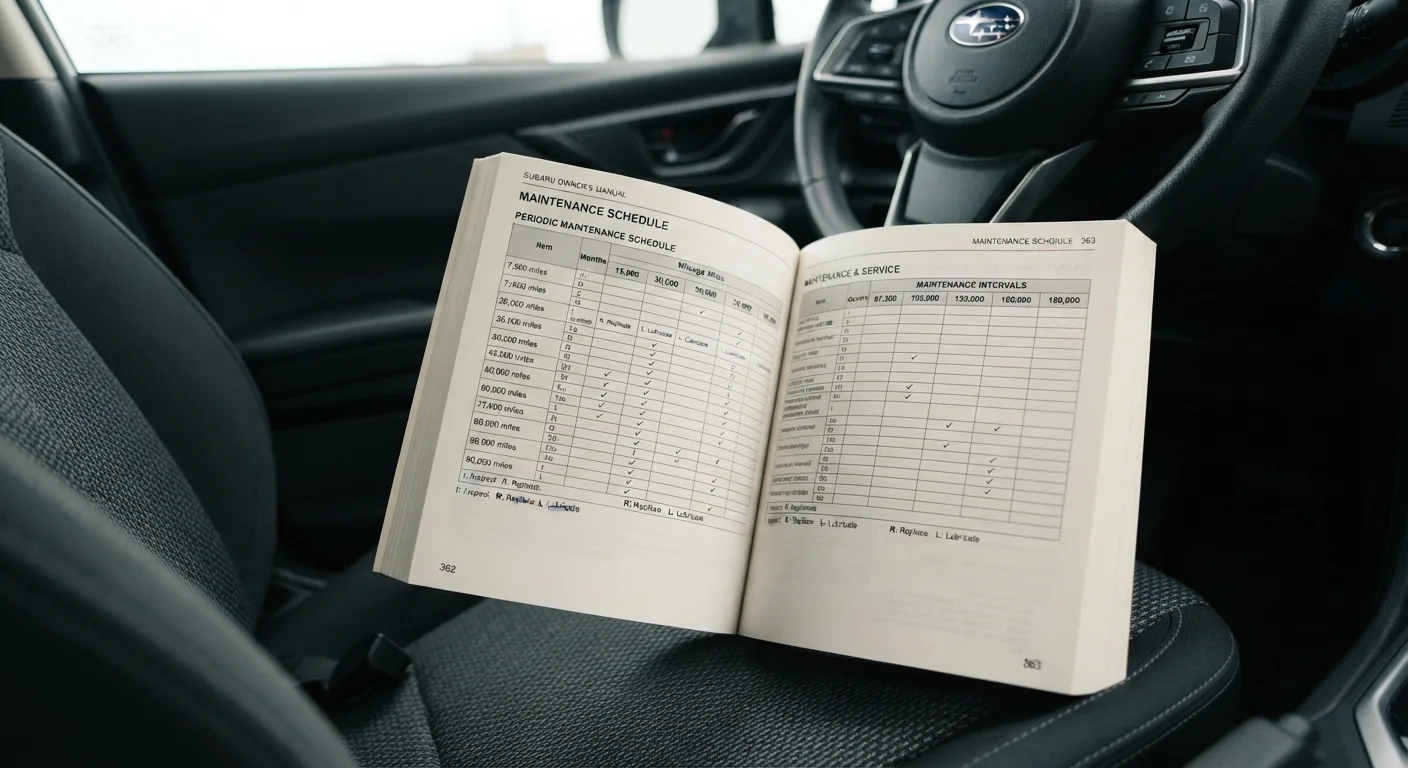
Look for a section titled "Maintenance Schedule," "Scheduled Maintenance," or "Service Intervals." In many manuals, it appears as a multi-column table listing mileage or time milestones across the top and service tasks down the side. If your manual is missing, manufacturer websites often publish digital versions searchable by model year and VIN (Vehicle Identification Number - the 17-character code on your dashboard or door jamb).
Some newer vehicles skip a printed schedule entirely, relying instead on an onboard system that monitors driving conditions and alerts you when a service is due. If your car has this, you'll still want to cross-reference with the manual to understand what the alert is actually asking for. For a broader introduction to maintenance concepts, see Car Maintenance From Scratch.
Service interval
The specific mileage or time period after which a maintenance task should be performed, as defined by the vehicle manufacturer.
VIN
Vehicle Identification Number - a unique 17-character code assigned to every vehicle that identifies its make, model, year, and manufacturing details.
Maintenance Minder
An onboard system used by some manufacturers that monitors driving conditions and alerts the driver when specific services are due, rather than relying on fixed mileage milestones.
Severe driving conditions
Operating patterns - like frequent short trips, towing, or extreme temperatures - that place greater stress on a vehicle and require more frequent maintenance than standard schedules.
Odometer
The instrument in your car that tracks total distance driven, used as a reference point for calculating when mileage-based services are due.
Decoding Intervals: Miles, Months, and Conditions
Service schedules list intervals in two ways: distance (miles) and time (months). The rule is straightforward - service is due when either threshold is reached, whichever comes first. A driver who covers only 5,000 miles per year still needs to follow time-based intervals, because fluids degrade and seals can dry out regardless of how little the car is driven.
A typical entry might read: Oil and filter change - every 7,500 miles or 12 months. If you hit 12 months before reaching 7,500 miles, the service is still due. Ignoring the time trigger is one of the most common mistakes low-mileage drivers make.
Use Whichever Comes First
Write both your next due mileage and next due date on a sticky note and put it in your glove box. Check it whenever you fill up with gas. This simple habit prevents you from accidentally letting either threshold slip by unnoticed.
For seasonal context around when these intervals tend to cluster throughout the year, The Seasonal Car Maintenance Calendar maps common checks to the time of year when they matter most.
Common Service Codes and What They Mean
Many manufacturers use letter or number codes to condense a list of tasks into a compact table. Honda's Maintenance Minder system, for example, uses a main code (like "A" or "B") paired with sub-codes (numbers 1-7) to indicate exactly which items need attention. Other brands use similar shorthand.
While codes differ by manufacturer, common categories include:
- Oil/fluid changes: Engine oil, transmission fluid, coolant, and brake fluid replacement
- Filter replacements: Engine air filter, cabin air filter, fuel filter
- Inspection items: Brakes, tires, belts, hoses, suspension components
- Rotation/adjustment: Tire rotation, wheel alignment check, brake adjustment
When you see a code you don't recognize, look it up in the index of your owner's manual - every code maps to a written description of the actual task. Your Car's Warning Lights, Decoded is a useful companion if a dashboard alert accompanies a service reminder.
Normal vs. Severe Driving: Which Schedule Applies to You?
Most owner's manuals include two service tracks: normal and severe (sometimes called "special operating conditions"). Severe schedules call for more frequent servicing. The challenge is that many drivers assume they fall under normal conditions when they actually don't.
Severe conditions typically include:
- Frequent short trips under 5 miles, especially in cold weather
- Stop-and-go city driving or heavy traffic commutes
- Towing, hauling heavy loads, or driving on unpaved roads
- Operating in extreme heat, cold, or dusty environments
If your daily commute involves a lot of city traffic or short runs, the severe schedule likely applies to you - even if your car never goes near a construction site. Using the normal schedule when severe conditions apply can accelerate engine and drivetrain wear.
Don't Assume You're a 'Normal' Driver
The severe-use schedule applies to a larger share of everyday drivers than manufacturers' wording implies. If you frequently drive in city traffic, take lots of short trips, or live somewhere with extreme seasonal temperatures, check whether the severe schedule fits your situation before assuming the standard one does.
Understanding which service type covers what work is also helpful here. Full Service vs Interim Service explains exactly what each level of service typically covers.
Keeping Track Without Losing Your Mind
The simplest system is a paper log kept in your glove box: note the date, mileage, and work done each time your car is serviced. Many mechanics will stamp or sign a service record booklet if you ask. Alternatively, several free and low-cost apps allow you to log services and set reminders based on your intervals.
Whatever method you choose, the key habit is recording the current odometer reading every time a service is completed. That's your baseline for calculating when the next one falls due. Keep receipts - they serve as proof of maintenance history, which matters both for warranty purposes and when you eventually sell the vehicle.
For fluids in particular, our plain-English guide to car fluids explains what each fluid does and how to know when it needs attention - useful background as you start to decode your schedule's fluid-change entries.