

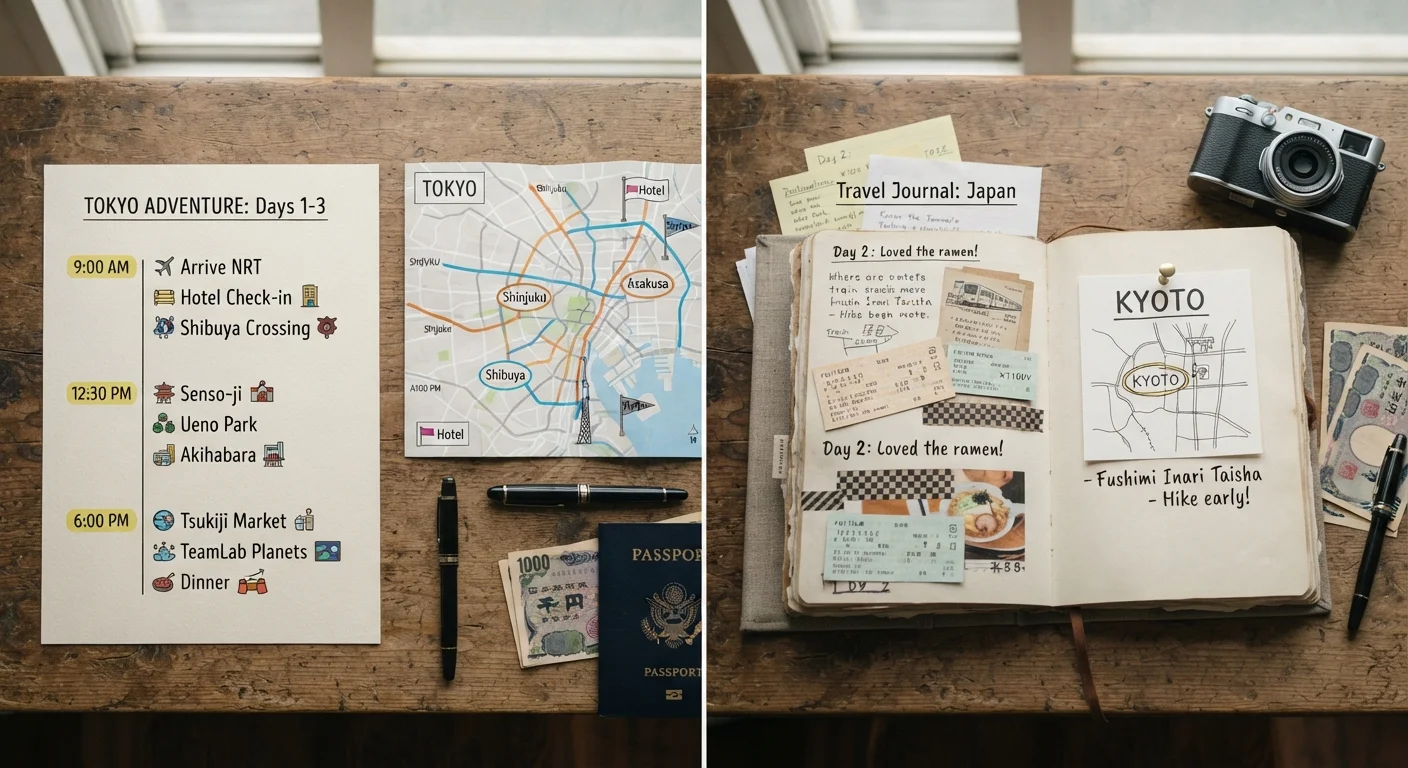
Key Takeaways
- Fixed itineraries reduce decision fatigue and protect access to high-demand attractions requiring advance booking.
- Flexible itineraries allow travelers to follow energy levels, weather, and unexpected discoveries rather than a schedule.
- Group travel and short trips typically benefit more from structure; solo and longer trips gain from built-in flexibility.
- A hybrid approach — anchoring key bookings while leaving buffer days unplanned — works well for most travelers.
- Your destination's infrastructure and booking culture should shape how rigid or open your plan needs to be.
Option A
Fixed Itinerary
The structured, pre-planned approach to travel.
Best for: Travelers with limited time, popular bucket-list destinations, or group trips requiring coordinated logistics.
Option B
Flexible Itinerary
The open-ended, discover-as-you-go approach.
Best for: Solo travelers, longer trips, or anyone who prioritizes spontaneity and adapting to local conditions.
If you have a short trip with must-see attractions
Fixed Itinerary
Limited days demand efficiency. Pre-booking popular sites ensures you don't lose hours to queues or sold-out slots.
If you're traveling solo for two weeks or more
Flexible Itinerary
Longer trips reward spontaneity. You can linger where you connect deeply and move on quickly from places that don't resonate.
If you're coordinating travel for a group of four or more
Fixed Itinerary
Aligning multiple schedules, preferences, and budgets is far easier with a shared, agreed-upon plan established in advance.
If your destination has limited tourist infrastructure
Flexible Itinerary
In less-visited regions, rigid plans often break down due to unreliable transport or seasonal closures — flexibility is a practical asset.
If you want the benefits of both approaches
Fixed Itinerary
Anchor your major bookings (flights, accommodation, headline experiences) but leave 20–30% of days deliberately unscheduled for discovery.
What Each Approach Actually Means in Practice
A fixed itinerary is a day-by-day plan with pre-booked accommodation, confirmed activities, and predetermined travel between locations. You know on Tuesday morning that you'll be at a specific museum at 10 a.m. and boarding a train at 3 p.m. This structure removes real-time decisions and protects access to popular experiences that require reservations — think timed-entry tickets at overcrowded heritage sites or restaurant reservations at sought-after spots.
A flexible itinerary, by contrast, typically anchors the start and end points (flights, perhaps the first night's hotel) and leaves most of the middle open. Direction is set, but pace and specific experiences emerge as the trip unfolds. This approach lets travelers respond to weather, energy levels, and local tips rather than a calendar. See our guide to itinerary anatomy for a deeper look at what belongs in any plan, regardless of its rigidity.
Neither approach is inherently superior — the right choice depends on trip length, destination, group size, and personal temperament.
| Criterion | Fixed Itinerary | Flexible Itinerary |
|---|---|---|
| Planning effort upfront | High — requires detailed pre-booking | Low to moderate — broad strokes only |
| Adaptability during the trip | Low — changes disrupt the chain | High — built to absorb changes |
| Best trip length | Short (3–7 days) | Long (2+ weeks) |
| Group size suitability | Works well for groups of 4+ | Best for solo or pairs |
| Access to popular attractions | Secured in advance | May be unavailable walk-up |
| Spontaneity | Limited | Maximized |
| Stress profile | Low day-to-day; higher if plans break | Higher day-to-day; resilient to disruption |
Where Fixed Planning Has the Edge
Structure pays off most in specific circumstances. When a trip is short — say, five days in a city with a packed list — a fixed schedule converts limited hours into maximum coverage without leaving decisions to chance each morning. Advance booking also unlocks experiences that genuinely can't be accessed walk-up: some national parks require timed-entry permits, popular cooking classes fill weeks ahead, and high-season accommodation in tourist-dense destinations disappears fast.
Group travel is another clear case for structure. Coordinating four or more people without an agreed framework invites daily friction over what to do and when. A shared plan, decided collectively in advance, neutralizes this. The same logic applies to multigenerational trips where different needs — mobility, dietary requirements, nap schedules — must be balanced proactively. For more on how group dynamics shape planning, see how solo and group planning diverge.
72%
Travelers who pre-book key activities
According to a Booking.com traveler survey, the majority of leisure travelers book at least one major activity or attraction in advance of their trip.
1 in 3
Travelers who change plans mid-trip
Research by travel platform Expedia has found that a significant share of travelers alter their itineraries at least once after departure due to weather, recommendations, or changed preferences.
Fixed planning also provides psychological comfort for first-time international travelers or those visiting destinations where language barriers or unfamiliar transit systems could make improvisation stressful.
Where Flexibility Wins
The strongest argument for flexibility is adaptability. Weather disrupts plans. A local at a café recommends a village that wasn't on your radar. An unexpected festival is happening the next town over. A rigid schedule treats these moments as problems; a flexible one treats them as the point of travel.
Longer trips (three weeks or more) particularly benefit from built-in breathing room. Packing every day with pre-committed activities leads to what travel planners sometimes call "itinerary fatigue" — the feeling of rushing from attraction to attraction without actually experiencing anywhere. Building a day-by-day itinerary without over-scheduling explores this balance in practical detail.
Destinations with limited or variable infrastructure — ferry-dependent islands, regions with seasonal road closures, off-the-beaten-path areas — also reward flexibility. When a boat doesn't run on Tuesdays or a road closes after rain, a loose plan bends where a fixed one breaks. This dynamic is particularly relevant when choosing lesser-visited Caribbean islands, where logistics routinely shift.
The Hybrid Case: Anchoring Without Over-Committing
Most experienced travelers land somewhere between the two extremes. The practical framework is simple: fix the non-negotiables, leave the rest open. Book flights, the first and last night's accommodation, and any experiences with genuine scarcity (timed-entry sites, guided tours with limited spots, special-event tickets). Then let the days in between breathe.
A useful rule of thumb: plan roughly 70% of your trip in advance and leave 30% unscheduled. This ratio shifts depending on destination — a multi-destination European rail trip needs more structure than a beach week — but the principle holds. For complex multi-stop trips, planning multi-destination trips from route logic to daily flow offers a framework for sequencing stops without over-committing each day.
Booking Culture Varies by Destination
In some destinations — Iceland in summer, popular US national parks, Kyoto during cherry blossom season — advance booking isn't just convenient, it's often mandatory for entry. In others, walk-up access is the norm and heavy pre-planning offers little practical advantage. Research the specific booking norms of your destination before committing to either extreme.
Seasonality also shapes how much pre-booking is genuinely necessary. Peak travel periods compress availability dramatically; shoulder and off-peak seasons often allow more improvisation. See principles for planning around weather and seasons for guidance on timing decisions.