

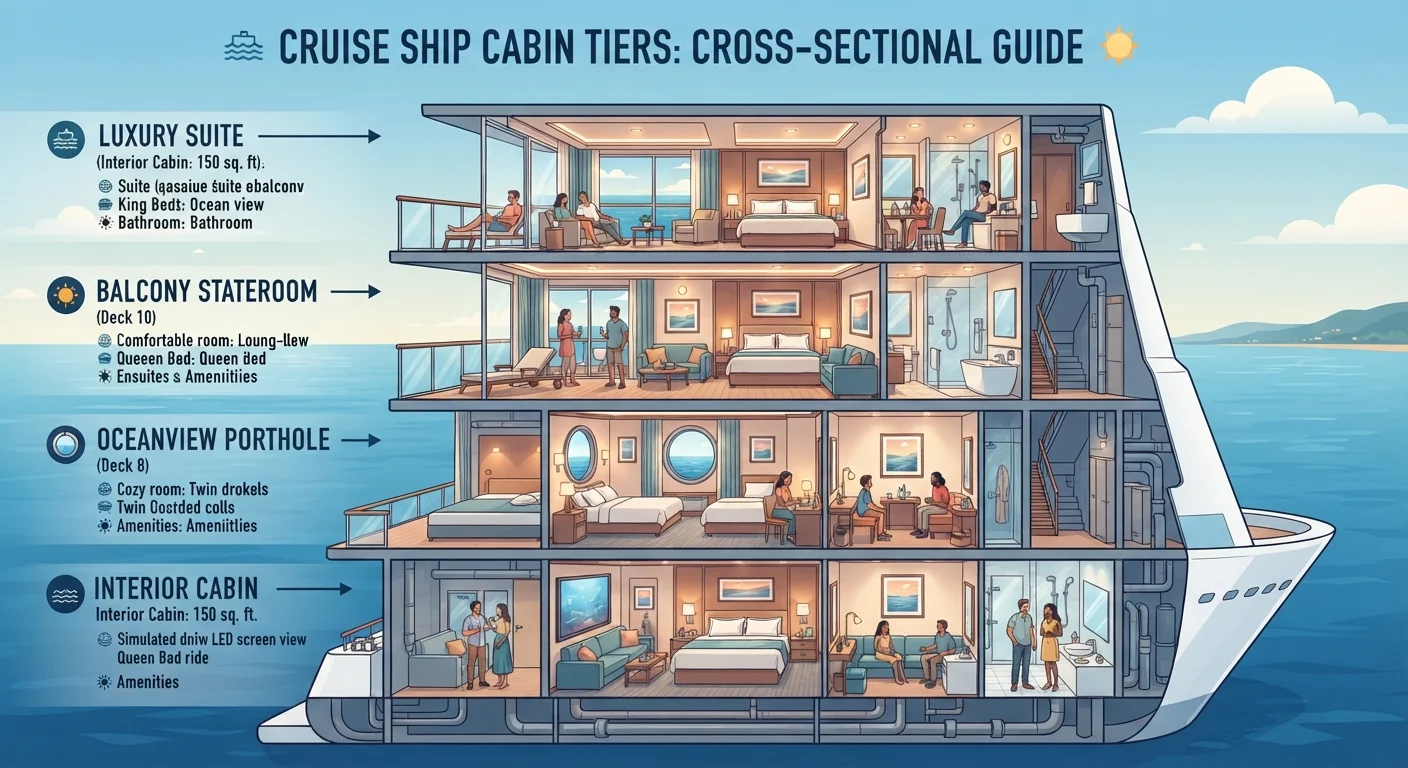
Key Takeaways
- Inside cabins offer the lowest price but no windows or natural light.
- Oceanview cabins add a window or porthole but no outdoor access.
- Balcony cabins are the most popular category and include private outdoor space.
- Suites provide significantly more room, priority services, and exclusive perks.
- Ship location — midship, forward, aft — matters as much as category for comfort.
- Cabin choice should reflect how much time you plan to spend in the room.
Cruise Cabin Categories
Cruise ships divide their accommodations into distinct tiers — commonly inside, oceanview, balcony, and suite — each offering a different level of space, natural light, and amenities. The category you choose affects not just your comfort onboard but also your price, location on the ship, and how much time you're likely to spend in the room. Understanding what each tier actually includes helps you weigh value against cost rather than simply booking by price alone.
Cruise lines use proprietary sub-categories and letter codes (e.g., 4A, 4B) within each tier to differentiate deck position, cabin size, or obstructed views — details that matter when selecting a specific stateroom number.
The Four Main Cabin Tiers
Every major cruise ship organizes its staterooms into a hierarchy of four broad categories. Understanding what separates them is the foundation of any smart cabin decision.
Inside Cabins
The entry-level option, inside cabins have no window and no view of the outside. They're typically the smallest rooms on the ship, designed efficiently with a bed, storage, and an en-suite bathroom. The price is usually the lowest available, making them popular with passengers who treat the cabin purely as a place to sleep. The main drawback is the absence of natural light, which some guests find disorienting on longer voyages.
Oceanview Cabins
One tier up, oceanview staterooms include a fixed porthole or a larger picture window. You can see daylight and the sea, but the window doesn't open and there's no outdoor space. These cabins suit travelers who want a visual connection to the outside world without paying for a balcony. Note that some oceanview cabins have obstructed views due to lifeboats — always check before selecting a specific room number.
Balcony Cabins
The most booked category on most modern ships, balcony staterooms add a private outdoor space — typically a small deck with two chairs and a table. You can open the door, breathe sea air, and watch ports approach at dawn. On scenic routes such as Alaska or Norwegian fjords, a balcony transforms the experience. On a Caribbean itinerary where you're off the ship most of the day, the added cost may deliver less return. See our itinerary guide to weigh this by region.
Suites
Suite categories vary widely — from junior suites that add a sofa and a little more floor space, to full multi-room residences with private dining, whirlpool tubs, and butler service. The price premium is significant, but suites often include perks that carry real value: priority embarkation, exclusive restaurant access, and sometimes included beverages or excursion credits. Understanding what's actually bundled in helps gauge whether the suite rate represents value for your trip. Our overview of the real cost of a cruise holiday breaks down where inclusions change the financial picture.
~40%
Share of new ships' cabins that are balcony staterooms
Industry analysis has consistently shown balcony cabins now make up roughly 40% or more of inventory on newly built large cruise ships, reflecting sustained passenger demand.
2–3x
Typical suite price premium over inside cabin
Suite fares on mainstream cruise lines commonly run two to three times the base inside cabin rate, though the gap widens significantly on luxury and expedition vessels.
30–50 sq ft
Average size difference: inside vs. balcony cabin
Balcony staterooms on mainstream ships typically add 30–50 square feet of outdoor space over comparable inside cabins, plus the balcony door introduces natural light.
Location on the Ship: The Factor People Often Overlook
Category is only half the equation. Where on the ship your cabin sits affects comfort just as meaningfully as what tier you book.
Midship cabins on lower-to-middle decks sit closest to the ship's center of gravity, meaning you feel the least motion here. This makes them a sensible default for first-time cruisers or anyone with seasickness concerns — something covered in depth in our article on seasickness on cruises.
Forward cabins (near the bow) offer some of the most dramatic views but tend to experience more pitch and vibration, especially in rough weather. Aft cabins (at the ship's stern) are prized by experienced cruisers for their wake views and often-larger balconies, but can be noisy if located above nightclub or engine spaces. Always check the deck plan before finalizing a cabin number.
Always Review the Deck Plan Before Booking
Cabin category tells you the tier; the deck plan tells you the reality. Check whether your shortlisted cabin sits above a nightclub, below a pool deck, or has a lifeboat blocking the window. Most cruise lines publish interactive deck plans on their websites, and third-party cruise review sites often carry passenger notes on specific cabin numbers.
Deck height also plays a role: higher decks feel more motion and can be noisier from pool areas above, while lower decks are quieter and more stable but have longer walks to elevators.
For a full orientation to onboard geography, our cruise terminology glossary explains terms like aft, forward, port, and starboard in plain language.
How to Choose the Right Category for Your Trip
The right cabin depends on three honest questions: how much time will you spend in the room, what does this itinerary reward, and what is your actual budget after factoring in extras?
First-time cruisers frequently overestimate how much time they'll spend in their cabin. On a port-intensive Caribbean or Mediterranean itinerary, the room may function mainly as a place to sleep and change. In that context, an inside or oceanview cabin often delivers better overall value than stretching the budget for a balcony rarely used.
Conversely, on a scenic cruising voyage — Alaska's Inside Passage, Norway's fjords, a repositioning crossing — being able to sit outside and watch the landscape unfold adds genuine, daily value. Here, a balcony earns its premium more reliably.
Suites make most sense for travelers who genuinely value the additional space, the service touches, or the priority access to onboard facilities. They're also worth examining closely if the inclusions — drinks packages, specialty dining, excursion credits — offset costs you'd otherwise pay separately. Understanding what all-inclusive actually covers is essential context before comparing suite packages.
Solo travelers face additional considerations around the single supplement, which can make inside cabins an even more practical starting point. Solo cruising has its own pricing logic worth understanding before you book.
Once your cabin is sorted, the next practical step is preparation — from what to pack to what dress codes actually require onboard. Packing for a cruise picks up where cabin selection leaves off.
“The most common mistake first-time cruisers make is booking the cabin category, not the cabin. Two balconies in the same category can deliver very different experiences depending on where they sit on the ship.”
— Travel Editorial Team, Cruise travel editors with extensive sailing experience across multiple cruise lines and itineraries