

Key Takeaways
- Zone-based organization groups items by activity or function, regardless of which room they're stored in.
- Room-by-room decluttering works through one enclosed space at a time, delivering contained, visible results.
- Zone-based thinking often reduces duplicate items scattered across a home more effectively.
- Room-by-room methods are easier to start and provide a clear sense of completion per session.
- Many households benefit from combining elements of both approaches rather than committing to one exclusively.
- The method that fits your schedule and motivation style is usually more effective than the 'objectively correct' one.
Option A
Zone-Based Organization
The activity-centered, whole-home approach.
Best for: Households where items migrate across rooms and clutter follows activities, not locations.
Option B
Room-by-Room Decluttering
The contained, space-by-space method.
Best for: People who want visible, room-level progress and a clear stopping point at the end of each session.
If clutter tends to spread across multiple rooms
Zone-Based Organization
When items related to one activity end up in three different rooms, organizing by zone consolidates them and removes the friction of searching. This approach directly addresses the root cause.
If you have limited time and need fast, visible wins
Room-by-Room Decluttering
Finishing one room completely - even a small one like a bathroom - delivers immediate, motivating results without requiring a full-home commitment upfront.
If your household members have different habits and spaces
Room-by-Room Decluttering
Assigning responsibility room by room makes it easier to coordinate with others and set clear boundaries. See our guide on organizing shared homes for more.
If you've decluttered repeatedly without lasting results
Zone-Based Organization
Repeated room-by-room efforts often fail because items keep returning. Thinking in zones addresses why things accumulate in the wrong places to begin with.
If you're starting your first major home organization project
Room-by-Room Decluttering
The room-by-room approach is more intuitive and easier to explain to household members, making it a lower-barrier entry point for first-time organizers.
What Each Method Actually Means
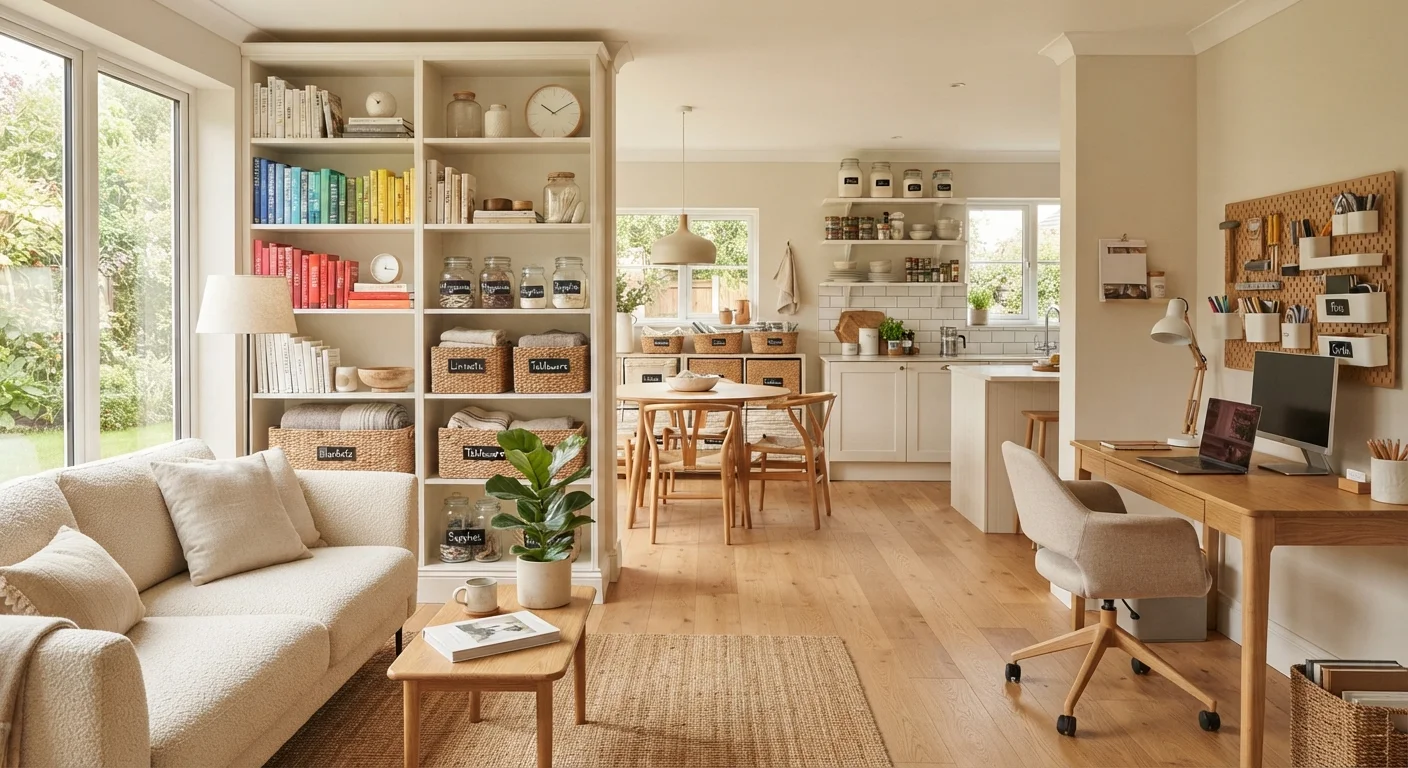
Zone-based organization treats your home as a collection of functional activity areas rather than distinct rooms. A "homework zone" might span a bedroom desk and a living room basket. A "craft zone" might live in a closet off the hallway. Items are stored where they're actually used - or at a single, logical home base - regardless of which room that happens to be in.
Room-by-room decluttering does what the name implies: you work through one enclosed space completely before moving to the next. You might spend a weekend on the kitchen, then two evenings on the bedroom, and so on until the whole home is addressed. Each room gets a clear beginning and end.
Neither method is inherently superior. What matters is whether the logic behind the approach matches the way your household actually uses space. If your home's clutter problem is rooted in how activities spread across rooms, organizing room by room may treat symptoms rather than causes. If your clutter problem is room-specific - say, a chronically chaotic bathroom - a zone lens adds unnecessary complexity. For a fuller picture of organizing principles across the whole home, see our complete home organization framework.
| Criterion | Zone-Based Organization | Room-by-Room Decluttering |
|---|---|---|
| Core logic | Organize by activity or function | Organize by physical space |
| Best starting point | Map activities across the home | Pick one room and begin |
| Visible progress | Slower - spans multiple areas | Fast - one room feels done |
| Reduces duplicates | Yes - consolidates by category | Less reliably - may just relocate |
| Works well for shared homes | Moderate - requires buy-in | Yes - easy to assign responsibility |
| Complexity to start | Higher - requires whole-home thinking | Lower - intuitive and contained |
| Addresses root cause of spread | Yes - by activity pattern | Not always |
Where Zone-Based Organization Has the Edge
Zone thinking shines when you notice the same category of items scattered everywhere. School supplies in the kitchen, the bedroom, and a hallway drawer. Phone chargers in four rooms. Wrapping paper in three closets. Organizing by zone consolidates these duplicates and creates one reliable location for each activity's tools.
It also tends to produce more durable results for households that have decluttered the same spaces repeatedly without lasting effect. If you want to understand why those efforts keep unraveling, our article on breaking the decluttering cycle explores the patterns behind recurring clutter in detail.
54%
Adults who feel overwhelmed by home clutter
A survey by the National Association of Professional Organizers found that more than half of American adults consider clutter a significant source of stress in their home.
~40%
Household items stored in the wrong location
Professional organizers commonly estimate that a large share of household items are not stored where they are most frequently used, contributing to search friction and clutter drift.
The trade-off is complexity upfront. Zone mapping requires you to think across your entire home before touching a single drawer, which can feel overwhelming if you're already fatigued by clutter.
Where Room-by-Room Decluttering Has the Edge
Room-by-room decluttering wins on motivation and manageability. Finishing one room - even a small bathroom or entryway closet - gives you a complete, visible result. That sense of completion is genuinely useful: it signals that progress is real and the method is working.
It's also easier to coordinate in shared households. Saying "let's tackle the kitchen this Saturday" is a clearer, more actionable ask than explaining zones to reluctant housemates. For households navigating different tidiness standards, our guide on organizing when households disagree offers practical middle-ground strategies.
The limitation is that room-by-room thinking can move clutter rather than eliminate it. Items that don't belong in a room get relocated - often to another already-cluttered space - rather than finding a permanent, logical home.
The Relocation Problem in Room-by-Room Decluttering
A common pitfall of strict room-by-room decluttering is the "donation pile shuffle" - items removed from one room end up temporarily staged in another, making the second room temporarily worse. Setting a firm rule about where displaced items go (a single designated holding area, not another living space) helps prevent this. Our article on organization myths that backfire covers related patterns worth knowing before you start.
Combining Both Approaches
In practice, many organized homes use a hybrid. Start room by room to get surfaces clear and build momentum. Then step back and audit by category or activity to identify where items are still doubling up or landing in the wrong place.
For example: declutter the home office as a room first, removing everything that clearly doesn't belong. Then apply zone logic to consolidate all work-related items - printer paper, chargers, notebooks - from wherever they've drifted in the house. This two-pass approach captures the motivational benefit of visible room-level progress while correcting the systemic issues that zone thinking addresses.
Before committing to either method, it's worth doing a quick audit of where your storage is actually breaking down. Our room-by-room organization audit can help you identify the real pressure points before you start moving things around. And if you're curious whether a more minimalist philosophy might change how you approach either method, our analysis of minimalism as an organization strategy offers an honest look at what that involves.