

Key Takeaways
- R-value measures insulation effectiveness - higher values mean better thermal resistance.
- Attics are typically the highest-priority zone for insulation upgrades in most US homes.
- Different insulation materials suit different locations; no single type works everywhere.
- Air sealing alongside insulation dramatically improves energy performance.
- Some insulation work is DIY-friendly; electrical, gas-adjacent, or permit-required zones need a pro.
Why Insulation Matters More Than Most Homeowners Realize
Insulation is one of those invisible systems that quietly determines how comfortable and efficient your home is year-round. Without adequate insulation, heating and cooling systems work harder to compensate for heat escaping in winter or flooding in during summer - resulting in higher energy bills and uneven temperatures room to room.
The U.S. Department of Energy estimates that heating and cooling account for roughly half of a typical home's energy use. Addressing insulation gaps is one of the most impactful steps a homeowner can take - often more effective than upgrading appliances. It also reduces drafts and noise, and can extend the life of your HVAC equipment by reducing how hard it has to run.
If you're also thinking about broader home upkeep, pairing insulation work with a structured maintenance schedule pays off. See our seasonal home maintenance checklist for a full picture of tasks that protect your home year-round.
~50%
Of home energy used for heating and cooling
According to the U.S. Department of Energy, space conditioning represents the largest share of household energy consumption.
R-60
Recommended attic R-value in coldest US climate zones
The Department of Energy's climate zone recommendations range from R-30 in warmer zones to R-60 in the coldest northern regions.
15-25%
Of heating/cooling lost through air leaks
The DOE estimates that sealing air leaks can reduce energy costs significantly, particularly in older homes with unaddressed gaps.
Understanding R-Values: The Language of Insulation
Every piece of insulation is rated by its R-value - a measure of thermal resistance. The higher the R-value, the more effectively the material slows heat transfer. R-values are cumulative: two layers of R-19 batts give you roughly R-38.
The right R-value for your home depends on your climate zone and the location being insulated. The Department of Energy divides the US into eight climate zones, and recommended R-values range from R-30 in warmer southern regions to R-60 in colder northern climates for attic insulation. Walls and floors carry their own target ranges.
Always check your climate zone on the DOE's website before purchasing insulation - buying for the wrong zone means you'll either overspend or under-insulate.
R-value recommendations differ substantially across the US, and a product that's sufficient for Florida may be inadequate for Minnesota.
When adding insulation to an existing attic, air-seal first, then add depth. Skipping this step is the single most common mistake homeowners make.
Insulation slows conductive heat transfer, but gaps around penetrations allow warm air to bypass the insulation entirely - dramatically reducing real-world performance.
It's important to understand that R-value only measures conductive heat flow. In real homes, air leakage (infiltration) is equally significant. Insulating without air sealing is like wearing a sweater with holes - you'll feel the difference by sealing gaps around outlets, pipes, and framing before or alongside adding insulation.
Types of Insulation and Where Each Works Best
Choosing the right insulation type is as important as choosing the right R-value. Each material has distinct strengths depending on the space.
- Fiberglass batts: The familiar pink rolls and batts. Easy to handle and cut, making them a common DIY choice for open wall cavities and attic floors between joists. They must fit snugly without compression to achieve their rated R-value.
- Blown-in (loose-fill) fiberglass or cellulose: Ideal for filling irregular attic floors and hard-to-reach cavities. Cellulose (made from recycled paper) has good environmental credentials. Both require a blower machine, which many hardware stores rent.
- Rigid foam boards: High R-value per inch. Used on basement walls, exterior sheathing, and under slabs where moisture resistance matters. Requires careful cutting and often a fire-rated covering when installed indoors.
- Spray foam: Comes in open-cell (lower density, lower R-value, good for interior) and closed-cell (higher R-value, excellent moisture barrier) varieties. Closed-cell spray foam is highly effective for rim joists and crawl spaces. Professional installation is strongly recommended for most spray foam applications.
- Mineral wool (rock wool): Fire-resistant and moisture-resistant. Works well in areas prone to dampness or where fire rating is a concern.
Don't Block Attic Ventilation
When adding insulation to an attic floor, always maintain clear pathways for airflow from soffit vents to ridge vents. Blocking ventilation can cause moisture buildup, mold, and roof damage. Use rafter baffles (also called insulation dams) at the eaves to keep vents open while still adding full insulation depth.
Where to Insulate First: Priority Zones in Your Home
Not all insulation gaps are equal. Addressing the highest-impact areas first gives you the greatest return.
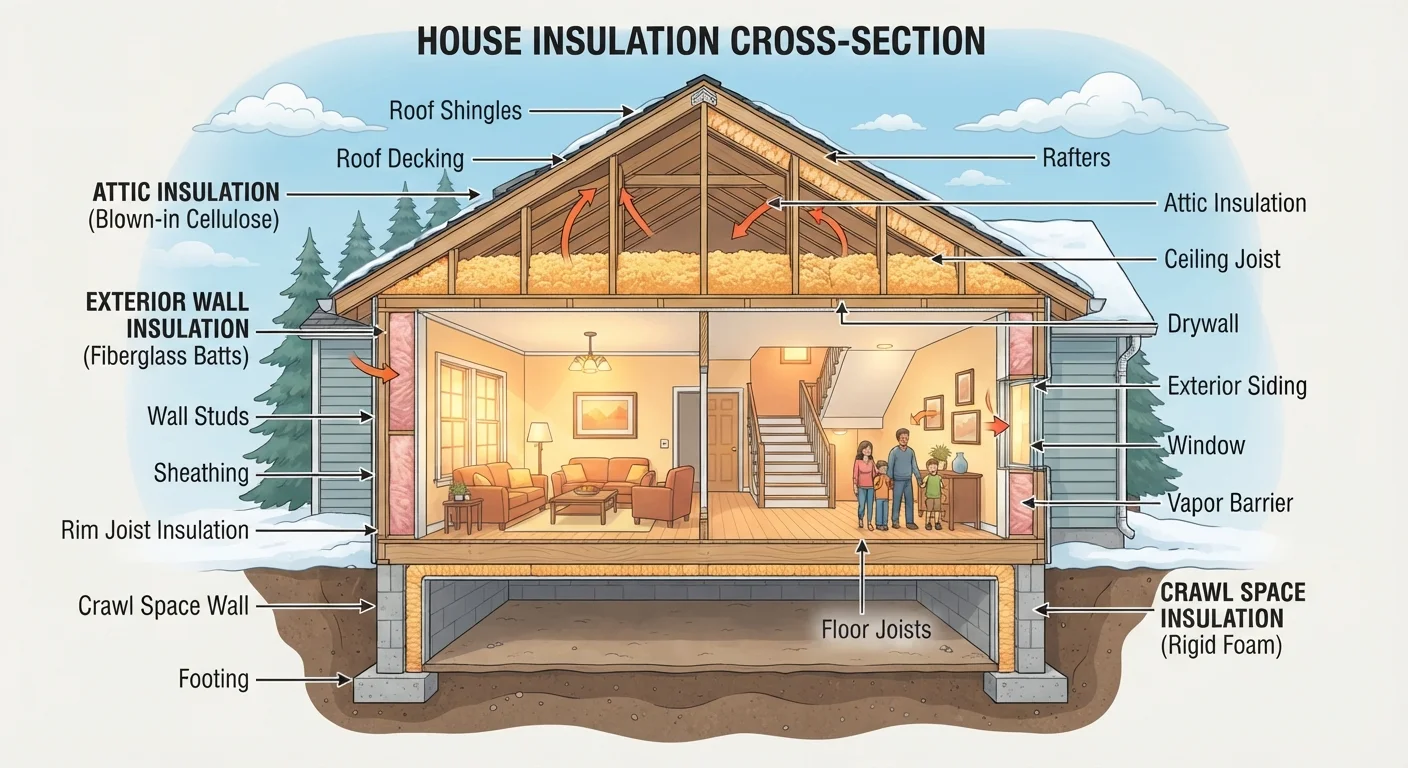
Attic
Heat rises, and attics are typically the biggest source of energy loss in a home. Most building experts recommend starting here. Aim for the R-value recommended for your climate zone, and air-seal around light fixtures, plumbing penetrations, and the attic hatch before adding bulk insulation.
Crawl Spaces and Basements
An uninsulated crawl space allows cold air and moisture to enter the living area above. Insulating the floor joists above an unconditioned crawl space - or encapsulating and conditioning the crawl space itself - are two different strategies with different trade-offs. A building professional can help you determine which suits your home's configuration.
Exterior Walls
Wall insulation is harder to retrofit without opening up drywall, but blown-in insulation can be injected through small holes in the exterior or interior surfaces. This is typically a job for professionals to avoid damage and ensure complete fill.
Rim Joists
The rim joist - where your floor framing meets the foundation - is a frequently overlooked but significant source of air leakage. Rigid foam cut to fit and sealed with caulk or spray foam is a DIY-accessible fix with noticeable results.
Start With a Simple Attic Inspection
Before calling anyone, take a flashlight into your attic and measure existing insulation depth with a tape measure. If you can see or nearly see the tops of floor joists, you almost certainly need more. This five-minute check can help you have a much more informed conversation with a contractor or guide your own project planning.
DIY vs. Professional Installation: Knowing the Line
Many insulation tasks are genuinely manageable for a prepared homeowner. Adding blown-in insulation to an attic floor, fitting fiberglass batts in an open crawl space, or cutting rigid foam for rim joists are all within reach with proper safety equipment - including a respirator, safety glasses, gloves, and protective clothing.
However, some scenarios call for a licensed professional:
- Insulating near recessed light fixtures not rated for insulation contact (IC-rated) - fire risk
- Spray foam application in large areas, which involves chemicals requiring proper handling
- Any work near electrical panels, knob-and-tube wiring, or gas lines
- Projects requiring building permits, which vary by municipality
Our guide on when to DIY and when to hire a pro walks through this decision-making framework more broadly if you're weighing multiple projects.
Permits and Codes Apply to Insulation Work
In many jurisdictions, insulation upgrades - especially in crawl spaces, basements, or as part of a renovation - may require a building permit or must meet minimum code standards. Work done without required permits can complicate home sales and insurance claims. Always check with your local building department before starting a project, and never insulate over knob-and-tube wiring without first consulting a licensed electrician.
Assessing What You Already Have
Before adding more insulation, understand what's already there. In the attic, you can usually measure existing depth with a ruler and compare it to a depth chart for your insulation type to estimate current R-value. In walls, an outlet on an exterior wall can be carefully removed (with the circuit breaker off) to check for insulation presence - though a professional energy audit gives a far more complete picture.
A home energy audit - performed by a certified auditor using tools like a blower door test and infrared camera - can map exactly where air and heat are escaping. Many utility companies offer subsidized or free audits, making this a logical first step before committing to any insulation project.
Once you've tackled insulation, you may find yourself thinking about organization and storage in newly usable spaces. Our room-by-room organization framework can help you make the most of spaces like basements and attics after you've made them more comfortable and functional.
This article is for general informational and educational purposes only. Insulation requirements, building codes, and permit rules vary by location. Always verify local requirements and consult a licensed contractor or energy professional before beginning any significant home improvement work.