

| Desirable total cholesterol | Below 200 mg/dL (American Heart Association guidelines) |
| Optimal LDL level | Below 100 mg/dL (American Heart Association guidelines) |
| Protective HDL level | 60 mg/dL or above (American Heart Association guidelines) |
| Normal triglyceride range | Below 150 mg/dL (National Heart, Lung, and Blood Institute) |
| Fasting required for accurate test | Typically 9-12 hours (Standard clinical practice) |
| Recommended testing frequency (adults) | Every 4-6 years (more often if risk factors present) (U.S. Preventive Services Task Force) |
The Four Numbers on Your Lipid Panel
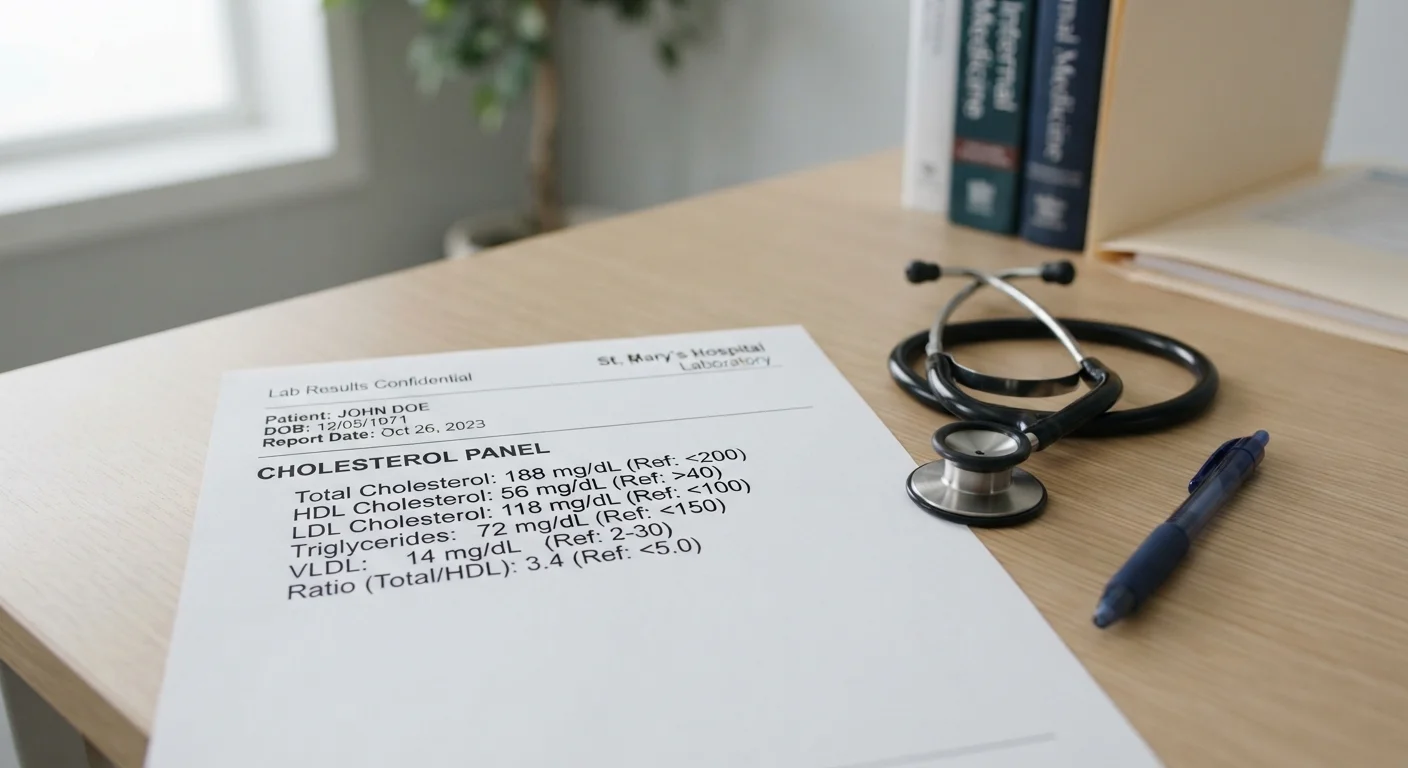
When your doctor orders a lipid panel - a standard blood test that measures fats circulating in your bloodstream - you receive four core figures: total cholesterol, LDL, HDL, and triglycerides. Each one tells a different part of your cardiovascular story. Understanding what each measures helps you have a more productive conversation with your clinician rather than staring at a lab printout trying to decode it alone.
| Desirable total cholesterol | Below 200 mg/dL (American Heart Association guidelines) |
| Optimal LDL level | Below 100 mg/dL (American Heart Association guidelines) |
| Protective HDL level | 60 mg/dL or above (American Heart Association guidelines) |
| Normal triglyceride range | Below 150 mg/dL (National Heart, Lung, and Blood Institute) |
| Fasting required for accurate test | Typically 9-12 hours (Standard clinical practice) |
| Recommended testing frequency (adults) | Every 4-6 years (more often if risk factors present) (U.S. Preventive Services Task Force) |
Cholesterol itself is not inherently harmful. It is a waxy, fat-like substance produced by the liver and consumed through food. Your body needs it to build cell membranes, produce hormones, and synthesize vitamin D. The concern arises when specific types accumulate in excess, potentially contributing to the buildup of arterial plaques - deposits that can narrow blood vessels and raise the risk of heart attack or stroke.
Much like a credit score summarizes your financial health in a single number, a lipid panel compresses complex biological information into a handful of figures - each requiring context to interpret correctly.
Breaking Down Each Measurement
Lipid panel
A blood test that measures cholesterol and triglyceride levels. It is routinely used to screen for cardiovascular disease risk and typically includes total cholesterol, LDL, HDL, and triglycerides.
LDL (Low-Density Lipoprotein)
A lipoprotein that carries cholesterol from the liver to the rest of the body. High LDL levels are associated with increased risk of arterial plaque buildup and cardiovascular disease.
HDL (High-Density Lipoprotein)
A lipoprotein that collects excess cholesterol from tissues and transports it back to the liver for elimination. Higher HDL levels are generally associated with lower cardiovascular risk.
Triglycerides
A type of fat (lipid) stored in the body and derived from excess dietary calories. Elevated triglyceride levels may increase the risk of heart disease, particularly when combined with other lipid abnormalities.
Arterial plaque
A buildup of fats, cholesterol, and other substances in and on artery walls. Over time, plaque can harden and narrow arteries, restricting blood flow and raising the risk of heart attack or stroke.
Cardiovascular risk profile
A comprehensive assessment of factors - including cholesterol levels, blood pressure, smoking status, diabetes, age, and family history - that together determine an individual's likelihood of developing heart disease.
LDL: Low-Density Lipoprotein
Often called "bad" cholesterol, LDL carries cholesterol from the liver to cells throughout the body. When LDL levels are elevated, excess cholesterol can deposit along arterial walls. According to the American Heart Association, an LDL below 100 mg/dL is generally considered optimal for most adults; levels above 160 mg/dL are typically classified as high. However, your clinician will interpret your LDL in the context of your overall cardiovascular risk profile - not as a standalone number.
HDL: High-Density Lipoprotein
HDL is often called "good" cholesterol because it transports excess cholesterol back to the liver for removal. Higher HDL is generally associated with lower cardiovascular risk. Most clinical guidelines consider HDL below 40 mg/dL in men and below 50 mg/dL in women to be a risk factor. Levels of 60 mg/dL or above are broadly viewed as protective, though HDL alone does not eliminate risk.
Triglycerides
Triglycerides are a type of fat derived from calories the body does not immediately use. Elevated levels - generally above 150 mg/dL - are associated with metabolic conditions and may compound cardiovascular risk, particularly when combined with low HDL or high LDL. Diet, alcohol intake, physical activity, and certain medications all influence triglyceride levels.
Total Cholesterol
Total cholesterol is the sum of all cholesterol types in your blood. A reading below 200 mg/dL is widely considered desirable; 200-239 mg/dL is borderline high; 240 mg/dL and above is classified as high. Because total cholesterol blends HDL, LDL, and a fraction of triglycerides, it is the least specific of the four values on its own.
For guidance on reading the dietary factors that influence these numbers, see what nutrition labels are actually telling you.
How Clinicians Use These Numbers Together
93 million
U.S. adults with total cholesterol above 200 mg/dL
According to data from the CDC and the American Heart Association's Heart Disease and Stroke Statistics.
~50%
Adults who have had their cholesterol checked in the past 5 years
Based on CDC surveillance data on preventive health screening behaviors among U.S. adults.
17%
U.S. adults with high LDL not receiving treatment
Highlighted in CDC reports on cholesterol management and treatment gaps in the American adult population.
No single cholesterol value determines your risk in isolation. Clinicians typically evaluate your lipid panel alongside other factors: age, sex, blood pressure, smoking history, diabetes status, and family history. Many use a validated risk calculator - such as the Pooled Cohort Equations endorsed by major cardiology organizations - to estimate your ten-year risk of a cardiovascular event before recommending any intervention.
Thresholds for treatment vary based on individual risk. Someone with existing heart disease may be advised to target an LDL below 70 mg/dL, while a young adult with no risk factors and borderline numbers may simply be advised to monitor with lifestyle changes. This is why the same lab result can lead to very different clinical recommendations depending on the patient.
This article is for general informational purposes only and does not constitute medical advice. Always consult a qualified healthcare professional to interpret your personal lab results and determine the most appropriate course of action for your health.