

Key Takeaways
- Lump-sum investing historically outperforms gradual contributions in rising markets, according to research.
- Dollar-cost averaging reduces the emotional and timing risk of investing a large sum all at once.
- Neither approach guarantees better returns - your risk tolerance and personal situation matter most.
- Having clear financial goals before investing helps determine which strategy fits your circumstances.
- Past market performance does not guarantee future results; consult a qualified financial adviser for personal guidance.
Our Verdict
Research generally favors lump-sum investing in markets that trend upward over time, but dollar-cost averaging remains a sound strategy for those who are risk-averse or emotionally uncomfortable deploying a large sum at once. The right choice depends less on market conditions and more on your financial goals, timeline, and ability to stay the course.
| Best for | Recommended |
|---|---|
| Investors with a long time horizon comfortable with short-term volatility | Lump-Sum Investing |
| Those who feel anxious about investing a windfall at the wrong moment | Dollar-Cost Averaging |
| Investors building habits with regular income rather than a windfall | Dollar-Cost Averaging |
What Each Strategy Actually Means
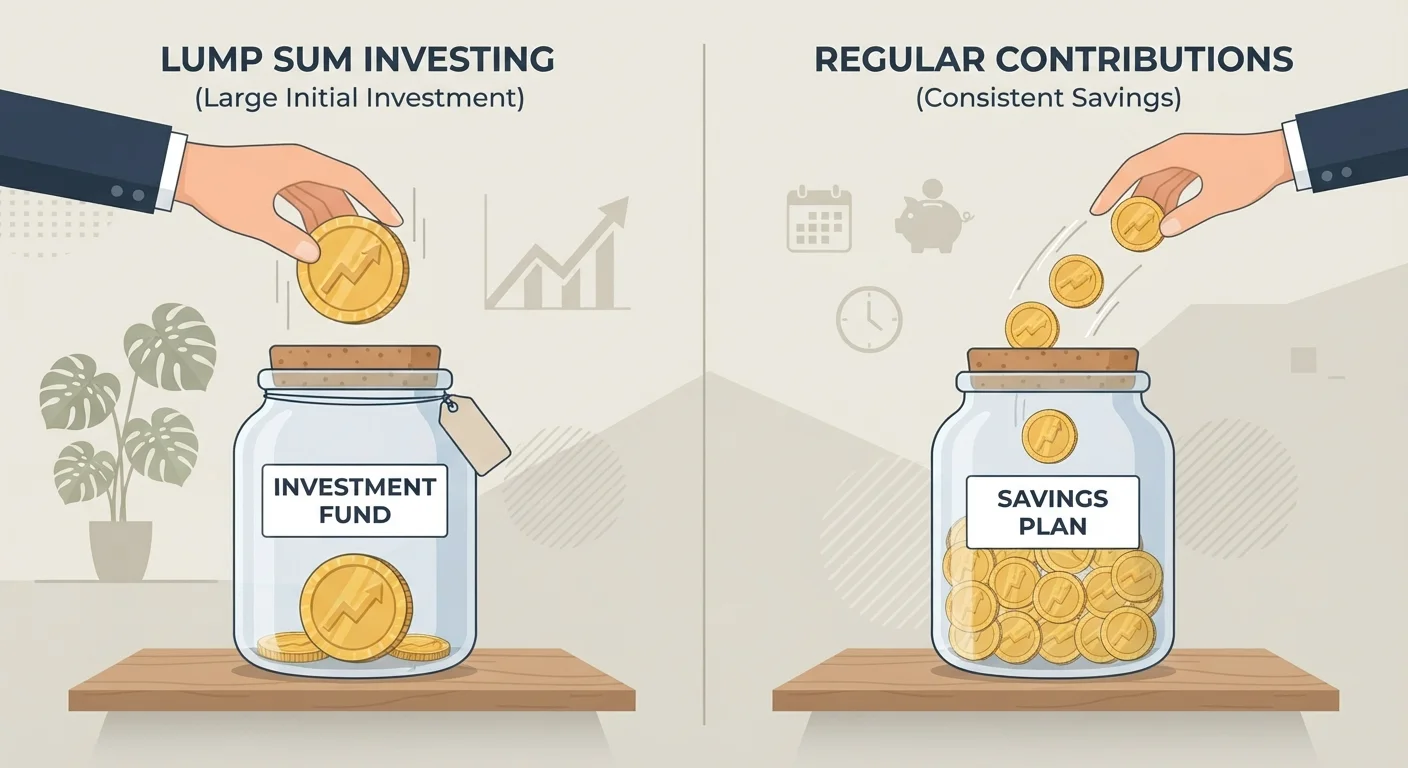
Lump-sum investing means deploying the full amount of available capital into the market at one time. If you receive an inheritance, a bonus, or proceeds from selling an asset, you invest the entire sum immediately rather than waiting.
Dollar-cost averaging (DCA) is the practice of dividing that sum into equal portions and investing them at regular intervals - weekly, monthly, or quarterly - over a set period. Instead of a single large transaction, you make many smaller ones regardless of what prices are doing.
These strategies are most relevant when you already have a lump sum to deploy. If you're building an investment habit from regular income, you're already dollar-cost averaging by default. See getting started with investing on a modest budget for that scenario. Before considering either approach, it's worth reviewing financial goals worth setting before you invest to make sure the foundations are in place.
The Case for Investing All at Once
The core argument for lump-sum investing rests on a straightforward observation: over long periods, diversified markets have generally trended upward. Every day your money sits on the sidelines, it is potentially missing out on that growth. Compound interest amplifies this dynamic - the earlier capital is invested, the longer it has to compound.
A frequently cited Vanguard analysis found that lump-sum investing outperformed dollar-cost averaging approximately two-thirds of the time across US, UK, and Australian markets over rolling 12-month periods, simply because markets rise more often than they fall. The margin of outperformance tended to widen over longer time horizons.
The practical implication: if you have a high risk tolerance, a long investment horizon, and the discipline to hold through short-term volatility, deploying capital immediately is often the mathematically stronger move.
Minimize Cash on the Sidelines
If you choose dollar-cost averaging, keep the uninvested portion in a high-yield savings account or money market fund rather than a standard checking account. This reduces the opportunity cost of delayed deployment and ensures the waiting cash is still working for you in the interim.
The Case for Spreading Contributions Over Time
Dollar-cost averaging addresses a real problem that pure math cannot: investor behavior. Studies in behavioral finance consistently show that people feel the pain of losses more acutely than the pleasure of equivalent gains - a concept known as loss aversion. Investing a large windfall the day before a significant market drop can trigger panic selling, which causes permanent harm to a portfolio.
By spreading investments over time, DCA reduces the risk of deploying all your capital at a market peak. You buy more shares when prices are low and fewer when prices are high, smoothing your average purchase price. This can also make it psychologically easier to stay invested - a factor that matters enormously for long-term outcomes.
DCA is also a logical fit if there's genuine uncertainty about whether you have a fully funded emergency reserve. Deploying every available dollar into markets before your safety net is solid is a separate risk worth weighing. The article on emergency fund versus investment account priorities walks through that decision in detail.
DCA Doesn't Eliminate Risk
Dollar-cost averaging reduces the risk of investing everything at a market peak, but it does not protect against sustained long-term market declines. It also doesn't guarantee a lower average cost than lump-sum investing. No strategy removes investment risk entirely, and all investing involves the possibility of loss.
How the Two Approaches Compare
The table below summarizes the key trade-offs across the dimensions most investors care about.
| Lump-Sum Investing | Dollar-Cost Averaging | |
|---|---|---|
| Historical performance | Outperforms ~2/3 of the time in rising markets | Underperforms lump sum in upward-trending markets |
| Timing risk | Full exposure to market at one moment | Risk spread across multiple purchase dates |
| Emotional difficulty | High - harder if market drops immediately after | Lower - smaller amounts feel less daunting |
| Opportunity cost | Minimal - capital invested immediately | Cash waiting to be deployed earns less |
| Complexity | Simple - one transaction | Requires a schedule and ongoing discipline |
| Best market environment | Trending upward over time | Volatile or declining short-term markets |
One factor the table doesn't capture is what happens to the cash while it waits during a DCA schedule. Keeping it in a high-yield savings account or money market fund - rather than a non-interest-bearing account - reduces the opportunity cost of not being fully invested. This is an important practical consideration if you choose the gradual approach.
For guidance on what a well-structured portfolio looks like once you're invested, see what a diversified portfolio actually looks like. And if you're deciding between index funds and other structures for either approach, index funds vs. actively managed funds covers that comparison directly.
Choosing What's Right for Your Situation
There is no universally correct answer. The research favoring lump-sum investing assumes a rational investor who will stay invested through volatility. If a large market drop shortly after investing would cause you to sell, the theoretical return advantage evaporates. Choosing an approach that keeps you invested and emotionally steady is often more valuable than chasing marginal statistical gains.
A few questions worth considering:
- What is your time horizon? Longer horizons generally support lump-sum investing, since there's more time to recover from any near-term downturn.
- How would you respond to an immediate 20% drop? Honest self-assessment of your risk tolerance matters more than abstract percentages.
- Do you have a financial safety net in place? Investing before an emergency fund is fully funded introduces a different kind of risk entirely.
- Is this a one-time windfall or part of an ongoing plan? Regular investors dollar-cost average naturally through paycheck contributions.
If market timing feels like the deciding factor, it's worth reading about why timing the market is harder than it sounds. For a broader view of how investment strategies evolve across life stages, saving and investing across every stage of adult life provides useful context.
This article is for general informational and educational purposes only and does not constitute personalized financial, investment, or tax advice. Consult a qualified, licensed financial adviser before making decisions based on your individual circumstances.