

Key Takeaways
- Index funds track a market benchmark passively; actively managed funds rely on manager decisions to try to beat that benchmark.
- Index funds typically carry significantly lower expense ratios than actively managed funds.
- Most actively managed funds underperform their benchmark index over long time horizons, net of fees.
- Active funds may offer more flexibility and potential for outperformance in less efficient market segments.
- Your time horizon, risk tolerance, and cost sensitivity should guide which approach fits your situation.
- Both fund types can coexist in a diversified portfolio depending on your financial goals.
Option A
Index Funds
The passive, low-cost market-tracking approach.
Best for: Long-term investors who want broad market exposure with minimal fees and hands-off management.
Option B
Actively Managed Funds
The research-driven, manager-selected portfolio approach.
Best for: Investors who believe skilled managers can outperform the market and are willing to pay higher fees for that potential.
If you're a long-term, cost-conscious investor building retirement savings
Index Funds
Low expense ratios compound favorably over decades, and broad market exposure reduces the risk of any single manager's poor decisions affecting your outcome.
If you want exposure to niche or less liquid market segments
Actively Managed Funds
Active managers may add value in markets where pricing inefficiencies are more common, such as small-cap international stocks or certain bond categories.
If you're new to investing and prefer simplicity
Index Funds
Index funds require no ongoing manager evaluation and provide instant diversification, making them a straightforward starting point for new investors.
If you have a specific short-term tactical goal and can tolerate higher fees
Actively Managed Funds
An active manager may be better positioned to respond to short-term market dislocations, though this involves higher costs and no guarantee of success.
How Each Approach Works
Understanding the difference starts with what each fund is actually doing with your money. If you're new to funds in general, our plain-language guide to stocks, bonds, and funds covers the foundational concepts.
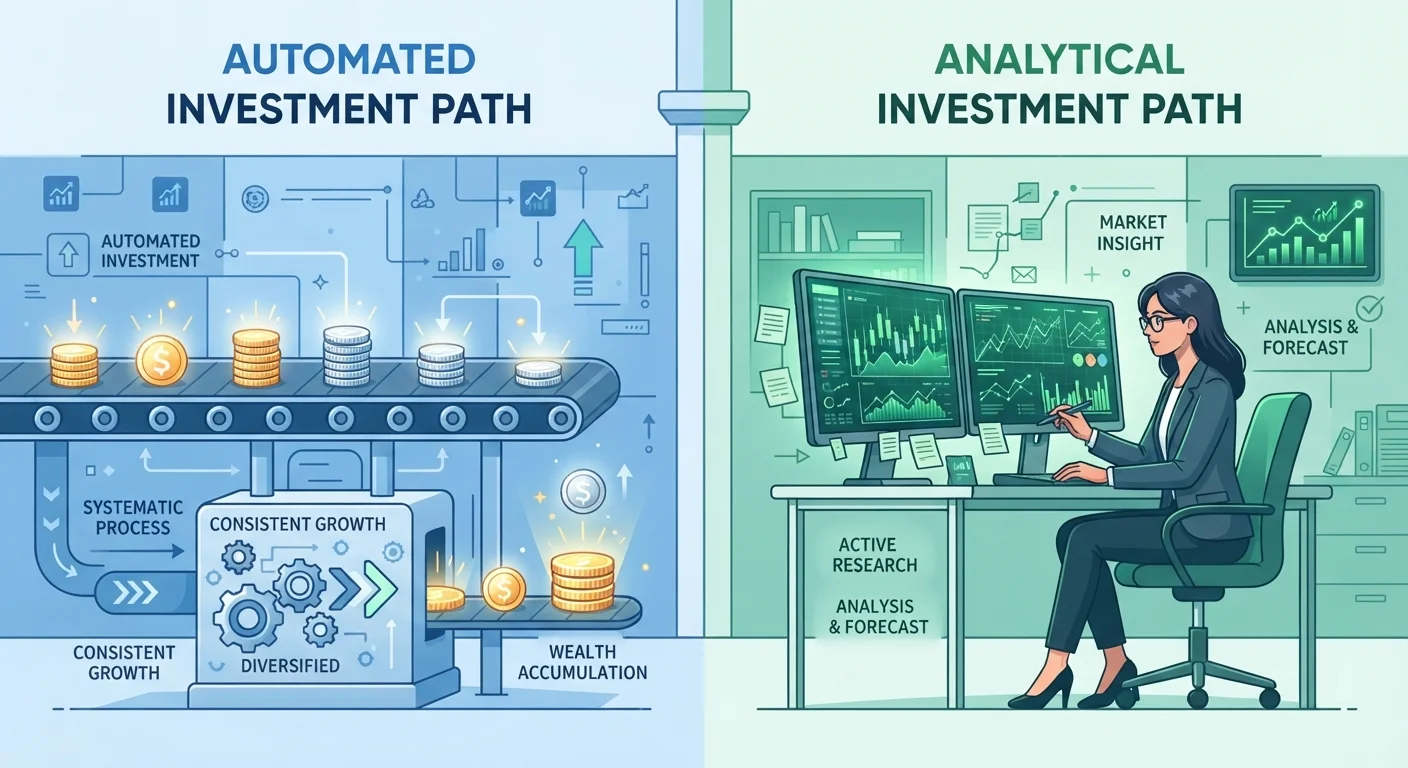
An index fund is designed to replicate the performance of a specific market index - such as the S&P 500, which tracks 500 large U.S. companies. The fund holds the same securities in roughly the same proportions as the index. There's no manager making calls about which stocks to buy or sell; the portfolio is adjusted only when the index itself changes. This is called passive investing.
An actively managed fund, by contrast, employs a portfolio manager (or team) who uses research, analysis, and judgment to select securities they believe will outperform the market. The goal is to generate returns that beat the relevant benchmark. This is called active investing.
| Criterion | Index Funds | Actively Managed Funds |
|---|---|---|
| Management style | Passive - tracks an index | Active - manager selects securities |
| Typical expense ratio | 0.03%-0.20% | 0.50%-1.50% or higher |
| Goal | Match market returns | Beat market returns |
| Trading frequency | Low - mirrors index changes | High - based on manager decisions |
| Long-term performance vs. benchmark | Matches benchmark minus fees | Most underperform net of fees |
| Transparency | High - holdings mirror index | Variable - disclosed periodically |
| Flexibility | Low - bound to index rules | High - manager has discretion |
The Cost Difference - and Why It Matters
One of the starkest contrasts between the two approaches is cost. Every fund charges an expense ratio - an annual fee expressed as a percentage of your investment. For index funds, expense ratios are often a fraction of a percent. For actively managed funds, they're typically much higher, reflecting the cost of research teams, trading activity, and manager compensation.
~0.05%
Average index fund expense ratio
According to Morningstar's annual fund fee study, asset-weighted average costs for passive funds have fallen dramatically over the past decade.
~85%
Active large-cap funds underperforming over 15 years
S&P Dow Jones Indices' SPIVA reports consistently show that a large majority of actively managed U.S. large-cap funds trail the S&P 500 over 15-year periods, net of fees.
1%+
Annual fee difference, active vs. passive
A 1 percentage point annual fee gap can reduce a portfolio's ending value by tens of thousands of dollars over a 30-year investment horizon due to compounding.
This gap matters more than it might appear. Fees are deducted from returns before you see them, so even a 1% annual difference compounds significantly over 20 or 30 years. A portfolio growing at 7% annually before fees will deliver meaningfully less to an investor paying 1.2% in fees versus one paying 0.05%.
It's also worth understanding that higher fees don't automatically translate to better performance. In fact, research consistently shows that most actively managed funds underperform their benchmark index over long periods, once fees are accounted for. This doesn't mean active management never adds value - but the burden of proof is on the fund to demonstrate it.
When Active Management May Have an Edge
The case for active management is strongest in less efficient markets - places where information isn't as widely available or pricing isn't as competitive. Certain segments, such as small-cap international stocks or specialized bond markets, may offer more opportunity for a skilled manager to identify mispriced securities.
Active funds can also respond to changing conditions more quickly than an index fund, which is bound to its benchmark. During periods of significant market disruption, some active managers have preserved capital better by reducing exposure to deteriorating assets - though this is far from guaranteed and depends heavily on the individual manager's skill and timing.
Some investors also prefer active funds for specific tax strategies or income objectives that require more tailored portfolio construction than a passive index can provide. That said, these scenarios are specific and nuanced - not a blanket argument for active management across all situations.
For context on how these choices fit a broader strategy, see our explainer on what a diversified portfolio actually looks like.
Active Fund Performance Varies Widely
Aggregate statistics about active fund underperformance reflect averages across thousands of funds - some active managers do outperform their benchmarks over sustained periods. The challenge for investors is identifying those managers in advance, before the outperformance occurs. Past outperformance by a specific fund or manager is not a reliable predictor of future results, and manager changes, fund size growth, and shifting market conditions can all erode a historical edge.
Choosing What Fits Your Situation
Neither index funds nor actively managed funds are universally right or wrong. The appropriate choice depends on your goals, time horizon, tolerance for fees and risk, and how much confidence you place in active management's ability to outperform. These are factors worth discussing with a qualified financial adviser who can assess your specific circumstances.
Many investors use a core-and-satellite approach: building a low-cost index fund base for the majority of their portfolio, then adding a smaller allocation to active funds in areas where they believe targeted expertise may add value. This isn't a strategy recommendation - it's simply one structural approach worth understanding.
If you're still deciding whether investing is the right next step at all, our article on the difference between saving and investing can help you frame the bigger picture. And once you're ready to think about how to deploy capital, lump-sum investing versus spreading contributions over time addresses another common decision point.
This article is for general informational and educational purposes only and does not constitute personalised financial, investment, or tax advice. Past performance does not guarantee future results. Please consult a licensed financial adviser before making decisions based on your individual situation.