

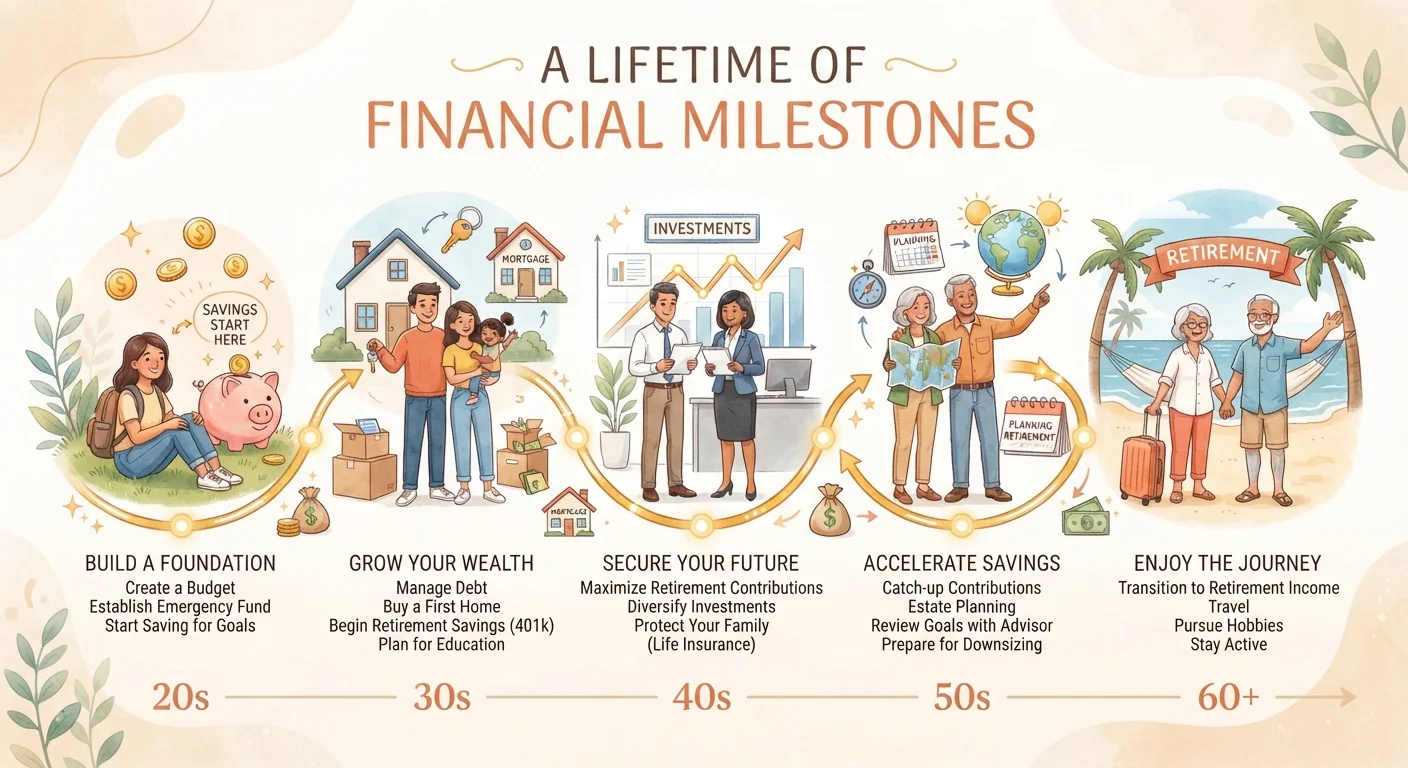
Key Takeaways
- The right financial strategy depends heavily on your current life stage and near-term obligations.
- In your twenties, establishing saving habits and starting to invest early creates long-term compounding advantages.
- Your thirties and forties typically require balancing debt paydown, family costs, and retirement contributions simultaneously.
- Tax-advantaged accounts like 401(k)s and IRAs are important tools at every stage but especially valuable early.
- Shifting toward capital preservation in your fifties is generally appropriate as retirement approaches.
- A licensed financial adviser can help tailor these general principles to your specific circumstances.
Why Life Stage Matters for Your Money
Personal finance is not one-size-fits-all. A strategy well suited to a 25-year-old with no dependents can be financially damaging for a 55-year-old within a decade of retirement. The variables that shape smart financial decisions - income stability, time horizon, risk tolerance, and obligations - all shift meaningfully as life progresses.
Understanding how your priorities are likely to evolve lets you make proactive adjustments rather than reactive ones. This guide walks through the core saving and investing considerations at each major life stage, from early adulthood through retirement. It is intended as general financial education, not personalized advice - for decisions specific to your situation, consulting a licensed financial adviser is strongly recommended.
$0
Minimum to open many index fund accounts
Many brokerage firms now offer accounts with no minimum balance requirement, removing a common barrier to starting early.
10x
Potential growth difference from starting at 25 vs. 35
Compound interest over additional decades can dramatically amplify investment returns, illustrating why time in the market matters.
15%
Commonly cited savings rate guideline (including employer match)
Many financial planning frameworks suggest targeting around 15% of gross income toward retirement savings, though the right figure varies by individual goals and timeline.
Your Twenties: Building the Foundation
Early adulthood is the most powerful window for long-term wealth building - not because incomes are high (they often aren't), but because time is the most valuable financial asset available to you. Money invested in your twenties has decades to compound before retirement.
Key priorities in your twenties
- Build an emergency fund first. A cash reserve covering three to six months of essential expenses prevents you from derailing long-term investments to cover short-term shocks.
- Start investing early, even in small amounts. Starting with a modest budget is more effective than waiting until you feel ready.
- Capture any employer match. If your employer offers a 401(k) match, contributing at least enough to receive the full match is widely considered a baseline step - it represents direct additional compensation.
- Manage debt strategically. High-interest debt (such as credit cards) typically warrants prioritization before aggressive investing, while lower-interest debt like federal student loans may be manageable alongside saving.
Building consistent saving habits during this decade creates behavioral foundations that compound alongside your financial ones.
Set up automatic contributions to a retirement account before your paycheck hits your checking account. When you never see the money, you rarely miss it - and consistency matters far more than timing the market.
Behavioral research consistently shows that automation overcomes the single biggest obstacle to saving: inertia. This is one of the highest-leverage habits to establish in your twenties.
When your income increases - a raise, a bonus, a new job - direct a meaningful portion of that increase straight to savings before your lifestyle adjusts to the new level.
Lifestyle inflation is one of the most common reasons higher earners still struggle to build wealth. Capturing income increases at the source prevents spending from automatically expanding to fill them.
Your Thirties: Balancing Competing Priorities
The thirties often bring the most complex financial picture: career advancement, mortgage decisions, growing families, and retirement goals all compete for the same dollars. The challenge is not choosing one priority but sequencing them intelligently.
Common financial considerations in your thirties
- Maximize tax-advantaged retirement contributions. Understanding how tax-advantaged accounts work can meaningfully improve long-term returns without requiring more risk.
- Revisit your investment allocation. A portfolio appropriate at 22 may carry more or less risk than makes sense at 35. Periodic rebalancing - realigning your holdings to your target allocation - keeps your portfolio aligned with your goals.
- Plan for major expenses deliberately. Home purchases, childcare, and education savings (such as 529 plans) benefit from dedicated accounts and clear timelines rather than being funded reactively.
Avoid Neglecting Retirement While Managing Near-Term Costs
It can be tempting to pause retirement contributions during financially stretched years - when childcare costs peak or a mortgage payment is new and large. However, years of missed contributions and foregone compounding can be difficult to recover later. Even reducing contributions temporarily rather than stopping entirely preserves more long-term momentum.
Before expanding investments, it is worth reviewing the financial foundations that should ideally be in place first.
Your Forties: Accelerating Wealth Building
For many people, the forties represent peak earning years - making this decade an important opportunity to accelerate progress toward retirement. With roughly two decades until traditional retirement age, there is still meaningful time for growth while also beginning to think more carefully about risk.
What to focus on in your forties
- Increase retirement contributions if possible. The IRS allows higher catch-up contribution limits for 401(k)s and IRAs once you reach age 50, but getting close to the standard annual limits before then is still impactful.
- Diversify beyond retirement accounts. Taxable brokerage accounts offer flexibility that retirement accounts don't - access before age 59½ without penalties, for instance - making them a useful complement.
- Reassess your risk exposure. A portfolio heavily weighted toward equities (stocks) may warrant gradual adjustment as retirement moves from abstract to concrete. The general principle is that as your time horizon shortens, preserving gains becomes more important relative to chasing growth.
- Protect what you've built. Life, disability, and long-term care insurance become increasingly relevant in this decade as assets grow and dependents remain.
“The investor's chief problem - and even his worst enemy - is likely to be himself. The risk of paying too high a price for good-quality stocks is not the only risk an investor faces.”
— Benjamin Graham, Author of 'The Intelligent Investor' and pioneer of value investing
Your Fifties and Beyond: Preparing for Retirement
The decade before retirement is often called the transition zone - the period in which shifting from accumulation (growing wealth) to distribution (using it) begins in earnest. Decisions made here can have lasting consequences, so careful planning matters more than ever.
Critical steps as retirement approaches
- Use catch-up contributions. Once you turn 50, the IRS permits additional contributions to 401(k)s and IRAs above the standard limits. These catch-up provisions exist precisely for this stage of life.
- Stress-test your retirement income plan. Understanding how much you'll need, what sources of income you'll draw on (Social Security, retirement accounts, savings, pensions if applicable), and how long your assets need to last helps identify gaps early enough to address them.
- Plan your Social Security claiming strategy. Claiming Social Security benefits earlier results in permanently lower monthly payments; delaying - up to age 70 - increases them. The optimal choice depends on health, other income sources, and personal circumstances.
- Shift toward capital preservation. A portfolio that was growth-oriented at 40 may be too volatile for someone who will need to begin drawing from it within a few years.
Consider a Retirement Income Simulation
Many nonprofit financial planning resources and government websites offer free retirement income calculators. Running a simulation with conservative return assumptions - rather than optimistic ones - gives you a more realistic picture of whether your current trajectory is on track. Adjust inputs as your circumstances change.
This article is for general informational and educational purposes only. It is not personalized financial, investment, tax, or legal advice. Individual circumstances vary significantly - please consult a qualified financial adviser, accountant, or attorney before making decisions about your own money.
Principles That Apply at Every Stage
While the specific tactics change at each life stage, several foundational principles hold regardless of age or income level.
- Automate what you can. Automated transfers to savings and investment accounts remove the friction that derails good intentions.
- Keep costs low. Investment fees compound just as returns do - in the wrong direction. Understanding expense ratios and other costs is part of evaluating any investment vehicle.
- Diversify broadly. Spreading investments across asset classes and geographies reduces the impact of any single loss. Diversification does not eliminate risk but can help manage it.
- Revisit your plan regularly. A financial plan is a living document. Life changes - income shifts, family events, market movements - warrant periodic review and adjustment.
- Know when to get professional help. General principles provide a useful framework, but a licensed financial adviser can translate them into a plan tailored to your specific situation, goals, and tax circumstances.
IRS Retirement Plans Information
The IRS website provides authoritative, current details on contribution limits, account rules, and tax treatment for 401(k)s, IRAs, and other retirement vehicles.
Social Security Administration Retirement Estimator
The SSA's official tool lets you estimate your future Social Security benefits based on your actual earnings record, helping inform your retirement income planning.
CFPB Financial Education Resources
The Consumer Financial Protection Bureau offers plain-language guides on budgeting, saving, credit, and debt - useful across every life stage.