

Key Takeaways
- Saving prioritises safety and accessibility; investing prioritises long-term growth.
- Both carry trade-offs: savings earn modest returns, while investments carry risk of loss.
- A financial safety net - typically three to six months of expenses - is usually established before investing.
- Inflation can erode the purchasing power of money left purely in savings over time.
- Tax-advantaged accounts can make investing more efficient for long-term goals.
- Most financial plans benefit from using both strategies simultaneously, not choosing one over the other.
Saving vs. Investing
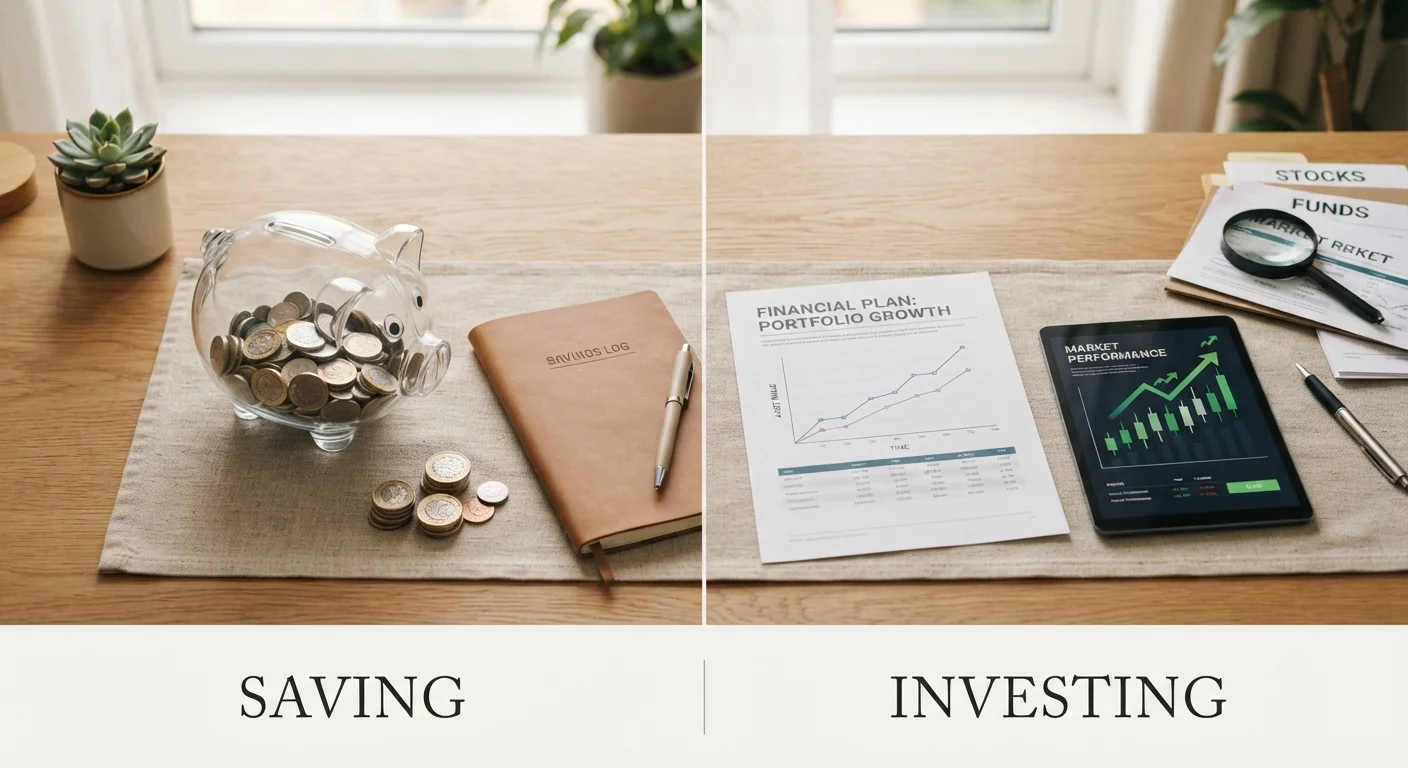
Saving means setting aside money in a safe, accessible place - typically a bank account - where its value stays stable. Investing means putting money into assets like stocks, bonds, or funds with the expectation that it may grow over time, though it also carries the risk of loss. The two strategies work together but serve different financial needs.
In finance, 'saving' refers to accumulating liquid, low-risk capital, while 'investing' involves deploying capital into instruments that carry market risk in exchange for potential returns above inflation.
Two Tools, Two Jobs
Saving and investing are often mentioned in the same breath, but they are fundamentally different tools designed for different financial jobs. Mixing them up - or treating them as interchangeable - can leave gaps in an otherwise thoughtful financial plan.
At its core, saving is about preservation and access. When you deposit money into a savings account or money market account, the goal is to keep that money intact and available when you need it. Returns are modest, but so is the risk. Investing, by contrast, is about growth over time. When you put money into stocks, bonds, mutual funds, or exchange-traded funds (ETFs), you are accepting some level of risk in exchange for the potential of higher returns.
Neither approach is inherently better. They simply serve different purposes - and understanding those purposes is the foundation of building financial confidence.
Not a Rivalry - A Partnership
Framing saving and investing as competing strategies is one of the most common misconceptions in personal finance. In practice, they work best when used together: savings provide stability and accessibility, while investments build long-term purchasing power. Most financial plans benefit from both running simultaneously, even if the amounts in each vary by life stage.
What Saving Actually Does
A savings account, high-yield savings account, or certificate of deposit (CD) keeps your money liquid (easily accessible) and protected. In the United States, deposits at FDIC-insured institutions are covered up to $250,000 per depositor, per bank, offering strong protection against institutional failure.
Saving is best suited for:
- Emergency funds - money set aside for unexpected expenses like medical bills or job loss
- Short-term goals - a vacation, a car down payment, or home repairs planned within one to three years
- Monthly cash flow buffers - extra cushion to avoid overdrafts or high-interest debt
The trade-off is that savings accounts typically earn interest rates that may not keep pace with inflation. Over many years, money held purely in cash can lose purchasing power in real terms, even if the nominal dollar amount stays the same or grows slightly.
For guidance on whether to prioritise building your safety net before putting money to work, see our side-by-side breakdown of emergency funds vs. investment accounts.
What Investing Actually Does
Investing means putting money into assets that have the potential to grow in value or generate income over time. Common investment vehicles include individual stocks, bonds, mutual funds, ETFs, and real estate. Each carries its own risk profile and return potential.
The central advantage of investing is the possibility of outpacing inflation over long periods. Historically, diversified equity portfolios have grown faster than inflation over multi-decade timeframes - though this pattern is not guaranteed to continue, and all investments carry risk of loss.
Investing is generally most appropriate for:
- Long-term goals - retirement savings, college funding, or wealth accumulation over ten or more years
- Money you won't need in the near term - so market volatility has time to even out
- Growth beyond what savings rates offer - when preserving purchasing power is a priority
~55%
US adults who own investments
Gallup polling has consistently found that roughly half to slightly more than half of American adults report owning stocks, either directly or through funds and retirement accounts.
3-6 months
Recommended emergency fund coverage
Financial educators broadly recommend holding three to six months of essential living expenses in accessible savings before prioritising investment contributions.
$0
Minimum to open many investment accounts
A number of brokerage platforms have removed minimum deposit requirements, lowering the barrier for new investors to begin with whatever they can set aside.
Account structure also matters. Tax-advantaged accounts such as IRAs and 401(k)s can shelter investment returns from certain taxes, potentially compounding your growth more efficiently over time.
If you're concerned that investing seems out of reach, our article on getting started with investing on a modest budget explores practical first steps. It's also worth reviewing common investing myths that keep people on the sidelines.
Why You Need Both - and How They Fit Together
The most important insight isn't choosing saving or investing - it's understanding how they complement each other in a complete financial picture.
A widely cited framework suggests establishing a liquid emergency fund first, then directing additional dollars toward investments aligned with longer-term goals. This sequencing protects you from having to sell investments at a potential loss during a financial emergency.
As your life circumstances evolve, the balance between saving and investing typically shifts. Early in a career, the priority might be building a safety net and starting to invest small amounts consistently. Later, as income grows and short-term obligations are covered, the proportion directed toward investing may increase. Our end-to-end guide on saving and investing across every stage of adult life covers how priorities shift decade by decade.
If you want to build the savings habit that makes all of this possible, our guide to building a saving habit that actually sticks offers a structured approach.
“Do not save what is left after spending, but spend what is left after saving.”
— Warren Buffett, Chairman and CEO, Berkshire Hathaway; widely cited investor and financial educator
This article is for general informational and educational purposes only and does not constitute personalised financial, investment, tax, or legal advice. Consult a licensed financial adviser or other qualified professional before making decisions based on your individual circumstances.