

Key Takeaways
- Most travelers underestimate trip costs by anchoring too heavily on flight and hotel prices alone.
- Airport meals, local transport, and activity fees are among the most consistently underbudgeted categories.
- Building a buffer of 15–20% above your estimated total is a widely recommended planning practice.
- Currency exchange decisions and dynamic pricing can significantly affect what you actually spend.
- A structured pre-trip cost audit — by category — catches gaps that intuitive budgeting misses.
Why the Headline Price Is Never the Whole Story
Most travelers begin budgeting with a flight fare and a hotel rate. Those two numbers feel concrete, and once they're locked in, the mental accounting often stops. But research on consumer spending behavior consistently shows that people underweight irregular, context-specific costs — exactly the category that dominates travel spending once you're actually on the ground.
The problem isn't carelessness. It's a structural gap between how trips are marketed (a fare, a nightly rate) and how they're experienced (dozens of small transactions across two weeks). For a deeper look at how a real travel budget actually breaks down by category, see how travel budgets actually break down.
Budgeting only for flights and accommodation, treating everything else as incidental.
Why it happens: Booking platforms surface flight and hotel costs prominently, so travelers treat them as the budget. Secondary costs feel too variable to estimate in advance.
Underestimating the cost of travel nodes — airports, stations, and tourist-dense areas.
Why it happens: Travelers mentally compare prices to their home city or recent experience, not to captive-market environments where competition is limited and pricing is elevated.
Ignoring local transport as a significant cumulative expense.
Why it happens: Individual fares seem trivial, so travelers don't project them across an entire itinerary. A single taxi looks cheap; fifteen taxis across two weeks does not.
Treating activity and entrance fees as optional until arrival.
Why it happens: Activities feel like a nice-to-have during planning, but in practice travelers almost always pay them — especially for marquee sites they've traveled specifically to visit.
Failing to account for currency exchange costs and dynamic pricing losses.
Why it happens: Exchange rates and fees are invisible at the transaction level — a purchase feels like it costs X, when the effective cost including margin and fees is meaningfully higher.
The Spending Categories That Blow Budgets Most Often
Once you understand why underestimation happens, the next step is mapping the specific categories where the gap tends to be largest.
15–20%
Recommended contingency buffer above estimated trip cost
Travel financial planning guides broadly recommend this range to account for unplanned expenses, price fluctuations, and spontaneous decisions during a trip.
~30–60%
Premium on food at airports vs. equivalent meals elsewhere
Consumer travel research consistently documents elevated pricing at captive-market food venues such as airport terminals and major transit hubs.
Local transport is one of the most underbudgeted line items in any trip. Travelers often price out a single airport transfer, then stop. But taxis, ride-hail services, metro fares, and ferry tickets across a multi-day itinerary add up to sums that can rival a night's accommodation. Currency exchange decisions compound this — if you're losing margin every time you convert money, those small transport fares cost more than they appear. The decisions most travelers get wrong about currency exchange often happen quietly, without the traveler noticing the cumulative impact.
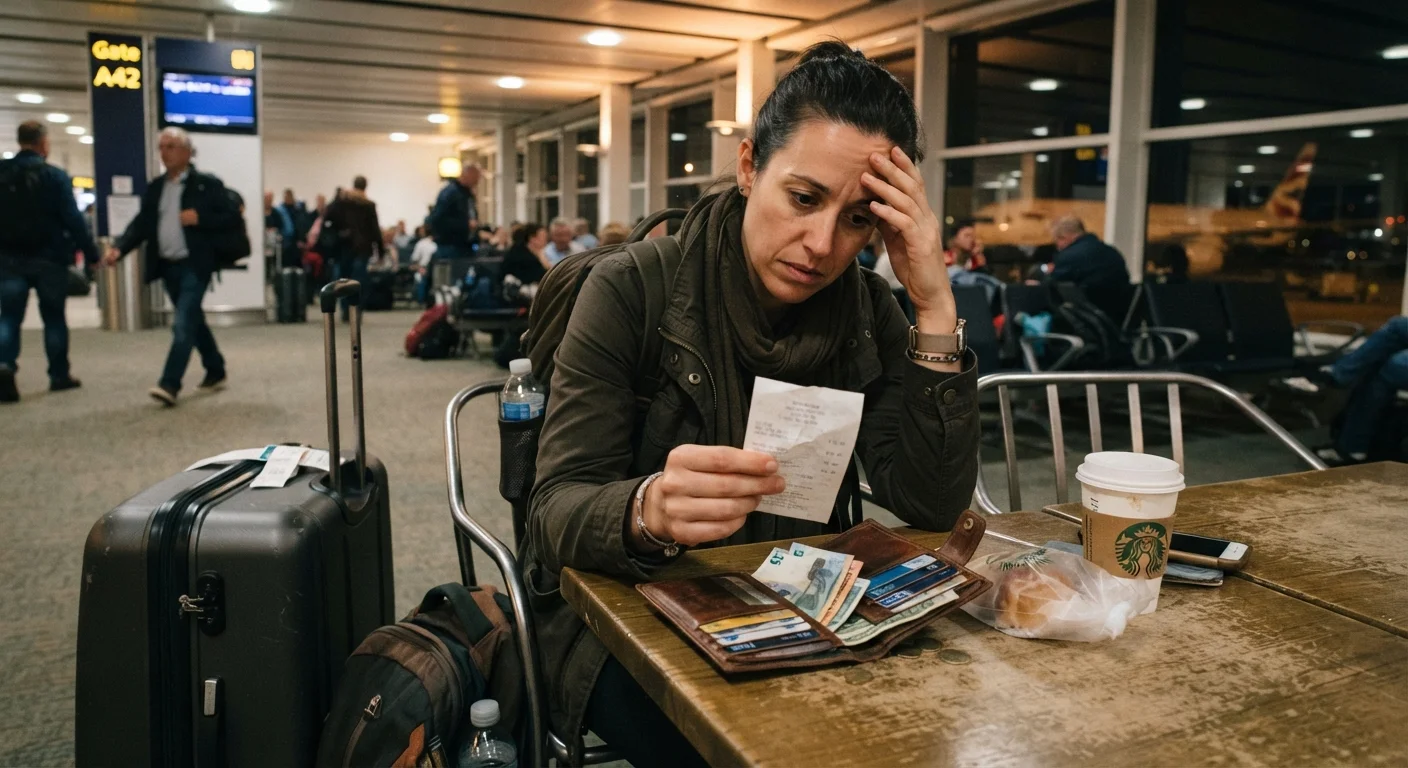
Food and drink at travel nodes — airports, train stations, tourist-area restaurants — consistently run 30–60% above equivalent meals elsewhere. A single airport layover can add $40–$60 in food costs that no one budgeted for. Activity and entrance fees are frequently treated as optional until travelers are standing in front of something they've traveled hours to see.
Dynamic Pricing Changes Costs After You Budget
Many travel costs — ride-hail fares, attraction tickets, and even some restaurant menus — use dynamic pricing that shifts with demand. A budget built on off-peak estimates can be inaccurate by the time you actually travel. Build flexibility into your estimates rather than anchoring to a single quoted price.
For cruise travelers, these dynamics are especially pronounced. Headline fares routinely exclude gratuities, specialty dining, shore excursions, and drinks packages — costs that can double the apparent price of a voyage. The real cost of a cruise holiday breaks this down in detail.
A Practical Framework for Correcting Your Estimates
The most reliable correction is a category-by-category audit done before you finalize any budget. Rather than estimating a single daily spend, build line items: accommodation, flights, local transport (per day, multiplied), food (separated by meal type and venue), activities and admissions, travel insurance, and incidentals.
After totaling those categories, apply a contingency buffer. A commonly recommended range is 15–20% above your estimated total — not as spending permission, but as a realistic acknowledgment that dynamic pricing, spontaneous decisions, and minor emergencies are part of travel. If you don't use it, you've simply come in under budget.
Reviewing travel planning assumptions before you go also helps. Common beliefs about when to book, how to estimate costs, and how flexible plans should be don't always hold up. The myths about travel planning that make trips harder than they need to be is a useful companion read before committing to a budget framework.
A Buffer Is Not a Spending Target
Adding a contingency line to your budget is a risk management practice, not an invitation to spend more. Treat your itemized estimate as the plan and the buffer as insurance. Travelers who conflate the two tend to spend up to the inflated total rather than finishing under their real estimate.
For broader travel preparation — from packing and visas to navigating transit — the Travel Know-How hub covers the practical essentials most travelers overlook in the planning phase.