

| City orientation system | Riverside / Lakeside / Upriver / Downriver (Standard local usage; compass directions are rarely used) |
| Oldest neighborhood | French Quarter, founded 1718 |
| Historic streetcar lines | St. Charles and Canal Street lines still in service |
| Noisiest area for visitors | Bourbon Street, French Quarter |
| Largest urban park | City Park (Mid-City), approx. 1,300 acres |
| Live music hub (local preference) | Frenchmen Street, Faubourg Marigny |
How New Orleans Is Organized
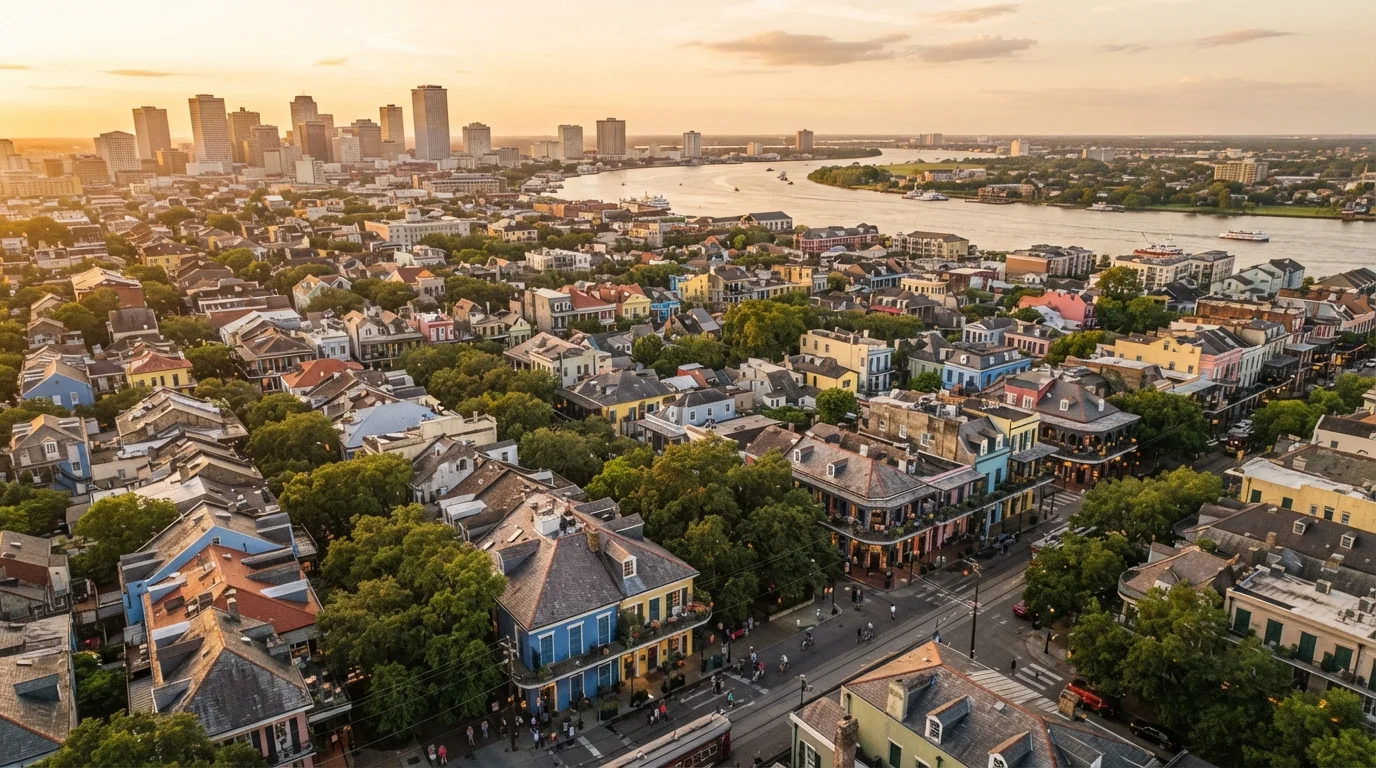
New Orleans sits in a crescent bend of the Mississippi River, which is why locals use "riverside" and "lakeside" rather than compass directions. The city is divided into neighborhoods that vary dramatically in character, noise level, walkability, and visitor infrastructure — knowing these differences before you book accommodation or plan itineraries makes a meaningful practical difference.
The districts covered here form the core of what most travelers encounter: the historic French Quarter, the residential Tremé, the nightlife corridor of Faubourg Marigny and Bywater, the broad Garden District, and the centrally located Mid-City. Each has a legitimate claim on your time, but for different reasons.
| City orientation system | Riverside / Lakeside / Upriver / Downriver (Standard local usage; compass directions are rarely used) |
| Oldest neighborhood | French Quarter, founded 1718 |
| Historic streetcar lines | St. Charles and Canal Street lines still in service |
| Noisiest area for visitors | Bourbon Street, French Quarter |
| Largest urban park | City Park (Mid-City), approx. 1,300 acres |
| Live music hub (local preference) | Frenchmen Street, Faubourg Marigny |
French Quarter, Tremé, and the Creole Neighborhoods
French Quarter (Vieux Carré): The Quarter is the city's oldest neighborhood, laid out in 1718 on a grid that remains largely intact. Its Spanish Colonial architecture — most structures date from after the 1788 and 1794 fires — features the signature ironwork balconies visitors associate with New Orleans. Bourbon Street is loud, heavily touristed, and active until very late; Royal Street and Chartres Street offer antique galleries, restaurants, and considerably more atmosphere. Staying in the Quarter puts you within walking distance of most major landmarks but expect street noise and premium accommodation prices.
Tremé: Directly behind the Quarter, Tremé is widely regarded as the oldest African American neighborhood in the United States and a foundational source of jazz culture. It is quieter, more residential, and less geared toward visitors — which is precisely its appeal for travelers who want neighborhood-level authenticity. Congo Square (now within Louis Armstrong Park) and St. Augustine Church are historically significant anchors. Tremé rewards explorers willing to go beyond the Quarter's edges.
Shotgun house
A narrow rectangular home, typically one room wide, with rooms arranged in a straight line front to back. The style is closely associated with New Orleans vernacular architecture and is common throughout Tremé, Marigny, and Bywater.
Creole cottage
A low-profile, four-room structure set close to the street without a porch setback, reflecting the French and Spanish colonial building tradition of early New Orleans.
Vieux Carré
French for "Old Square," the formal name for the French Quarter. The Vieux Carré Commission oversees architectural preservation within its boundaries.
Faubourg
A French term meaning "suburb" or "outer neighborhood," used historically for the districts that grew up adjacent to the original city grid. Faubourg Marigny and Faubourg Tremé are both examples.
For a deeper framework on researching neighborhoods before you visit, see our destination research guide.
Faubourg Marigny, Bywater, and the Frenchmen Street Scene
Faubourg Marigny sits immediately downriver from the Quarter and centers on Frenchmen Street, a three-block stretch of live music venues that many locals prefer over Bourbon Street for hearing actual New Orleans jazz, brass band, and R&B performances. The neighborhood is walkable from the Quarter and has a relaxed, slightly bohemian character with corner bars and colorful Creole cottages.
Bywater, further downriver, has attracted artists and younger residents over the past two decades. It is less immediately tourist-ready than Marigny but has strong restaurant options and a distinctive visual character of painted shotgun houses. Travelers comfortable navigating a working-class neighborhood will find it rewarding.
1718
Year New Orleans was founded
The city's original grid, now the French Quarter, was established by French colonial authorities and remains largely intact today.
~1,300 acres
Size of City Park in Mid-City
City Park is one of the largest urban parks in the United States, larger than Central Park in New York City.
3 blocks
Length of Frenchmen Street's live music strip
Despite its compact size, Frenchmen Street hosts multiple music venues operating nightly and is widely regarded as the city's authentic live music corridor.
Garden District, Uptown, and Mid-City
Garden District: Developed by American merchants in the early 19th century who wanted to distinguish themselves from Creole culture downtown, the Garden District is defined by Greek Revival and Italianate mansions set behind ornate iron fences on wide, oak-shaded streets. Magazine Street, its commercial spine, runs through Uptown and offers independent boutiques, cafes, and restaurants. It is a quieter base than the Quarter, well-served by the historic St. Charles streetcar line.
Mid-City is the geographic center of the city — flat, residential, and home to City Park, one of the largest urban parks in the United States. The New Orleans Museum of Art and the Sculpture Garden sit within it. Mid-City's Bayou St. John corridor has a neighborhood-coffee-shop energy that reflects daily city life more than the tourist districts. Visitors staying here need the Canal Street streetcar or ride-shares to reach the Quarter efficiently.
Understanding how to weigh an urban district against a quieter residential area is a framework that applies broadly — much as travelers navigating the tradeoffs between Paris and provincial France face a similar set of decisions about noise, pace, and access to local life.
Safety and Flooding Awareness
Like all destinations, New Orleans neighborhoods vary in safety profiles that can shift block by block. Flooding risk also differs meaningfully across the city — Mid-City and Bywater sit at lower elevations than the French Quarter or the Garden District's natural levee. Travelers are encouraged to consult current travel advisories and local sources before choosing where to stay, and to verify any weather or storm-season considerations with official sources before arrival.