

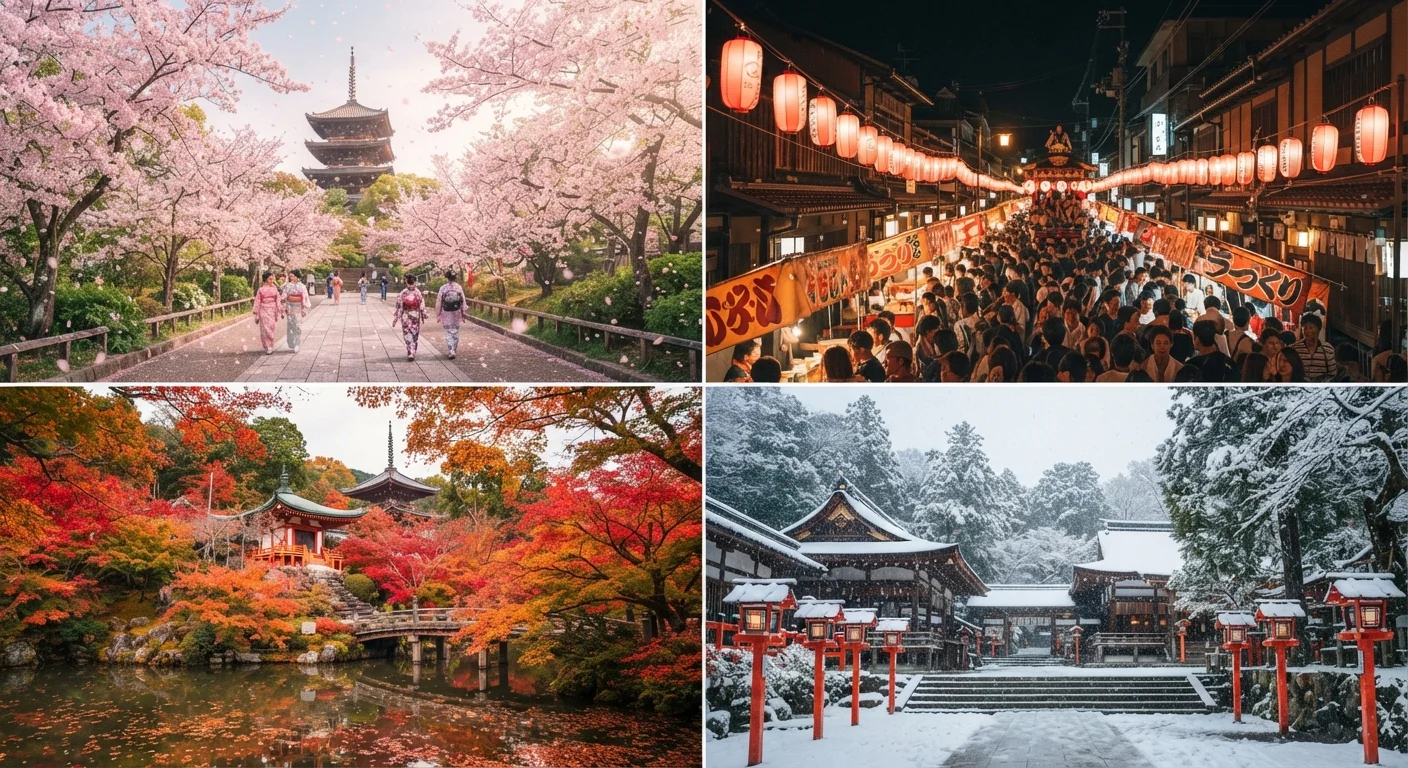
Key Takeaways
- Spring (late March–April) offers iconic cherry blossoms but draws the largest crowds and peak prices.
- Summer is hot and humid; the Obon festival season (mid-August) is culturally rich but very crowded domestically.
- Autumn (mid-October–November) is widely regarded as the most comfortable season for sightseeing.
- Winter offers serene temples, world-class skiing, and far fewer foreign tourists outside major holidays.
- Timing your trip around Japan's rainy season and typhoon period (June–October) significantly shapes the experience.
- Regional climate differences are large — Hokkaido and Okinawa feel like different countries in any given month.
Japan's Seasonal Climate
Japan experiences four distinct seasons shaped by its geography — a long island chain spanning temperate to subtropical zones. Spring brings mild temperatures and cherry blossoms, summer is hot and humid with a defined rainy period, autumn delivers crisp air and vivid foliage, and winter ranges from cold and snowy in the north to mild in the south. Each season creates a genuinely different travel experience.
Japan's climate is influenced by monsoon patterns: the Baiu (plum rain) front in June–July brings sustained rainfall across most of Honshu, while winter precipitation is driven by cold Siberian air masses that dump heavy snow on the Sea of Japan side of the country.
Spring: Beauty, Crowds, and the Sakura Window
Spring in Japan is genuinely spectacular — and genuinely crowded. The cherry blossom (sakura) season concentrates millions of domestic and international travelers into a two-to-three-week window. In Tokyo and Kyoto, peak bloom typically falls between late March and mid-April, though this varies meaningfully from year to year. Parks like Ueno in Tokyo and Maruyama in Kyoto fill with hanami (flower-viewing) picnics, and popular spots become shoulder-to-shoulder by midday.
Beyond the blossoms, spring temperatures are genuinely pleasant — generally ranging from the low 50s to mid-60s Fahrenheit across central Japan. This is a strong season for sightseeing, but accommodation books out early and prices rise accordingly. Travelers who want the sakura experience without peak intensity often target weekdays, early mornings, or secondary destinations like Sendai or Hirosaki, which bloom later and attract smaller crowds.
Tracking Cherry Blossom Dates Before You Book
Japan's meteorological agencies and major weather services begin issuing sakura bloom forecasts each January. These forecasts improve in accuracy as spring approaches. If cherry blossoms are a priority, holding off on booking flights and accommodation until late January — when early forecasts are published — allows you to align your travel window with expected peak bloom rather than guessing from historical averages.
Summer: Heat, Festivals, and the Rainy Season
Japan's summer is defined by three overlapping realities: the rainy season (Tsuyu), intense heat and humidity, and an extraordinary calendar of festivals. Tsuyu typically settles over Honshu in early June and lifts by mid-July, bringing grey skies and frequent rain. After it clears, temperatures climb quickly — Tokyo regularly sees days above 90°F with high humidity through August.
Despite the conditions, summer has a strong case. The Gion Matsuri in Kyoto spans most of July, climaxing with elaborate float processions. Bon Odori festivals animate neighborhoods nationwide in mid-August. Fireworks displays (hanabi taikai) are held across the country throughout the season. Hokkaido offers meaningful relief — temperatures there remain cooler, and the island's lavender fields peak in July.
~3 weeks
Typical cherry blossom viewing window per city
Bloom periods vary by location and year; Japan's meteorological agencies begin issuing sakura forecasts annually in January.
35°C+
Peak summer temperatures in Tokyo and Osaka
The Japan Meteorological Agency records regular heat advisories across central Honshu during July and August.
Mid-Oct to late Nov
Autumn foliage season across central Japan
The foliage front moves southward from Hokkaido through October, reaching Kyoto and Osaka by mid-to-late November in a typical year.
Typhoon risk increases through August and September. Travelers should build in schedule flexibility if visiting during this period and monitor forecasts from Japan's Meteorological Agency. For a broader framework on timing trips around weather patterns, see how to plan around seasonal weather.
Autumn: The Most Comfortable Season for Most Travelers
Autumn is consistently cited by experienced Japan travelers as the most rewarding season for general sightseeing. From mid-October through November, temperatures cool to a comfortable range — typically the 50s and 60s Fahrenheit — and the foliage turns. Maple (momiji) and ginkgo trees shift to vivid reds, oranges, and yellows, particularly in Kyoto's temple districts, the mountains of Nikko, and Osaka's Minoh Park.
Crowds are significant — particularly in Kyoto during peak foliage in November — but generally more manageable than spring's sakura rush. The lack of rain and lower humidity make long days of walking genuinely enjoyable. This is also one of the more comfortable seasons for multi-city travel across Japan's extensive rail network. If you're planning a first trip to Tokyo during this window, understanding how Tokyo is structured before you arrive will help you navigate it efficiently.
Regional Variation Is Significant
Japan spans a wide latitudinal range, and climate differences between regions are substantial. Okinawa's subtropical climate means mild winters and early summers, while Hokkaido has cool summers and very cold, snowy winters. Even within Honshu, the Pacific coast and Sea of Japan coast experience different precipitation patterns in the same month. Any seasonal planning should account for the specific region you intend to visit, not just a general 'Japan' average.
Winter: Serenity, Snow, and a Different Japan
Winter in Japan rewards travelers willing to look past the postcard-season expectations. From December through February, foreign tourist numbers drop noticeably, which means shorter queues at major temples, more available accommodation, and a calmer atmosphere. Kyoto's temples and Nara's deer park take on a quiet, contemplative quality under cold skies that summer and autumn rarely allow.
The northern regions tell a different story. Hokkaido receives some of the world's deepest powder snowfall, supporting a well-developed ski infrastructure. The historic snow festivals in Sapporo (typically held in February) draw large crowds, but are managed events with their own distinct energy. On the Sea of Japan side of Honshu, cities like Kanazawa and Takayama sit under heavy snow that accentuates their preserved historic districts beautifully.
In contrast, Okinawa remains mild through winter — averaging temperatures in the low 70s Fahrenheit — making it a viable warm-weather option within Japan when the mainland is cold. Winter is also when Japan's onsen (hot spring) culture feels most intuitive, offering a practical and culturally authentic way to warm up after cold-weather sightseeing.
Travel conditions, visa requirements, and entry rules can change. Always verify the latest information with official government and tourism sources before finalizing travel plans.