

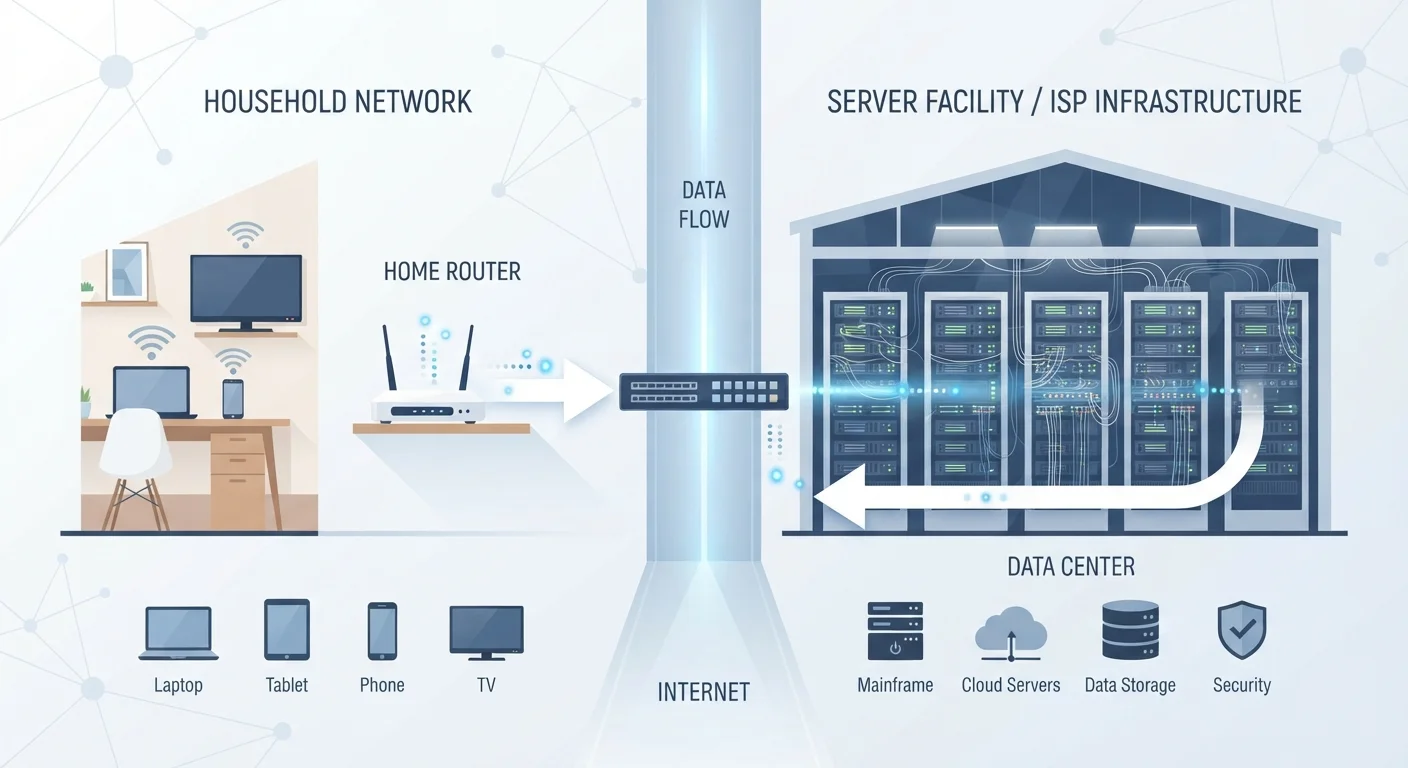
Key Takeaways
- Your ISP controls the physical connection, provisioned speeds, and certain traffic policies on their own network.
- Website performance, server location, and content delivery are outside ISP control.
- Your home Wi-Fi quality is determined by your router and environment, not your ISP.
- ISPs can see the domains you visit unless you use encrypted DNS or a VPN.
- Switching providers changes your connection type and infrastructure, not the open internet itself.
Internet Service Provider (ISP) Control
An ISP is the company that physically delivers internet connectivity to your home or business. Their control covers the network infrastructure between you and the broader internet — including the speeds they provision, the equipment they manage, and, in some cases, the traffic policies they apply. Beyond that boundary, however, your browsing experience is shaped by many other factors the ISP has no authority over.
The dividing line is often the customer premises equipment (CPE) — typically the modem or gateway the ISP provides. Traffic on the far side of that device, including your home network, falls outside the ISP's direct jurisdiction.
What Your ISP Actually Owns and Manages
Your ISP's authority begins at the physical infrastructure level. This includes the cables, fiber lines, or wireless towers that connect your home to the internet backbone, plus the modem or gateway device (if they supply it) that sits at the edge of your property. Within this infrastructure, they control several important things:
- Provisioned bandwidth: The maximum speed tier you're allocated based on your plan. This is what the ISP delivers to your modem.
- Network routing: How your data traffic is directed through their network before it reaches the open internet.
- Traffic management policies: ISPs can apply rules that throttle certain types of traffic — such as video streaming or peer-to-peer file sharing — during congestion periods, subject to the applicable regulations in your area.
- DNS resolution (by default): Most ISPs operate the DNS servers your devices use automatically unless you change them. This means they can see which domain names you're requesting. Understanding how DNS works is a useful starting point if you want to explore privacy-friendly alternatives.
The type of connection technology also matters. Different connection types like fiber, cable, and DSL each come with distinct performance characteristics that your ISP manages at the infrastructure level.
~43%
Of US adults who report slow internet during peak hours
Pew Research Center surveys consistently show peak-time congestion is among the most common internet complaints among US broadband users.
3–5
Network hops between your modem and a typical website
On average, data passes through multiple independent networks before reaching its destination — each outside your ISP's control.
Where ISP Control Ends
Once your data exits the ISP's network and enters the broader internet, your ISP becomes just one of many players. Here's what lies firmly outside their control:
- Website and server performance: If a website is slow because its own servers are overloaded or poorly optimized, your ISP can do nothing about it. The internet is a network of independent systems, and your provider controls only their segment.
- Content delivery networks (CDNs): Major platforms distribute content across global server networks. How quickly that content reaches your device depends heavily on which CDN node is nearest to you — not on your ISP alone.
- Your home Wi-Fi network: From the moment data reaches your router, your ISP's responsibility ends. Router placement, device interference, and hardware quality all determine how that connection is distributed inside your home.
- Third-party app and platform performance: Buffering on a streaming service, lag in a cloud gaming session, or slow file sync — these often trace back to the platform's infrastructure, not your ISP.
“The internet is not one network — it's a network of networks. No single ISP controls the whole path your data takes. They control the first mile, and sometimes the last, but the middle is a shared, distributed system.”
— Andrew Blum, Author of 'Tubes: A Journey to the Center of the Internet'
This boundary matters practically. When something goes wrong online, knowing which side of the line the problem sits on tells you whether calling your ISP will actually help — or whether the fix lies elsewhere.
The Nuanced Middle Ground: Throttling and Traffic Policy
One area where ISP control gets murky is traffic management. ISPs can — and sometimes do — slow down specific types of traffic, such as video streaming, during high-demand periods. This practice, called throttling, sits inside the ISP's technical reach but is subject to ongoing regulatory debate.
In the United States, net neutrality rules have fluctuated over time, affecting how much latitude ISPs have to treat different types of traffic differently. The practical takeaway: an ISP may be influencing your experience with a specific service even when your overall connection speed tests fine.
Test at the Modem, Not Just the Device
When diagnosing a slow connection, plug a laptop directly into your modem with an Ethernet cable and run a speed test. If speeds are close to your plan's advertised rate, the issue likely lies with your home Wi-Fi setup. If speeds are significantly lower, it's worth contacting your ISP. This one step tells you which side of the control boundary the problem sits on.
If you suspect throttling, running speed tests both with and without a VPN can reveal discrepancies — though keep in mind a VPN introduces its own performance variables. What a VPN actually does to your connection explains the trade-offs clearly.
Also worth noting: ISPs typically don't control the content of websites — they don't decide what's on a page, they only decide whether to deliver it to you. That distinction matters for understanding both their power and its limits. If you're weighing whether to switch internet providers, understanding these mechanics helps you ask the right questions before committing.