

Key Takeaways
- The First Amendment restricts government action, not private individuals or companies.
- Private employers can generally discipline employees for their speech without violating the First Amendment.
- Social media platforms are private companies and can moderate content under their own policies.
- Certain categories of speech-such as true threats and incitement-receive no First Amendment protection.
- Public employees have some First Amendment protections that private-sector workers do not.
First Amendment Free Speech
The First Amendment to the U.S. Constitution protects individuals from government censorship of their speech, expression, and beliefs. It does not create a universal right to say anything without consequence in every setting. Private employers, social media companies, and other non-government entities are generally not bound by it.
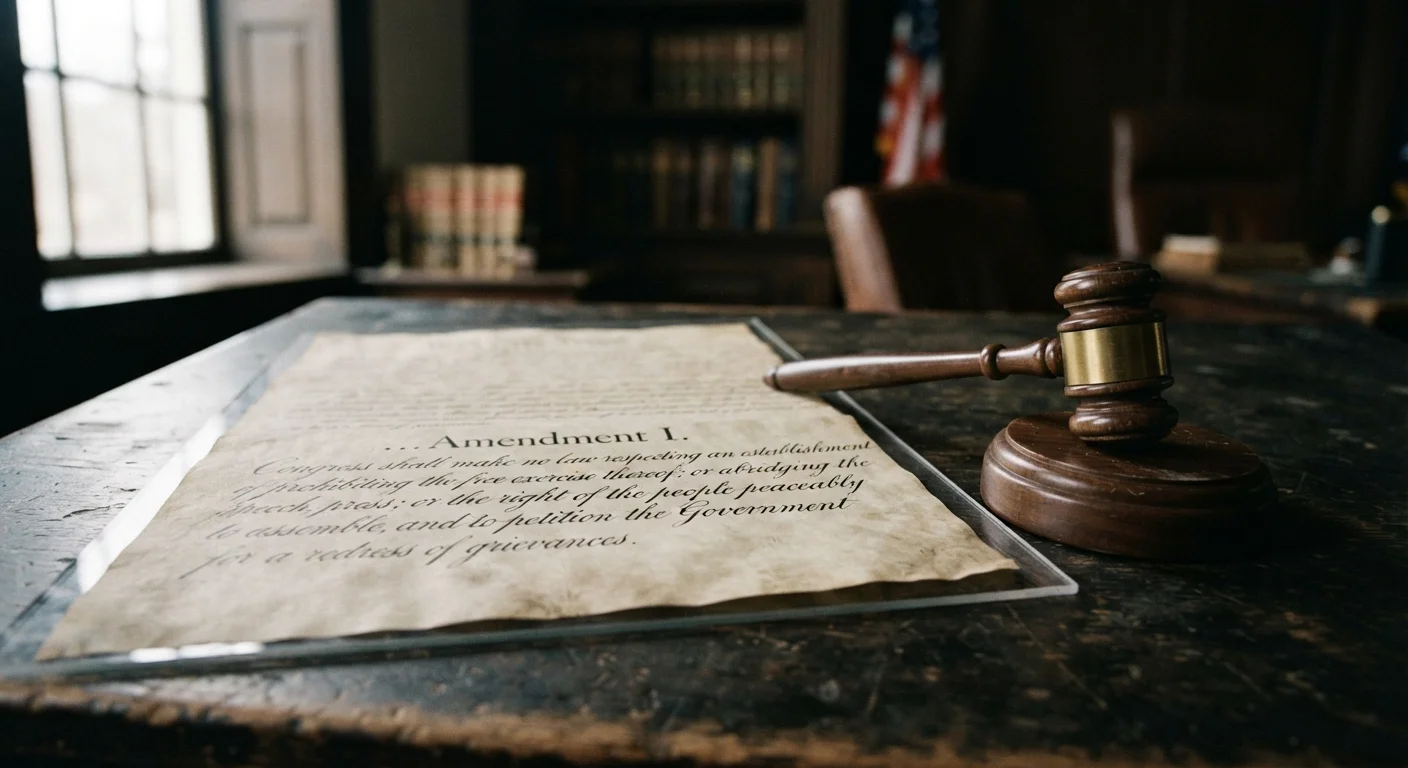
The First Amendment reads: 'Congress shall make no law... abridging the freedom of speech.' Courts have interpreted this to apply to all levels of government through the Fourteenth Amendment's incorporation doctrine.
The Core Principle: It's About Government Power
When people say their free speech rights are being violated, they often mean someone-a boss, a platform, a school-won't let them express themselves. But the First Amendment was designed with a specific target: the government. Federal, state, and local government actors are prohibited from silencing speech based on its content or viewpoint in most circumstances.
This distinction matters enormously in everyday life. A city government cannot arrest you for holding a protest sign on a public sidewalk. A public university cannot expel you for publishing an opinion column in the student paper. But a private business can set its own rules about what employees or customers say on its premises.
Understanding this boundary is the starting point for knowing when your speech rights are genuinely at stake-and when another legal framework applies instead.
Incorporation and State Governments
The First Amendment originally limited only the federal government ('Congress shall make no law...'). Through the Fourteenth Amendment's due process clause, the Supreme Court has applied, or 'incorporated,' First Amendment protections against state and local governments as well. This means a state legislature is just as bound by free speech limits as Congress.
What Speech Is Actually Protected
The First Amendment covers far more than just words. Courts have extended protection to symbolic expression, political donations as a form of speech, artistic works, and even certain forms of commercial advertising. The guiding principle is that the government cannot suppress expression simply because it dislikes the message.
Protected speech includes controversial, offensive, and unpopular viewpoints. The Supreme Court has repeatedly rejected laws targeting speech based on its content alone. This is why provocative political speech, flag burning as protest, and even deeply offensive demonstrations have been upheld as constitutionally protected.
45+
Supreme Court First Amendment cases decided since 2000
The Supreme Court has continued to refine the boundaries of free speech through dozens of major rulings, reflecting how frequently these limits are contested.
~40%
Americans who believe hate speech is unprotected
A Pew Research Center survey found a significant share of Americans mistakenly believe hate speech is not constitutionally protected under current U.S. law.
However, protection is not absolute. The Court has identified specific categories that fall outside First Amendment coverage entirely.
Unprotected Speech: Where the Line Is Drawn
Several narrow categories of speech receive no First Amendment protection. These include:
- Incitement: Speech that is directed to producing imminent lawless action and is likely to do so (Brandenburg v. Ohio, 1969).
- True threats: Statements that communicate a serious intent to commit violence against a specific person or group.
- Defamation: False statements of fact that harm someone's reputation, made with the required degree of fault.
- Obscenity: Material meeting the three-part legal test established in Miller v. California (1973).
- Fraud and perjury: Deliberate deception in specific legal or commercial contexts.
Critically, being offensive, hurtful, or politically extreme does not move speech into these unprotected categories. U.S. law sets a high bar for restricting expression.
Private Employers, Platforms, and Schools
One of the most common misconceptions is that free speech protections follow you everywhere. They do not. Private employers-companies not owned or operated by the government-can discipline or dismiss employees for speech that violates workplace policies, and the First Amendment offers no recourse. Some states have enacted additional employee speech protections under state law, so the picture varies by jurisdiction.
Social media companies like Facebook or X (formerly Twitter) are private platforms. Their content moderation decisions-removing posts, suspending accounts-do not implicate the First Amendment. Users must agree to each platform's terms of service, which define what speech is permitted.
Private schools and universities operate under their own rules as well. Public schools and state universities, however, are government actors and must respect students' First Amendment rights, within reasonable time, place, and manner restrictions.
Know Your State's Speech Protections
Some states have laws that go beyond the First Amendment to protect employees from retaliation for off-duty speech or political activity. California, Colorado, and New York, among others, have specific statutes addressing this. If you believe you've faced consequences for lawful off-duty speech, research your state's labor laws or consult an employment attorney.
Just as the First Amendment has defined limits, so does the Fourth Amendment's protection against unreasonable searches-another right that is frequently misunderstood in everyday situations. See our guide to Fourth Amendment protections for a plain-language breakdown.
Public Employees: A Special Category
Government workers occupy a middle ground. Because their employer is the government, the First Amendment applies-but not without limits. Under Garcetti v. Ceballos (2006), the Supreme Court held that when public employees speak in their official capacity as part of their job duties, that speech is not protected. But when they speak as private citizens on matters of public concern, they may have First Amendment protection.
This means a city firefighter who speaks to a local newspaper about public safety concerns may have constitutional protections that a private-sector counterpart would not. The analysis is fact-specific and context-dependent, and consulting an employment or civil rights attorney is advisable for anyone facing retaliation as a public employee.
This article is for general informational and educational purposes only and does not constitute legal advice. Laws vary by state and jurisdiction. Consult a licensed attorney for guidance specific to your situation.