

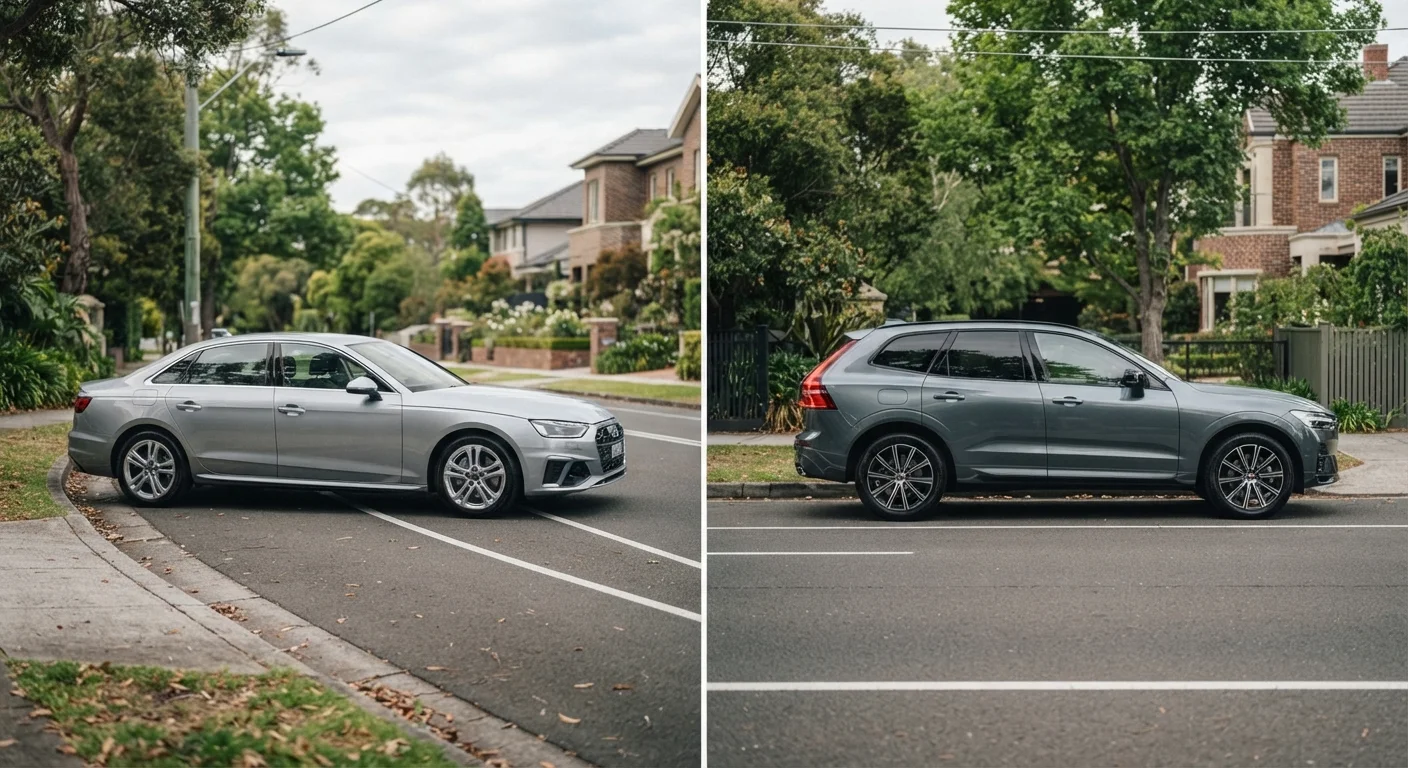
Key Takeaways
- Midsize sedans typically deliver better fuel economy and a lower center of gravity for confident highway driving.
- Compact SUVs offer more cargo space, higher ride height, and optional all-wheel drive for varied conditions.
- Sedans generally carry a lower base price and cost of ownership than comparable compact SUVs.
- Compact SUVs provide easier entry and exit, which matters for families with young children or older passengers.
- Your choice should reflect your typical cargo needs, passenger count, and preferred driving environment.
Option A
Midsize Sedan
The refined, road-focused classic.
Best for: Drivers who prioritize fuel efficiency, highway comfort, and a smooth, car-like driving experience.
Option B
Compact SUV
The versatile, elevated everyday hauler.
Best for: Families and active drivers who need cargo flexibility, higher seating, and optional all-wheel drive.
If you primarily commute on highways and value fuel savings
Midsize Sedan
Sedans consistently achieve higher EPA-estimated fuel economy figures and produce less aerodynamic drag at highway speeds, making long daily commutes more cost-effective over time.
If you need flexible cargo space for gear, groceries, or road trips
Compact SUV
A compact SUV's taller cargo area and fold-flat rear seats accommodate bulky items that a sedan's fixed trunk simply cannot handle.
If you drive in snow, mud, or unpaved conditions
Compact SUV
Many compact SUVs offer available all-wheel drive and greater ground clearance, providing meaningful traction advantages in slippery or rough terrain.
If budget and running costs are your primary concern
Midsize Sedan
Sedans typically start at a lower MSRP and carry lower insurance averages, and their superior fuel economy reduces per-mile costs over a typical ownership period.
If you're buying for a growing family with young children or aging passengers
Compact SUV
The elevated seating position and wider door openings make installing car seats and helping passengers in and out significantly easier day to day.
How These Two Segments Actually Differ
Midsize sedans and compact SUVs have traded the title of America's most popular vehicle type for years - and for good reason. Both serve a wide range of drivers, overlap in price, and share many modern safety and tech features. But they're engineered around different priorities, and those differences show up in daily use.
Before diving into specifics, it helps to understand what each body style actually is. If you're still getting comfortable with automotive terminology, our guide on body style differences is a useful starting point. A sedan has a fixed, enclosed trunk separate from the passenger compartment. A compact SUV - more precisely a crossover SUV in most cases - uses a car-based platform but adds a taller roofline, a hatchback-style cargo area, and optional all-wheel drive.
| Criterion | Midsize Sedan | Compact SUV |
|---|---|---|
| Typical cargo space | 15-16 cu ft (fixed trunk) | 25-40 cu ft, expandable |
| EPA combined fuel economy | Upper 20s-mid 30s MPG | Low-to-mid 20s-30 MPG |
| All-wheel drive availability | Select models only | Widely available |
| Ground clearance | Typically 5-6 inches | Typically 7-9 inches |
| Ease of entry/exit | Lower seat, more effort | Higher seat, easier access |
| Driving dynamics | Lower center of gravity, sportier feel | Higher seating, elevated road view |
| Typical base price range | Generally lower | Generally $2,000-$4,000 higher |
| Resale value trend (US market) | Moderate | Slightly stronger |
That taller structure is the root of almost every practical difference between the two. Height changes cargo access, seating posture, aerodynamic efficiency, and handling dynamics all at once.
Practicality: Cargo, Passengers, and Daily Routines
Cargo capacity is where compact SUVs hold a clear structural advantage. Typical compact SUVs offer roughly 25-40 cubic feet of cargo space behind the rear seats, often expanding to 55-75 cubic feet with seats folded. Most midsize sedans provide 15-16 cubic feet of trunk space - useful, but fixed. You cannot fold the rear seats flat in a traditional sedan to load a bicycle or flat-pack furniture.
Passenger comfort is more nuanced. Midsize sedans often have a slight edge in rear legroom because their lower rooflines allow longer wheelbases relative to overall size. Adults on long trips frequently find sedan rear seats more comfortable for extended sitting. Compact SUVs, however, win on ease of entry: stepping into a higher seat is less physically demanding than lowering yourself into a low-slung car - a genuine consideration for older passengers or anyone with mobility limitations.
~38%
US new vehicle sales: compact SUVs
Compact and subcompact SUVs/crossovers have consistently accounted for roughly 35-40% of total US new vehicle sales in recent model years, according to industry sales data.
2-5 MPG
Typical sedan fuel economy advantage
On average, midsize sedans achieve 2-5 MPG better combined fuel economy than comparably priced compact SUVs, based on published EPA estimates across the segment.
~55 cu ft
Max cargo with seats folded (compact SUV)
With rear seats folded flat, many compact SUVs offer 55-75 cubic feet of load space - up to four times the fixed trunk volume of a typical midsize sedan.
For families using rear-facing or convertible car seats, the compact SUV's door height and seat height make the install and daily buckle-up routine meaningfully less frustrating.
Fuel Economy, Performance, and Driving Feel
Sedans carry a consistent fuel economy advantage. Their lower drag coefficient - a product of that sloped roofline - means engines work less at highway speeds. Most midsize sedans in the segment achieve EPA combined estimates ranging from the upper 20s to mid-30s MPG. Compact SUVs typically land 2-5 MPG lower in real-world combined driving, though hybrids in both categories are narrowing this gap substantially.
On driving dynamics, sedans feel more planted and responsive through corners. A lower center of gravity reduces body roll. If you enjoy the experience of driving rather than simply arriving, most drivers find sedans more engaging. Compact SUVs compensate with a commanding view of the road, which many drivers find reduces fatigue in urban stop-and-go traffic.
All-wheel drive availability is a meaningful differentiator. While some sedans offer AWD, it's standard or widely available across the compact SUV segment. For drivers in regions with significant winter snowfall or occasional dirt-road travel, that option carries real value. For a structured way to evaluate these trade-offs against specific models you're considering, see what to look for when comparing two car models.
Cost of Ownership: Price, Insurance, and Long-Term Spend
Midsize sedans generally start at a lower base MSRP than equivalent compact SUVs - often by $2,000-$4,000 depending on trim and segment positioning. Insurance costs also tend to run lower for sedans, partly due to lower replacement costs and different risk profiles. Fuel savings compound over time: a driver covering 15,000 miles annually could see a meaningful difference in annual fuel spend between a 28 MPG sedan and a 24 MPG SUV, depending on local fuel prices.
Compact SUVs tend to hold resale value slightly better in the current US market, where consumer demand for SUVs has remained strong. This can offset some of the higher upfront cost if you plan to sell or trade within five to seven years. Whether you're financing new or considering used options, the new vs. used car trade-offs comparison covers how purchase path affects total cost for either body style.
Reliability Depends on the Model, Not the Segment
Body style alone does not determine how reliable a vehicle will be. Long-term dependability is driven by engineering, manufacturing quality, and maintenance - all of which vary widely within both the midsize sedan and compact SUV segments. Research specific model-year reliability data from independent, non-commercial sources before narrowing your choice. For a broader orientation to how automakers and segments are structured, this car market overview provides useful context.
Neither segment is categorically more reliable than the other - reliability varies significantly by make, model, and model year rather than body style alone.