

Key Takeaways
- Always use your vehicle's door-jamb sticker or owner's manual for the correct PSI - not the number printed on the tyre sidewall.
- Check pressure when tyres are cold, before driving more than a mile, for the most accurate reading.
- Under-inflation causes excess heat, accelerated tread wear, and reduced fuel economy; over-inflation reduces grip and causes centre-tread wear.
- Tyre pressure drops naturally over time - a monthly check is the widely recommended minimum interval.
- A TPMS (Tyre Pressure Monitoring System) warning light signals a significant deviation; it is not a substitute for regular manual checks.
Tyre Pressure
Tyre pressure is the amount of air inside a tyre, measured in pounds per square inch (PSI) or bar. It determines how much of the tyre's surface contacts the road, directly influencing grip, ride comfort, fuel efficiency, and tyre wear. Every vehicle has a manufacturer-specified pressure range - keeping tyres within that range is one of the simplest and highest-impact maintenance tasks a driver can perform.
Tyre pressure is measured as gauge pressure - meaning the reading reflects pressure above atmospheric pressure, not absolute pressure. Temperature changes of roughly 10°F can shift PSI by approximately 1 PSI, which is why cold-inflation readings are the reliable standard.
Why One Number Carries So Much Weight
Most drivers treat tyre pressure as an afterthought - something to address only when a warning light appears. In reality, keeping tyres inflated to the manufacturer's specification touches almost every aspect of how a car behaves: handling response, braking distance, fuel consumption, and how long the tyres themselves last.
The recommended PSI for your vehicle is an engineering decision, not an arbitrary figure. It's calculated to distribute the vehicle's load evenly across the tyre's contact patch - the small footprint where rubber meets road. Deviate significantly in either direction and that contact patch changes shape, with cascading consequences for safety and running costs.
For new drivers building good habits, understanding tyre pressure belongs alongside knowing your oil level. It's covered in depth in our car maintenance guide for new drivers.
~1-2 PSI
Natural monthly pressure loss per tyre
Tyres lose air gradually through normal permeation of the rubber, independent of any puncture or damage.
25%
Pressure drop that triggers a TPMS warning
U.S. federal standards require the TPMS light to activate when any tyre reaches 25% below the vehicle's recommended cold-inflation pressure.
~0.2%
Fuel economy lost per 1 PSI under-inflation
The U.S. Department of Energy has noted that under-inflated tyres can reduce fuel economy by roughly 0.2% for every 1 PSI drop across all four tyres.
Under-Inflation vs. Over-Inflation: Two Different Problems
Under-inflation is the more common and more dangerous condition. When a tyre carries less air than specified, its sidewalls flex more with each rotation. That flexing generates heat - and sustained heat is the primary enemy of tyre structure. The tyre's contact patch widens and becomes uneven, wearing the outer edges prematurely and increasing rolling resistance. The result is higher fuel consumption and a tyre that reaches the end of its life sooner than it should.
Over-inflation creates the opposite geometry: the tyre bulges at the centre, reducing the actual contact patch and concentrating wear on the middle of the tread. A harder, less compliant tyre transmits more road imperfections into the cabin and, critically, has less grip when cornering or braking. The margin for safe stopping shrinks.
Both conditions compromise the braking system's ability to function as designed. Understanding how braking forces interact with tyre contact is explained in our guide to brake pads, rotors, and callipers.
Check Pressure Before a Long Trip
Highway driving at sustained speeds generates more tyre heat than city driving. Starting a long journey at the correct cold-inflation pressure gives the tyre the best chance of handling that heat safely. Take two minutes to check all four tyres - and the spare - before heading out on any extended drive.
How to Check Tyre Pressure Correctly
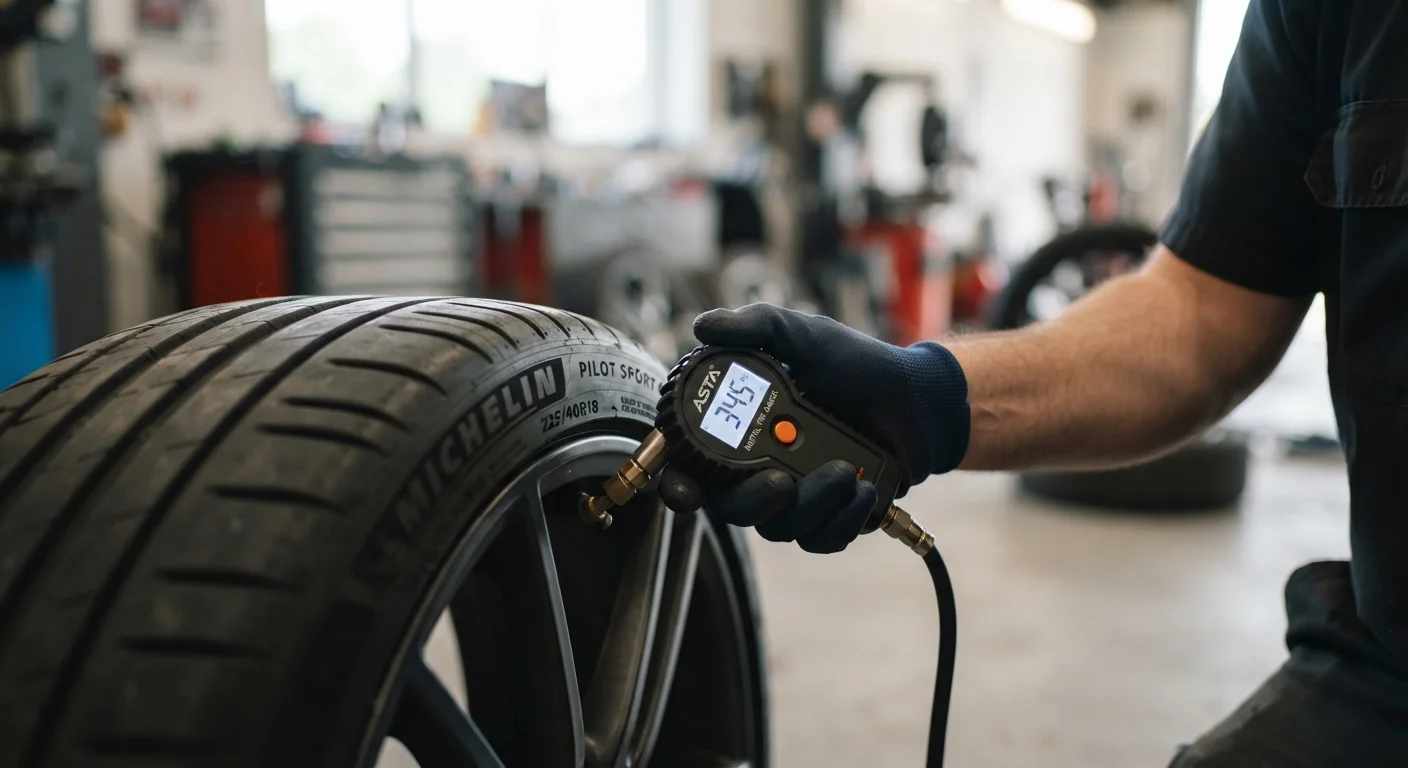
Checking tyre pressure is a five-minute task requiring only a pressure gauge - available at auto parts stores, or often free to use at gas stations. Follow this straightforward process:
- Check cold. Tyre pressure readings are accurate only when the tyre hasn't been driven on recently. Aim for first thing in the morning or after the car has been parked for at least three hours.
- Find the recommended PSI. Look at the sticker on the driver's door jamb - not the number on the tyre sidewall, which is the maximum allowable pressure, not the target.
- Remove the valve cap on each tyre and press the gauge firmly onto the valve stem until you get a stable reading.
- Add or release air as needed. Most gas station air pumps allow you to add air directly; to release pressure, press the small pin inside the valve stem.
- Recheck after adjusting and replace all valve caps.
Tyre condition matters alongside pressure. Our article on how to check your tyre tread depth walks through the parallel check every driver should perform regularly.
Understanding TPMS - and Its Limits
Since 2008, federal regulation has required all new passenger vehicles sold in the United States to be equipped with a Tyre Pressure Monitoring System (TPMS). The system uses sensors inside each wheel to track pressure and illuminates a dashboard warning light when a tyre drops roughly 25% below the recommended level.
TPMS is a genuine safety net - but it has an important limitation. By the time the light activates, pressure has already fallen to a level that affects handling and accelerates wear. The system is designed to catch dangerous under-inflation, not to keep tyres optimally inflated day to day. Relying on TPMS alone and skipping manual checks means you may regularly operate tyres that are somewhat low without ever seeing a warning.
If you see the TPMS symbol on your dashboard and aren't sure what it means, our guide on decoding dashboard warning lights explains it alongside every other common indicator.
Seasonal Pressure Changes Are Normal
As temperatures drop in autumn and winter, tyre pressure falls - approximately 1 PSI for every 10°F decrease in ambient temperature. This means a tyre that was correctly inflated in summer may be noticeably low by midwinter without any leak present. Build in an extra pressure check at the start of each season to account for this predictable shift.