

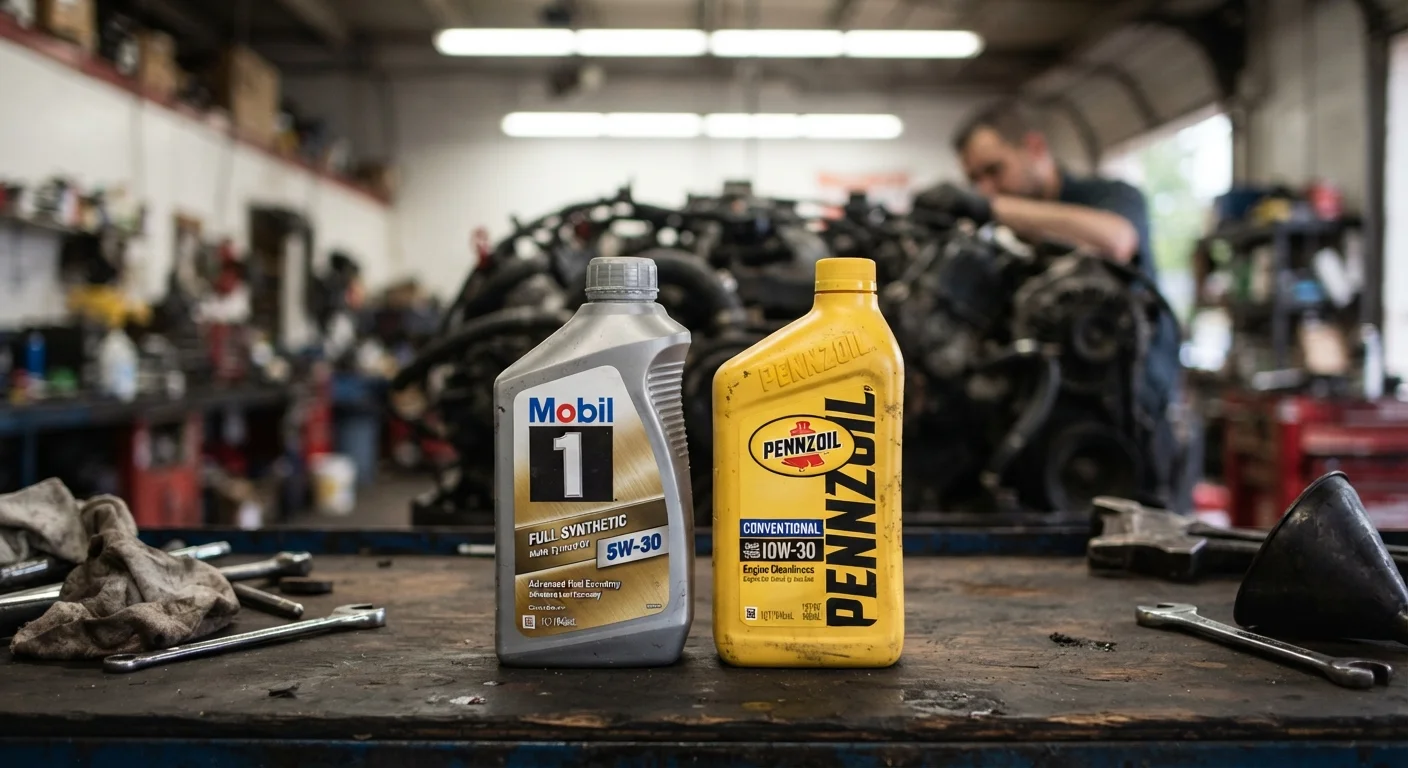
Key Takeaways
- Synthetic oil is chemically engineered for uniform molecules; conventional oil is refined directly from crude petroleum.
- Synthetic oil generally handles temperature extremes better and resists breakdown longer than conventional oil.
- Your owner's manual - not marketing claims - should determine which oil type your engine requires.
- Switching from conventional to synthetic in high-mileage engines carries specific considerations worth understanding first.
- Oil change intervals differ significantly between the two types, affecting long-term maintenance costs and planning.
Option A
Synthetic Motor Oil
The engineered, high-performance formulation.
Best for: Drivers with newer vehicles, high-performance engines, extreme climates, or longer intervals between oil changes.
Option B
Conventional Motor Oil
The refined, time-tested petroleum standard.
Best for: Owners of older vehicles with simple engines and moderate driving conditions who change oil on a regular schedule.
If you drive a newer vehicle or turbocharged engine
Synthetic Motor Oil
Modern engine tolerances are tighter and turbochargers run extremely hot; synthetic oil's stability under high heat and pressure is well-suited to these demands.
If you own an older vehicle with a simpler engine design
Conventional Motor Oil
Older engines were designed around conventional oil's characteristics, and provided the vehicle isn't leaking or burning oil excessively, conventional oil is adequate with regular changes.
If you live in a region with extreme hot or cold temperatures
Synthetic Motor Oil
Synthetic oil flows more reliably at cold startup and resists viscosity breakdown at high operating temperatures, offering consistent protection across a wider range.
If you want longer intervals between oil changes
Synthetic Motor Oil
Synthetic formulations are engineered to resist oxidation and degradation longer, which is why many manufacturers allow extended drain intervals when synthetic oil is used.
If your manufacturer specifies conventional oil and budget is a priority
Conventional Motor Oil
When your vehicle's specifications don't require synthetic, conventional oil used on schedule delivers reliable protection at a lower per-change cost.
What Sets These Two Oils Apart at the Molecular Level
Motor oil's core job is to create a protective film between moving metal parts - but oil does considerably more than lubricate, including cooling, cleaning, and sealing internal components. How well it performs those roles depends partly on what it's made of.
Conventional motor oil starts as crude petroleum extracted from the ground. Through a refining process, impurities are removed and additives are blended in to improve performance. The result is a functional but chemically inconsistent product - crude oil contains a natural mix of molecular shapes and sizes that no refining process fully standardizes.
Synthetic motor oil, by contrast, is built from scratch in a lab. The base stock is either chemically synthesized from simpler compounds or starts as refined petroleum that undergoes further processing to create uniform, purpose-designed molecules. This uniformity is the key distinction. When molecules are consistent in size and shape, they flow more predictably, resist breakdown more effectively, and perform more reliably under stress.
| Criterion | Synthetic Oil | Conventional Oil |
|---|---|---|
| Base stock origin | Chemically engineered molecules | Refined crude petroleum |
| Molecular consistency | Highly uniform | Naturally variable |
| Cold-weather flow | Flows faster at low temps | Thickens more in cold |
| Heat resistance | Higher thermal stability | Degrades faster under heat |
| Typical change interval | 7,500-15,000 miles (varies by vehicle) | 3,000-7,500 miles (varies by vehicle) |
| Cost per change | Generally higher | Generally lower |
| Suited to modern engines | Yes, especially turbocharged | Older, simpler engine designs |
Performance Under Pressure: Heat, Cold, and Wear
The practical difference between these oils becomes most visible at temperature extremes - the very conditions where engine protection matters most.
At cold startup, oil must flow immediately to lubricate components before the engine reaches operating temperature. Conventional oil thickens more in cold weather, meaning there's a brief window at startup where metal-on-metal contact is higher. Synthetic oil flows faster at low temperatures, reducing that wear window.
At high operating temperatures - especially in turbocharged engines, towing situations, or stop-and-go summer driving - conventional oil oxidizes and degrades faster. It also evaporates at a higher rate (a property called volatility), which can cause oil consumption between changes. Synthetic oil's engineered molecules are more thermally stable, maintaining their viscosity and protective properties longer under heat stress.
~10x
Difference in molecular uniformity
Synthetic base oils are engineered to a molecular consistency that conventional refining processes cannot reliably match, according to industry lubrication engineers.
Up to 15,000 mi
Synthetic oil change intervals
Many vehicle manufacturers now publish extended drain intervals for full synthetic oil, though actual intervals vary significantly by make, model, and driving conditions.
~30%
Lower volatility in synthetics
Synthetic oils typically exhibit lower evaporation rates than conventional oils under high-temperature conditions, which can reduce oil consumption between changes.
This temperature resilience is also why extended oil change intervals are now common with synthetic oil. The oil simply doesn't break down as quickly.
When the Choice Isn't Yours to Make
For many drivers, the synthetic vs. conventional decision has already been made - by the vehicle manufacturer. Many modern engines, particularly those with turbochargers, direct injection, or tight internal tolerances, specify full synthetic oil in their owner's manual. Using conventional oil in those engines isn't a cost-saving measure; it's a maintenance shortcut that can accelerate wear and potentially affect warranty coverage.
A Note on 'Synthetic Blend' Oils
A third category - synthetic blend oil - combines conventional and synthetic base stocks. It offers some of synthetic's performance advantages at a lower price point than full synthetic. Blends are a reasonable middle ground for drivers whose vehicles don't require full synthetic but who want better temperature performance than conventional oil alone provides. As always, verify compatibility with your owner's manual.
High-mileage vehicles introduce a separate consideration. Engines with significant miles may have worn seals that have adapted to conventional oil's slightly higher viscosity. Switching to synthetic in these cases isn't automatically harmful, but it's worth consulting a qualified mechanic first - especially if the engine has any history of oil leaks or consumption.
The inverse is also true: there's rarely a harm in using synthetic oil where conventional is merely the minimum requirement, but it won't transform an engine that wasn't designed to take advantage of synthetic's properties. Always check your owner's manual before changing oil type, and understand that delaying any oil change - regardless of oil type - carries real cumulative consequences for engine health.
Making a Practical Decision for Your Vehicle
Once you understand the chemistry, the practical decision becomes straightforward. Start with your owner's manual - it specifies the oil type and viscosity grade your engine was designed around. If it calls for synthetic, use synthetic. If it allows conventional, weigh your driving conditions: extreme climates, long highway trips, frequent towing, or turbocharged engines all tip the balance toward synthetic even when it isn't strictly required.
Oil changes themselves are well within reach for many home mechanics, though knowing where to draw the line on DIY maintenance is important - some tasks are better left to professionals, and an oil change done incorrectly can cause more damage than skipping it.
What's not worth debating is whether regular oil changes matter. Both synthetic and conventional oil degrade over time and under use. The difference is how quickly - and that difference, compounded over the life of a vehicle, has real implications for engine longevity.