

Key Takeaways
- Most failing batteries give several warning signs before they die completely.
- Slow engine cranking and dashboard warning lights are among the earliest indicators.
- Extreme temperatures - hot or cold - accelerate battery wear significantly.
- A battery older than three to five years warrants routine testing, even if it seems fine.
Why Batteries Rarely Die Without Warning
A car battery doesn't typically go from fully functional to completely dead overnight. It degrades gradually, and that process leaves a trail of signals that most drivers either overlook or chalk up to something else. Recognizing these signs early is the difference between scheduling a convenient service appointment and calling for a tow on a freezing morning.
The six warning signs below are listed in order of how early they tend to appear. Some are easy to spot; others require you to pay deliberate attention to how your car behaves day to day.
Slow or labored engine cranking
When you turn the key or press the start button, the starter motor draws a surge of power from the battery. If the engine sounds sluggish - turning over slowly with a laboring, low-pitched groan before catching - that hesitation is a direct sign the battery can no longer deliver its full output. Many drivers mistake this for an occasional fluke and dismiss it. It rarely is.
Cold mornings make this symptom worse, because low temperatures reduce a battery's ability to generate current - a property measured in CCA. If it only happens when it's cold, that doesn't mean the battery is fine the rest of the time; it means the margin is already narrow.
A sluggish crank is rarely a fluke - it's usually the battery's first clear distress signal.
Dim headlights or interior lights
Your vehicle's lighting draws power from the battery, especially when the engine is off or just starting. If headlights appear noticeably dimmer than usual - particularly at idle - or if interior lights seem weak when you first open the door, the battery may not be holding a proper charge.
Some drivers notice this most when running accessories like the radio or climate control with the engine off for an extended period. While that kind of drain is normal, a healthy battery recovers quickly once the engine runs. A battery that stays dim or takes unusually long to recover is signaling reduced capacity.
Dimming lights under load are a straightforward sign of reduced battery capacity.
Frequent need for jump-starts
One dead battery can happen to anyone - a forgotten interior light, an unusually long stretch of cold weather. But needing a jump-start more than once in a short window is a pattern, not a coincidence. Each time a severely depleted battery is jump-started and then only partially recharged through short drives, its long-term capacity degrades further.
If you've jump-started the same vehicle two or more times within a few weeks, the battery deserves a professional load test rather than another jump. A load test applies a controlled electrical demand to the battery and measures whether it can sustain voltage - a much more accurate picture than a simple voltage reading.
Recurring jump-starts are a pattern, not bad luck - the battery needs a professional load test.
Visible corrosion on the terminals
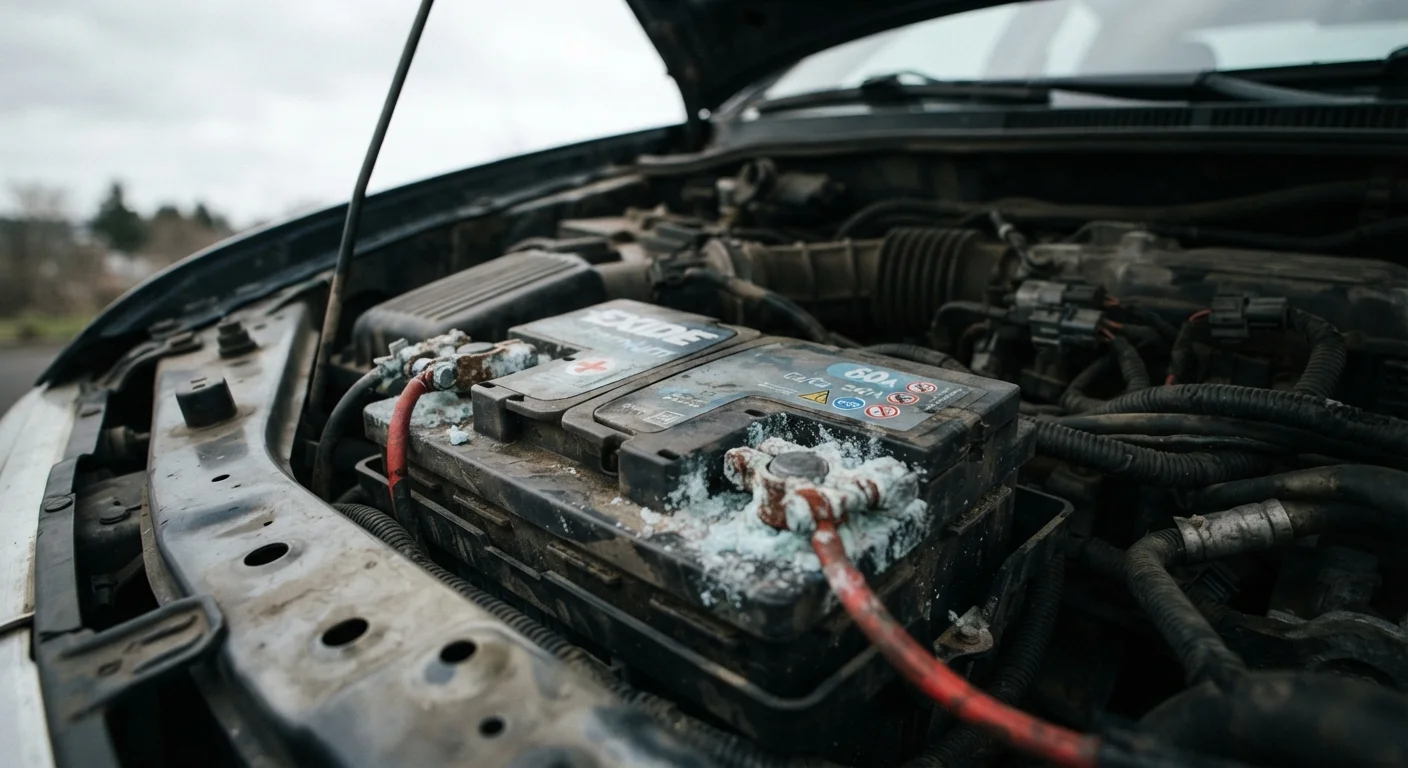
Battery terminals - the metal posts where cables connect - can develop a white, blue, or greenish powdery buildup over time. This corrosion increases electrical resistance, which can reduce the power the battery delivers and impair charging from the alternator.
Minor surface corrosion can sometimes be carefully cleaned, but heavy buildup - especially when paired with other warning signs - often indicates a battery that has been leaking gases or is aging out. It's worth having a technician assess whether cleaning is sufficient or whether replacement is the better course. For context on what tasks fall within DIY territory, see our guide to DIY car maintenance limits.
Terminal corrosion raises electrical resistance and often signals a battery nearing the end of its life.
Dashboard battery or check-engine warning light
Most modern vehicles have a dedicated battery warning light - typically a rectangular battery icon - that illuminates when the charging system isn't operating properly. This can point to the battery itself, the alternator, or the wiring connecting them. In some vehicles, a weak battery can also trigger a check-engine light because onboard sensors detect voltage irregularities.
Neither light should be ignored. Understanding what dashboard warning lights actually mean is one of the most practical skills a driver can develop - these signals are the vehicle's way of asking for attention before a breakdown occurs.
A battery warning light means the charging system needs inspection - don't delay acting on it.
Battery age beyond three to five years
Most automotive lead-acid batteries have a practical service life of three to five years under typical driving conditions. Heat, frequent short trips, and accessories that draw power while the engine is off all shorten that window. A battery approaching or past that range may show no obvious symptoms - until it fails without warning.
Proactive testing costs far less than a roadside breakdown. Building battery checks into your regular maintenance routine is one of the simplest habits that keeps a car reliable over the long haul. For a broader look at maintenance habits that pay off, see our guide on keeping a car in good shape over the long term.
A battery over five years old can fail without warning - proactive testing is the smarter strategy.
Alternator vs. Battery: Know the Difference
Not every charging problem stems from the battery. The alternator - which recharges the battery while the engine runs - can also fail and produce similar symptoms. A proper diagnosis by a qualified technician will distinguish between the two. Replacing a battery when the alternator is the real problem won't solve anything, and vice versa.
What to Do Once You Suspect the Battery
If two or more of the signs above sound familiar, the next step is a load test - not a guess. A basic multimeter can confirm whether resting voltage is within range, but only a load test reveals whether the battery can actually sustain output under demand. Many service shops perform this test quickly and without requiring an appointment.
Test Before Winter Arrives
Cold temperatures are the most common trigger for a marginal battery to give out entirely. Having your battery load-tested in early fall - before temperatures drop - gives you time to act rather than react. Many auto parts stores and service centers offer this test at no charge.
If the battery tests within acceptable range but symptoms persist, ask the technician to check the alternator and the charging circuit as well. Batteries don't operate in isolation, and a complete picture of the charging system is the only way to rule out compounding issues.
When replacement is warranted, a qualified mechanic can ensure the new battery is properly matched to your vehicle's electrical demands - a step that's easy to overlook and genuinely matters for longevity.