

Key Takeaways
- Laminate resists scratches and moisture better than hardwood, making it more forgiving in active households.
- Hardwood can be sanded and refinished multiple times, giving it a longer usable lifespan than laminate.
- Laminate typically costs less upfront, but hardwood may add more to a home's resale value over time.
- Neither option suits rooms with standing water risk - laminate tolerates humidity better, but neither is waterproof.
- Installation method matters: laminate is more DIY-friendly; hardwood often requires professional fitting and acclimation.
Option A
Laminate Flooring
The practical, budget-conscious look-alike.
Best for: High-traffic areas, households with kids or pets, or rooms where moisture and heavy use are concerns.
Option B
Hardwood Flooring
The timeless, refinishable natural original.
Best for: Living rooms, bedrooms, and spaces where long-term investment, resale value, and authentic character matter most.
If you have young children, pets, or heavy foot traffic
Laminate Flooring
Laminate's wear layer resists everyday scratches and scuffs better than bare hardwood. It's also easier to clean and replace if a section is damaged.
If long-term home value and character matter most to you
Hardwood Flooring
Solid hardwood can be refinished over decades and is widely recognized by buyers as a premium feature that supports resale value.
If you want a strong DIY-friendly installation
Laminate Flooring
Most laminate uses a click-lock floating system that doesn't require nailing, gluing, or professional acclimation periods.
If you're furnishing a basement or moisture-prone room
Laminate Flooring
Laminate handles fluctuating humidity better than solid hardwood, which can cup or warp in damp below-grade environments.
If authenticity and the ability to change finishes matter to you
Hardwood Flooring
Hardwood can be stained, buffed, and refinished to suit changing tastes - an option laminate simply cannot offer.
What You're Actually Standing On
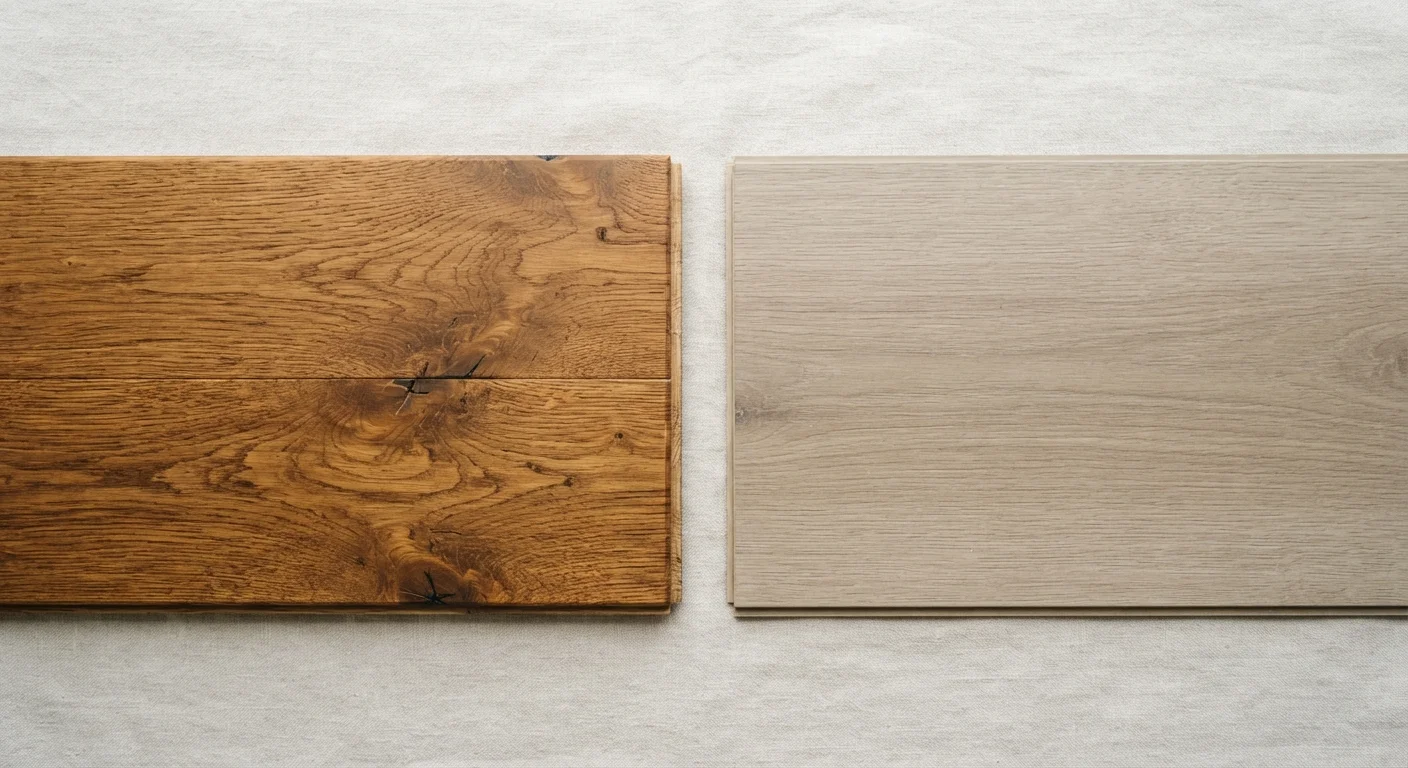
Walk into most showrooms and laminate can look nearly identical to hardwood. That's by design. But the construction underneath each plank is where the real differences begin - and where homeowners often get surprised after installation.
Hardwood is exactly what the name suggests: a solid plank of milled natural wood, typically 3/4 inch thick. Its surface can be sanded down and refinished many times throughout its life. Laminate, by contrast, is a layered synthetic product. A high-density fiberboard (HDF) core is topped with a photographic image layer printed to resemble wood grain, then sealed with a clear protective wear layer. No natural wood grain runs through it - what you see is a photo.
This distinction drives nearly every difference in performance, repairability, and feel underfoot. Hardwood has a solidity and acoustics that laminate struggles to replicate, and many homeowners notice the difference when walking across each type.
| Criterion | Laminate | Hardwood |
|---|---|---|
| Core material | High-density fiberboard (HDF) | Solid milled natural wood |
| Surface appearance | Photographic image layer | Real wood grain throughout |
| Scratch resistance | High (protective wear layer) | Moderate; varies by species and finish |
| Moisture tolerance | Moderate; handles humidity better | Low; susceptible to swelling and cupping |
| Repairability | Damaged sections must be replaced | Can be sanded and refinished multiple times |
| Typical DIY install | Yes - click-lock floating system | More complex; often professional install |
| Upfront cost | Generally lower per square foot | Generally higher per square foot |
| Lifespan (typical) | 15-25 years | 50+ years with refinishing |
| Resale value impact | Moderate | High - recognized as premium feature |
Durability, Moisture, and Real-World Wear
Laminate's wear layer gives it genuine scratch resistance - a meaningful advantage in homes with pets, kids, or furniture being dragged around. Hardwood's surface is natural wood, which dents and scratches more easily, though it can be refinished to remove damage. Once laminate's surface layer is breached, there's no repairing it - that section typically needs replacement.
Moisture is the area where laminate pulls ahead most clearly. While neither material is waterproof, laminate tolerates humidity fluctuations and occasional spills more gracefully than solid hardwood. Solid hardwood can swell, cup, or warp when exposed to moisture over time. For this reason, solid hardwood is rarely recommended for basements, bathrooms, or laundry rooms.
15-25 yrs
Typical laminate flooring lifespan
General industry guidance suggests most laminate floors last 15 to 25 years depending on traffic levels and installation quality.
50+ yrs
Potential hardwood lifespan with refinishing
Solid hardwood floors can last over 50 years - or longer - when properly maintained and periodically refinished.
4-7 days
Hardwood acclimation period before install
Flooring professionals typically recommend allowing solid hardwood to acclimate to a home's indoor humidity for several days before installation to reduce post-install movement.
It's worth noting that engineered hardwood - a plywood-core product topped with a real wood veneer - occupies middle ground: more moisture-stable than solid hardwood, with a refinishable real-wood surface. If you love hardwood but need more flexibility, engineered hardwood is worth researching separately.
Installation, Cost, and Long-Term Value
Laminate is one of the more accessible DIY flooring options available. Most modern laminate uses a click-lock floating system: planks snap together and rest on a foam underlayment without adhesive or nails. With proper preparation, a determined DIYer can complete a room in a weekend.
Hardwood installation is more demanding. Solid hardwood typically needs to acclimate to the home's humidity for several days before installation. It's commonly nailed or stapled to a subfloor, which requires specific tools and experience. Many homeowners hire professionals for hardwood work, which adds to the total cost.
On material cost alone, laminate is generally less expensive per square foot than comparable-looking hardwood. However, hardwood's longevity and refinishability mean that over 30 or 40 years, the cost-per-year calculation can shift. A hardwood floor installed in the 1970s can still be refinished and look beautiful today - a laminate floor from the same era almost certainly could not.
From a resale perspective, real hardwood flooring is widely considered a desirable feature by buyers. Laminate can appeal to buyers looking for a clean, practical floor, but it doesn't carry the same premium perception. Just as matching paint finishes to the right rooms can transform how a space reads - see our guide to paint finish types for a similar surface-decision framework - flooring choice shapes how a room feels and is valued.
What About Engineered Hardwood?
Engineered hardwood sits between laminate and solid hardwood: it has a real wood veneer surface bonded to a plywood core. It handles moisture better than solid hardwood and can often be refinished at least once. If you want real wood but need more installation flexibility or plan to use it in a space with moderate humidity variation, engineered hardwood is worth exploring as a third option before making a final decision.