

Key Takeaways
- Credit cards charge variable rates, typically higher than personal loans, but offer flexibility for short-term borrowing.
- Personal loans carry fixed rates and fixed repayment schedules, making total cost easier to predict upfront.
- Carrying a credit card balance long-term is almost always more expensive than a personal loan for the same amount.
- Your credit score significantly affects the rate you'll receive on either product.
- Neither option is universally better - the right choice depends on amount, timeline, and repayment behavior.
Our Verdict
For borrowers who can repay within one to two billing cycles and have access to a 0% introductory APR offer, a credit card can be a cost-effective tool. For larger amounts or anything you plan to repay over months or years, a personal loan's fixed rate and defined end date typically produce lower total costs. The best choice is always the one you can repay on schedule.
| Best for | Recommended |
|---|---|
| Short-term, smaller purchases paid off quickly | Credit Card |
| Larger lump-sum needs with a multi-month repayment plan | Personal Loan |
| Debt consolidation with a predictable payoff date | Personal Loan |
| Ongoing or unpredictable expenses needing flexible access | Credit Card |
How Each Borrowing Tool Is Structured
Credit cards and personal loans both let you borrow money and repay it over time, but they work very differently under the hood. Understanding those structural differences is the first step to comparing their real costs.
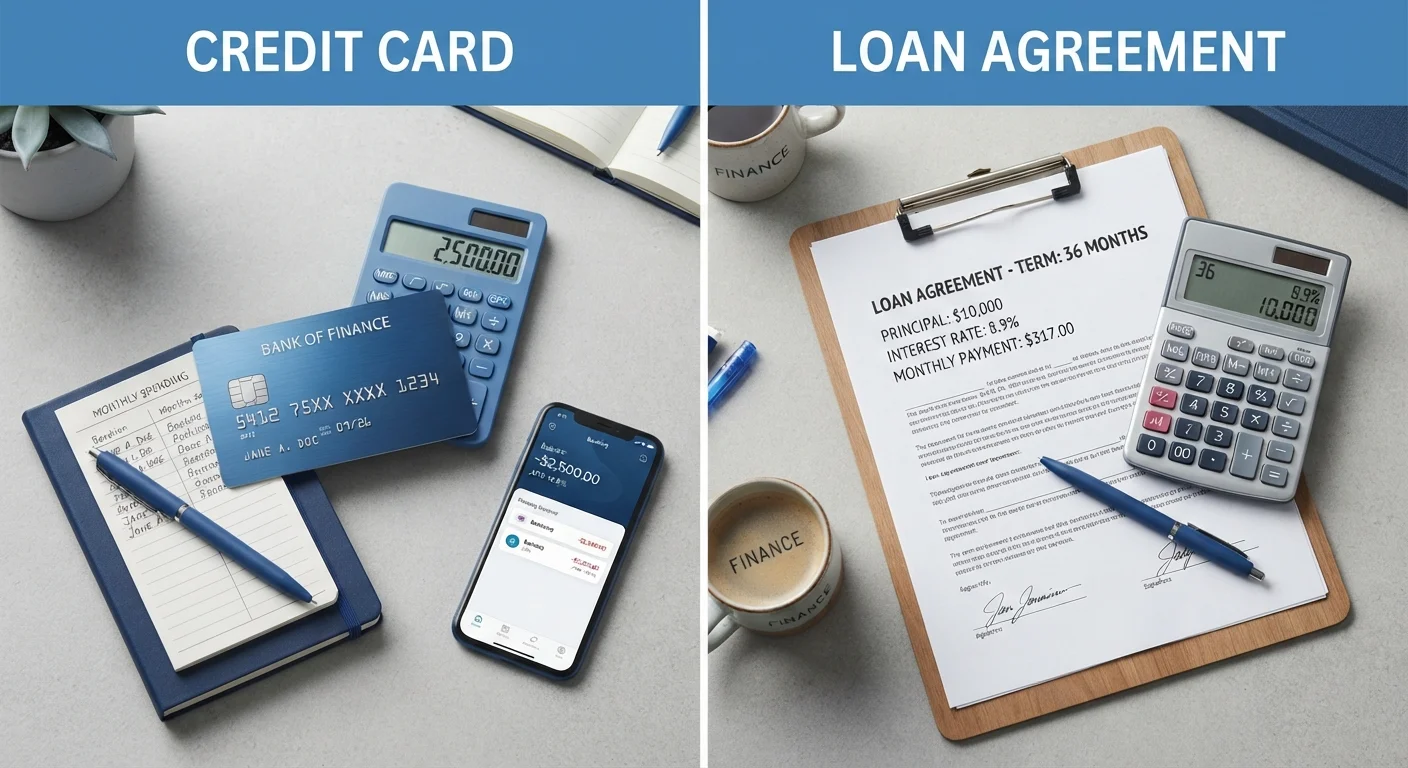
A credit card is a revolving line of credit. You have a set credit limit, and you can borrow up to that limit, repay some or all of it, and borrow again. Interest accrues on any balance you carry from month to month. Rates are almost always variable, meaning the APR can change as market rates shift.
A personal loan is an installment product. You receive a lump sum upfront, then repay it in fixed monthly installments over a defined term - typically 12 to 60 months. The interest rate is usually fixed, so your payment and total cost are predictable from day one.
For a broader look at how these products fit into the overall borrowing landscape, see our end-to-end credit and debt resource.
| Credit Card | Personal Loan | |
|---|---|---|
| Interest rate structure | Variable APR, typically 20-30%+ | Fixed APR, typically 8-24% |
| Repayment schedule | Flexible minimum payments | Fixed monthly installments |
| Access to funds | Revolving - reusable as you repay | Lump sum, one-time disbursement |
| Origination fees | Usually none | Often 1-8% of loan amount |
| Predictability of total cost | Low - depends on balance and payments | High - known from the start |
| Credit score impact | Affects utilization ratio closely | Adds installment loan to credit mix |
| Best loan horizon | Days to a few months | 12-60 months |
Where the Costs Actually Diverge
The most meaningful cost difference between the two products comes down to rate level and repayment behavior.
21.5%
Average credit card interest rate (APR)
The Federal Reserve has tracked average credit card rates exceeding 20% on accounts assessed interest in recent reporting periods.
11-12%
Average personal loan APR for qualified borrowers
Federal Reserve consumer credit data indicates personal loan rates for borrowers with strong credit are meaningfully lower than credit card rates.
~$1,400
Extra interest on a $5,000 balance over 2 years at card vs. loan rates
Illustrative calculation comparing a 22% APR credit card against a 12% personal loan over 24 months, assuming minimum card payments.
Credit cards charge interest only when you carry a balance. If you pay your statement in full each month, you owe nothing in interest. That makes them genuinely cost-free for short-term borrowing - but only if you have the discipline and cash flow to pay in full.
Personal loans charge interest from day one on the full disbursed amount. However, because rates are typically lower and the repayment term is fixed, the total interest paid over a multi-month period is usually less than what a credit card would cost for the same balance.
Minimum Payments Can Be a Debt Trap
Credit card minimum payments are designed to keep you current, not to pay down your balance efficiently. Paying only the minimum on a $5,000 balance at 22% APR can extend repayment beyond seven years and cost more in interest than the original purchase. If you're carrying a balance, calculate an actual payoff amount and timeline rather than defaulting to the minimum.
One cost that personal loans may add that credit cards generally don't is an origination fee - a one-time charge deducted from your loan proceeds or rolled into the balance. Always calculate total repayment cost, not just the stated APR, when making your comparison.
Check for Origination Fees Before You Commit
Personal loans often advertise attractive APRs, but some lenders deduct an origination fee of 1-8% directly from your disbursement. Factor this into your true cost comparison. A 10% APR loan with a 5% origination fee may cost more than a 13% loan with no fee, depending on your repayment timeline. Always calculate the total dollar amount you will repay, not just the monthly payment.
Scenarios Where Each Option Has the Edge
Neither product dominates in every situation. Context determines which is more cost-effective.
When a Credit Card Makes Sense
- Short repayment window: If you can pay the full balance within one to two billing cycles, you avoid interest entirely.
- Ongoing or variable expenses: Credit cards work well when you don't know the exact amount you'll need - home repairs, travel, medical copays.
- 0% introductory APR offers: Some cards offer interest-free periods of 12-21 months. Used strategically, this is a genuine low-cost option.
When a Personal Loan Makes Sense
- Larger fixed amounts: For expenses you know in advance - a medical procedure, a home improvement project - a lump-sum loan with a defined repayment schedule keeps costs transparent.
- Debt consolidation: Rolling several high-rate card balances into a single fixed-rate loan can reduce your monthly interest burden and give you a clear payoff date.
- Behavioral guardrails: Because a personal loan disburses once and has fixed payments, it removes the temptation to keep borrowing that a revolving credit line presents.
Your credit score heavily influences the rate you'll receive on either product. How lenders use credit scores to set rates follows similar principles across most consumer loan products - stronger scores unlock meaningfully lower APRs.
Making the Right Call for Your Situation
The right borrowing tool is the one that costs the least given your specific timeline, amount, and repayment habits. A few questions can sharpen your decision:
- How much do you need? Small amounts you can clear quickly favor a credit card. Larger sums you'll repay over months favor a personal loan.
- How long will repayment realistically take? Be honest. If there's any chance you'll carry a balance beyond 60 days, run the interest math for a personal loan comparison.
- What rates are available to you? Your credit profile determines both your card APR and your loan offers. Check both before deciding.
- Are there fees on the loan? Factor origination costs into your total-cost comparison, not just the rate.
This is general financial information and not personalized advice. For decisions involving significant borrowing, consulting a licensed financial adviser or credit counselor can help you evaluate your full picture - including how new debt may interact with existing obligations.
This article is for informational purposes only and does not constitute personalized financial, legal, or investment advice. Consult a qualified financial professional before making borrowing decisions based on your individual circumstances.