

Key Takeaways
- Platform sharing lets automakers build diverse models while controlling engineering and manufacturing costs.
- Shared platforms often mean shared parts, which can simplify repairs and affect parts availability.
- Vehicles on the same platform can still differ significantly in handling, quality, and features.
- Understanding platform relationships helps you compare models more accurately and spot true value.
- A platform change between generations can fundamentally alter a model's driving character and reliability profile.
Platform Sharing
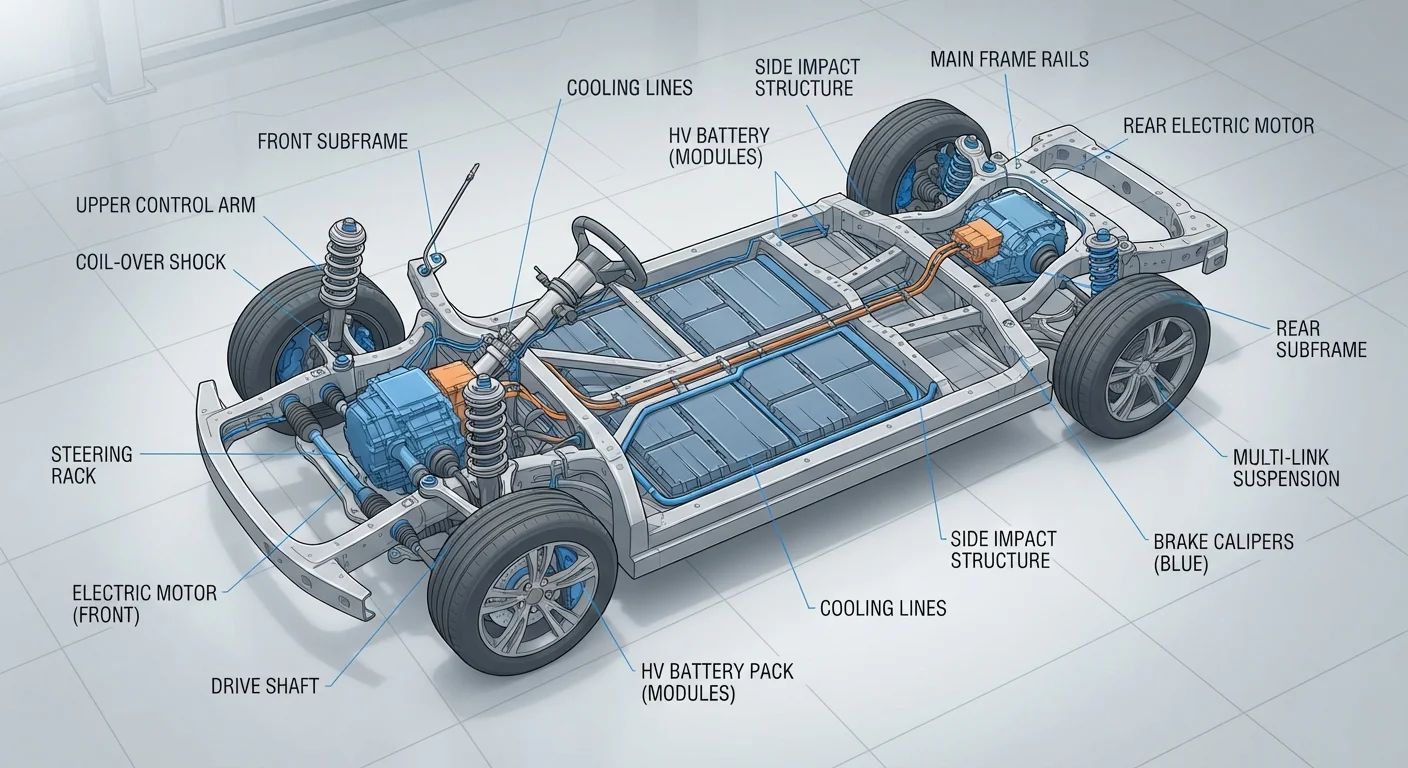
Platform sharing is when two or more vehicle models are built on the same underlying engineering foundation - including the floor structure, suspension geometry, and core mechanical architecture. Automakers use this approach to develop multiple models more efficiently, spreading engineering costs across a larger production volume. The result is that cars which look and feel distinct on the outside may share significant mechanical DNA underneath.
A platform typically defines wheelbase options, suspension mounting points, engine orientation (front-wheel-drive transverse vs. rear-wheel-drive longitudinal), and structural rigidity targets. Shared platforms do not necessarily mean identical powertrains or body structures above the beltline.
What a Car Platform Actually Is
Strip away a car's body panels, interior trim, and brand badges, and you're left with its platform - the engineered backbone that determines how the vehicle sits, steers, and absorbs forces. A platform defines the architecture of the floor pan, the placement and type of suspension at each corner, and the spatial envelope for the engine and drivetrain. It also governs key safety structures including the crumple zones and door sill reinforcements.
Automakers invest enormous resources developing a platform because it must satisfy crash regulations, handle diverse powertrains, and accommodate varying wheelbases. By designing one robust platform and deploying it across several models - sometimes spanning sedans, SUVs, and crossovers simultaneously - manufacturers amortize that development cost far more efficiently. Buyers indirectly benefit from this, since each individual model would be prohibitively expensive to engineer entirely from scratch.
It's worth distinguishing a platform from a body. The platform is below - structure, suspension, and architecture. The body sits on top and is largely independent, which is why a compact crossover and a small sedan can ride on identical platforms yet look nothing alike. For a deeper look at how these engineering decisions play out over time, see how generational redesigns affect what you're buying.
How Platform Sharing Affects Parts and Repairs
One of the most practical implications of platform sharing is its effect on the parts ecosystem. When a suspension control arm or a wheel bearing is shared across, say, four different models built by the same manufacturer, production runs for that part are substantially larger. Higher volume typically translates to greater parts availability, more aftermarket suppliers entering the market, and - in many cases - lower replacement costs.
~30-40%
Typical development cost reduction from platform sharing
Industry analysts broadly estimate that shared platform programs can reduce per-model engineering and tooling costs by roughly 30-40% compared to developing each model independently, though actual figures vary by manufacturer and program scale.
Up to 8
Distinct models that can share one platform family
Some high-volume modular platform programs are designed to underpin a wide range of body styles and sizes, with manufacturers publicly documenting deployment across sedans, crossovers, and SUVs within a single architecture family.
This matters particularly for owners of vehicles positioned as premium or niche within a lineup. A luxury crossover that shares its platform with a volume-selling sedan may benefit from the sedan's abundant parts supply, even if the crossover's badge commands a higher sticker price. Conversely, model-specific components - unique body panels, proprietary electronic modules, or platform-exclusive drivetrain variations - remain subject to tighter supply and higher pricing regardless of what sits on the same underpinnings.
When researching a potential purchase, it's worth identifying platform siblings and checking whether independent repair shops are familiar with the shared components. Widely deployed platforms tend to attract broad mechanic familiarity, which expands your service options beyond the dealership network.
Quality Differences Within the Same Platform Family
Shared foundations do not mean equivalent finished products. Automakers deliberately differentiate models built on the same platform through tuning choices, material specifications, and manufacturing tolerances. A luxury-tier model on a shared platform may receive stiffer chassis reinforcements, more sophisticated adaptive dampers, and acoustically deadened body panels - all of which meaningfully change the ownership experience even though the structural geometry underneath is identical to a mass-market sibling.
“A platform is like a city's street grid - it defines the layout, but the buildings that go up on it can vary enormously in quality, purpose, and character.”
— Cars Editorial Team, Automotive editorial analysts
Assembly quality is another variable. Vehicles sharing a platform may be produced at different plants with different workforce training standards and quality control regimes. This can produce measurable differences in fit, finish, and long-term durability even when the core engineering is shared. Reliability records for platform siblings can therefore diverge based on powertrain choices and plant-specific quality rather than anything inherent to the platform itself.
When comparing two models you suspect share a platform, focus on what differs: powertrain options, suspension tuning specifications published in press materials, interior materials, and available safety technology. For a structured approach to this comparison, a side-by-side model comparison framework can help you stay focused on what actually affects ownership rather than surface-level badge differences.
Using Platform Knowledge to Compare Models Confidently
Knowing which vehicles share a platform is a useful filter when shortlisting cars - but it shouldn't be the only one. Start by identifying whether two models you're considering are platform siblings (manufacturer press releases and reputable automotive outlets typically document this). Then investigate where the automaker invested differently between them: suspension calibration, soundproofing, powertrain choices, and warranty terms frequently reveal real value distinctions that justify price differences between ostensibly similar vehicles.
Research the Platform Name, Not Just the Badge
Manufacturer engineering platforms are often publicly named - terms like modular transverse architecture or similar designations appear in press materials and technical documentation. Searching for a model's platform name can quickly reveal its siblings and give you a more accurate picture of parts commonality and long-term serviceability before you commit to a purchase.
Platform knowledge is also valuable when evaluating used vehicles. A low-volume model with a shared platform from a high-volume sibling often benefits from abundant parts supply and widespread mechanic familiarity - factors that can meaningfully reduce running costs over time. For a broader framework on evaluating these long-term ownership factors, the guide on comparing car makes across reliability, safety, and running costs provides useful context.
Platform sharing is also a reminder that the automotive market is more interconnected than brand marketing suggests. Models sold under distinct badges at different price points sometimes share more than buyers realize - which can represent genuine value, or simply a repackaging exercise. Knowing the difference is what separates a well-researched decision from a marketing-driven one. For broader context on how regional and market factors further complicate model comparisons, see why the same model can vary significantly across markets.