

Key Takeaways
- Dealer financing routes your loan through third-party lenders, and dealers may earn a markup on the rate.
- Pre-approvals from banks or credit unions let you separate price negotiations from financing conversations.
- Manufacturer promotional rates (e.g., 0% APR) are only available through dealer financing programs.
- Credit unions often offer competitive rates, particularly for members with strong credit histories.
- Having a pre-approval in hand gives you a concrete rate benchmark before entering any dealership.
Option A
Dealer Financing
The all-in-one, on-the-spot financing option.
Best for: Buyers who want a single-stop transaction and may qualify for manufacturer promotional rates.
Option B
Bank or Credit Union Loan
The independent, pre-arranged lending approach.
Best for: Buyers who want to negotiate the vehicle price separately from financing and enter the dealership with a set budget.
If you qualify for a manufacturer promotional APR offer
Dealer Financing
Promotional rates like 0% APR are exclusively available through manufacturer-affiliated lenders and cannot be matched by outside banks or credit unions.
If you want maximum negotiating leverage on price
Bank or Credit Union Loan
Walking in with a pre-approval lets you negotiate the vehicle price independently, without financing terms complicating the discussion.
If you prefer a streamlined single-visit transaction
Dealer Financing
Everything from vehicle selection to loan paperwork can be completed at the dealership, reducing coordination time.
If you have a long-standing relationship with a credit union
Bank or Credit Union Loan
Credit unions frequently offer member-favorable rates and transparent loan structures with no dealer markup layer.
If you want to compare multiple lenders before committing
Bank or Credit Union Loan
Shopping your own lenders before visiting a dealer lets you evaluate APR, term length, and fees on your own schedule without sales pressure.
How Each Financing Path Actually Works
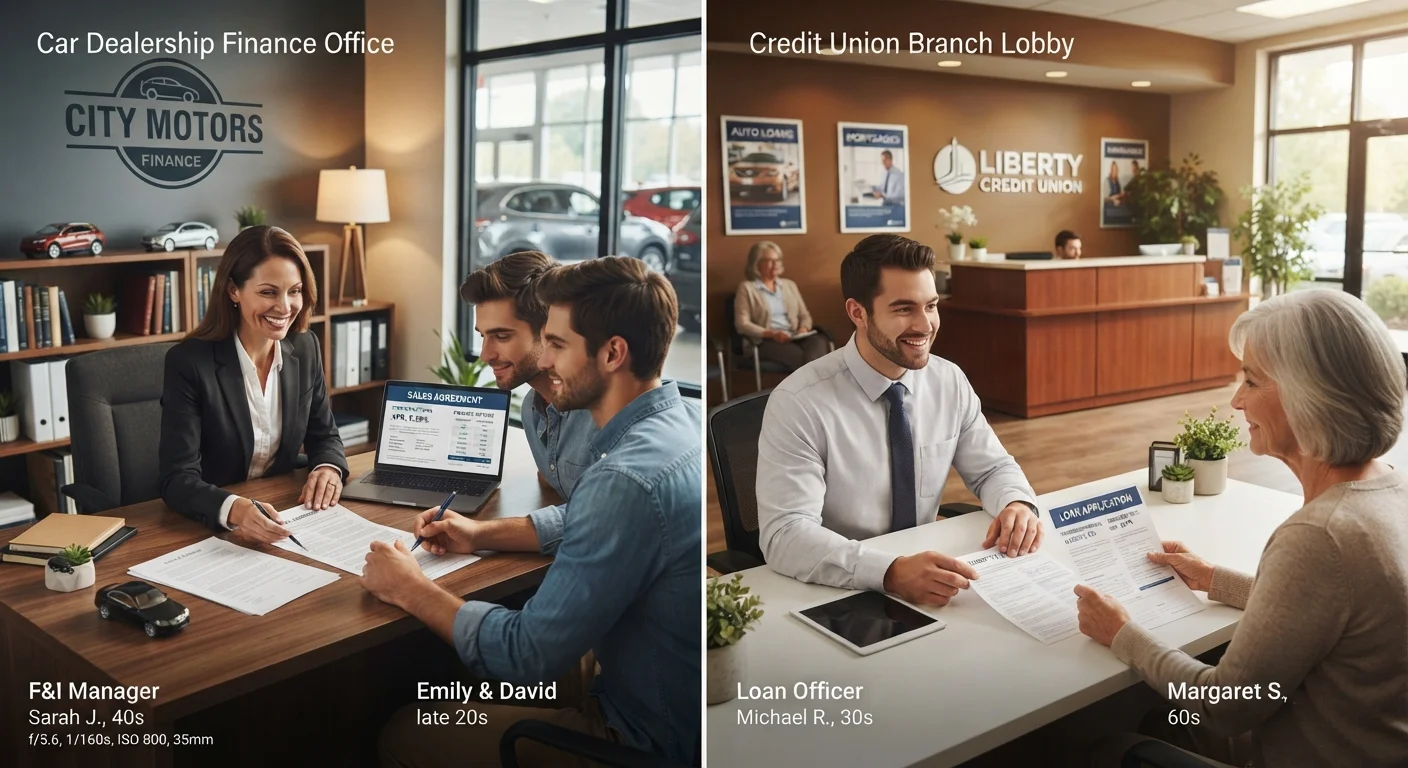
When you finance a vehicle through a dealership, the dealer acts as an intermediary. You fill out a credit application on-site, and the dealership submits it to one or more wholesale lenders - typically banks or captive finance arms owned by automakers. The lender approves a rate, and the dealer may add a markup, called a dealer reserve, before presenting terms to you. That markup is legal in most states and represents additional profit for the dealer.
A bank or credit union loan works differently. You apply directly with the lender before or after visiting a dealership. If approved, you receive a pre-approval letter stating the maximum loan amount and interest rate you qualify for. You then shop as a near-cash buyer, paying the dealer from loan proceeds while your lender relationship stays separate from the dealership's finance department.
Understanding this structural difference is fundamental. Dealer financing bundles convenience with a potential cost layer; direct lending separates the purchase from the financing, giving you clearer visibility into each. See our guide to the F&I office to understand exactly what happens once you sit down with a dealer's finance team.
| Criterion | Dealer Financing | Bank or Credit Union Loan |
|---|---|---|
| Where you apply | At the dealership | Directly with your lender |
| Rate transparency | May include dealer markup | Rate quoted is rate you pay |
| Promotional APR access | Yes, via manufacturer programs | Not available |
| Shopping flexibility | Limited to dealer's lender network | Shop multiple lenders freely |
| Negotiation dynamic | Payment-focused conversations | Price-focused conversations |
| Convenience | Single-stop transaction | Requires prior lender contact |
| Typical approval speed | Same-day, at point of sale | Hours to a few business days |
Rate Differences, Promotional Offers, and Hidden Markups
Interest rates are where the two paths diverge most sharply in practice. Banks and credit unions set their auto loan rates based on your creditworthiness, the loan term, and prevailing market conditions. Because you deal with the lender directly, the rate you're quoted is the rate you pay - there's no intermediary adding a margin.
Dealer financing introduces a second variable: the dealer's willingness (and legal ability) to mark up the rate above what the lender actually approved. This spread can range from a fraction of a percent to several percentage points, depending on the dealer and the lender's policy. On a multi-year loan, even a one-point rate difference compounds meaningfully.
However, dealer financing holds one significant advantage that outside lenders cannot replicate: manufacturer promotional rates. These are subsidized offers - sometimes 0% APR for well-qualified buyers - funded by the automaker's captive finance arm as a sales incentive. No bank or credit union can offer these rates because they originate from the manufacturer, not from the open lending market. If a promotional rate is available on the vehicle you want and you qualify, it may outperform anything you can source independently.
72 months
Average new-car loan term in the US
Experian's State of the Automotive Finance Market report has tracked average loan terms extending toward six years, increasing total interest exposure significantly.
1-3%
Typical dealer reserve markup range
Consumer Financial Protection Bureau research has noted dealer markup ranges commonly falling between one and three percentage points above the lender's approved rate.
Your credit profile drives outcomes under both paths. Learn how your credit score shapes loan terms before you apply anywhere - it's the single biggest factor lenders use to set your rate.
Negotiation Dynamics and Practical Considerations
One underappreciated advantage of securing a pre-approval before visiting a dealer is negotiating clarity. When financing is arranged at the dealership, monthly payment becomes the primary lever dealers use to structure deals. Stretching a loan term from 48 to 72 months lowers a monthly payment while dramatically increasing total interest paid. A pre-approved buyer with a fixed rate and term can redirect the conversation to the vehicle's out-the-door price instead.
That said, dealer financing is not always the weaker option. For buyers who prefer a single-visit experience, are purchasing during a promotional APR window, or have limited time to shop lenders, the dealership's F&I office offers genuine convenience. Some captive lenders also offer competitive non-promotional rates for buyers with strong credit.
Credit unions deserve particular mention. As member-owned, not-for-profit institutions, they frequently offer auto loan rates that undercut comparable bank products. Membership requirements vary by institution, but many are accessible through employer affiliation, geographic criteria, or community membership.
Before committing to either path, consult our dealership preparation checklist - having your financing strategy decided in advance is one of the most effective ways to enter a negotiation with confidence.
Rate Shopping Won't Hurt Your Credit Score
Many buyers hesitate to apply with multiple lenders, fearing credit score damage. Credit bureaus treat multiple auto loan inquiries within a short window - typically 14 to 45 days depending on the scoring model - as a single inquiry. Shopping two or three lenders before committing is a sound practice and carries minimal credit impact.
This article provides general financial information for educational purposes and does not constitute personalized financial or lending advice. Loan rates, terms, and eligibility vary by lender and individual circumstances. Consult a qualified financial professional for guidance specific to your situation.